
AI news ·
OpenAI enters legal market as Anthropic and Microsoft compete for sector share
OpenAI hired Ironclad founder Jason Boehmig to lead its push into legal tech, marking the company's first direct move into the sector. The entry puts OpenAI alongside Anthropic and Microsoft in a fight for law firms and corporate legal departments.
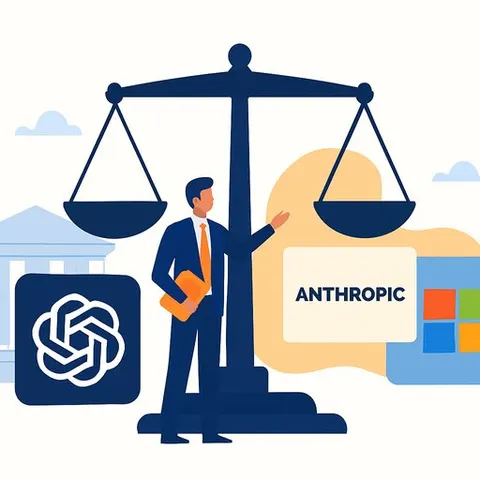
OpenAI's Legal Hire Signals Big Tech's Formal Entry Into Legal Market
OpenAI has hired Jason Boehmig, founder of contract management company Ironclad, to lead its push into the legal sector. The move marks the first formal commitment from the AI giant to compete directly in legal technology - joining Anthropic and Microsoft in what is shaping up as a three-way battle for market share among law firms and in-house legal departments.
What happens next depends entirely on how seriously these companies pursue the legal market. Three scenarios are plausible, each with different implications for the legal tech companies that have dominated the past decade.
Scenario One: Big Tech Dominates
OpenAI and Anthropic decide legal is worth the investment. Post-IPO, both companies need growth beyond their consumer and general enterprise products. They hire aggressively from legal tech and law firm innovation teams, build forward-deployed engineering teams dedicated to legal adoption, and establish proper support functions.
In this scenario, in-house legal departments migrate to OpenAI and Anthropic offerings for routine contract work. Law firms remain more fragmented - they prefer not to depend on a single vendor. But contract lifecycle management and similar productivity-focused legal tech companies face a precipice. Some sell quickly. Others collapse.
Multiple legal tech insiders have told industry observers that nearly everyone is currently looking to sell. The list of companies seeking buyers includes both established names and smaller players.
Companies with defensible data assets - and those that don't rely primarily on productivity gains - weather the shift better. Document management systems face less pressure than contract-focused tools.
Even in this extreme scenario, legal tech survives. Three giants sit in the middle of the market rather than consuming it entirely.
Scenario Two: Half-Hearted Effort
OpenAI and Anthropic dabble in legal without committing serious resources. They don't build out support teams. They don't develop adoption programs. The tools remain adequate but not compelling enough to kill the competition.
Market share shifts somewhat, but the existing legal tech ecosystem survives under pressure. Sales become harder. Buyers now compare legal tech products against what OpenAI and Anthropic can offer. Getting heard becomes the central challenge for established vendors.
Legal tech companies continue operating, but the ground has shifted. The market evolves rather than ruptures.
Scenario Three: They Lose Interest
After investing resources without achieving expected returns, OpenAI and Anthropic decide legal isn't worth the effort. They maintain their offerings but don't develop them further. Team members leave. The legal tech market returns to its previous trajectory - evolving but stable.
Which Is Most Likely?
OpenAI and Anthropic are unlikely to abandon legal entirely. Enterprise software is where the real money is for AI companies, and legal sits squarely in that space.
The actual question is how much resources they'll commit. Do they build out sales and support functions? Do they hire talent aggressively? If they want a large chunk of legal market share, they can probably take it. Their post-IPO capital gives them that option.
What's certain: the legal tech market that existed over the past decade has already changed. The market shape is now fundamentally different, regardless of which scenario unfolds.
For legal professionals: Understanding how AI for Legal systems work - and how Generative AI and LLM technology functions - is now essential to navigating vendor decisions and internal tool adoption.