Periodic Labs: Building an AI Scientist With Its Own Lab
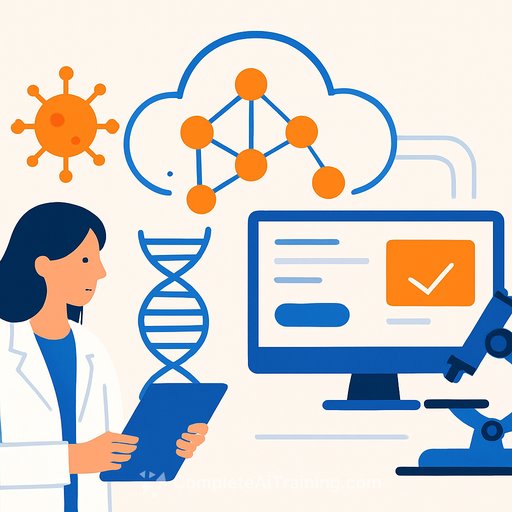
Two high-profile departures set the stage: Liam Fedus, former VP of Research at OpenAI, and Ekin Doğuş Cubuk, a lead scientist at DeepMind in chemistry and materials, left to build Periodic Labs. Their thesis is blunt: internet-scale text is tapped out; discovery needs fresh, physical data. So they're putting AI inside an autonomous lab and giving it the tools to run experiments end to end.
Backed by a $300 million seed round, the company's stated goal is simple and ambitious: create an AI scientist that can hypothesize, run experiments, learn from outcomes, and iterate. The intent isn't to write better papers-it's to find new materials faster than human-only pipelines can manage.
Why now: Scaling text models hit a ceiling; science needs new data
Fedus highlighted the obvious pressure point: text corpora in the tens of trillions of tokens are near exhaustion, and bigger models alone don't guarantee breakthroughs. Cubuk added a hard constraint from physics: purely literature-driven LLMs won't discover room-temperature superconductors. The answer they landed on-generate data directly from nature with automated labs and couple it to models that learn from every outcome.
Core idea: failed experiments aren't waste; they're training signal. In materials science, most runs fail. That "negative" data rarely gets published but is exactly what a learning system needs to refine priors about the physical world.
The platform: A closed loop from hypothesis to hardware
Periodic Labs describes an AI-driven science platform that ties three capabilities into one system and runs them in a loop:
- Autonomous robotic lab: Powder handling, synthesis, processing, and characterization with robotic arms, furnaces, and spectrometers.
- High-fidelity simulation: AI-guided physics and chemistry simulators to pre-screen ideas and bound risk before touching hardware.
- LLM research assistant: A reasoning model that reads literature, proposes experiments, analyzes results, and plans the next round.
Workflow: literature + simulation form hypotheses → robots execute → instruments stream high-dimensional data → the model updates beliefs and designs the next batch. The loop repeats, compressing iteration time and pulling learning out of both hits and misses.
Proof point: A-Lab's 41 new compounds in 17 days
The team's blueprint builds on Cubuk's earlier work: an automated materials lab that synthesized 41 new compounds in 17 days-evidence that closed-loop discovery is viable at scale. See the 2023 Nature paper for context: Autonomous discovery in materials synthesis.
Periodic Labs extends this logic with tighter integration across robotics, simulation accuracy, and model reasoning. In their words, "nature becomes the reinforcement learning environment."
Data strategy: Make the "invisible 90%" visible
Most lab work never makes it to a journal. Parameter sweeps, off-target phases, noisy characterizations-this is the hidden bulk of scientific effort. Periodic Labs is capturing it all and treating it as first-class training data.
That means timestamped protocols, instrument telemetry, compositions, processing histories, and outcomes-successful or not. Over time, this becomes a proprietary dataset that improves the model's priors and shrinks search space with each cycle.
Capital and incentives: $300M for speed, scale, and talent
The seed round-led by a16z with participation from DST, NVentures (NVIDIA), and prominent angels including Jeff Bezos and Eric Schmidt-signals a simple consensus: time-to-discovery can be shortened. Investors framed it as compressing multi-year R&D cycles in materials and semiconductors to a few years.
One noteworthy detail: OpenAI isn't on the cap table. Analysts point to a strategic split-general-purpose AI versus a vertical stack tightly coupled to real-world experimentation.
Team: AI + materials veterans under one roof
More than 20 researchers reportedly joined from Meta, OpenAI, DeepMind, and Microsoft. The mix is intentional: half AI, half physical sciences. Advisors include leading figures from Stanford, MIT, and a Nobel laureate in chemistry, aligning search algorithms with domain constraints.
Initial focus: high-temperature superconductors. Practical use demands operation near ambient conditions, and the upside spans energy transmission, computing, and sensors. The team is also applying agents to thermal interface and heat-dissipation materials with a chipmaker partner-an area where faster iteration matters immediately.
What this means for R&D leaders
If you run a lab or a research program, the signal is clear: experiment orchestration, machine reasoning, and data flywheels are converging. You don't need a $300M budget to start adapting.
- Instrument your failures: Log every run-inputs, process conditions, measurements, and metadata. Treat negatives as gold.
- Digitize protocols: Move to executable recipes with strict versioning so robots (or humans) can reproduce steps exactly.
- Start closed loops small: Pick one property, one synthesis path, and one characterization pipeline. Automate the plan-run-measure-iterate cycle.
- Use simulation as a filter: Run fast approximate models to prune candidates; reserve hardware for the top slice.
- Track the right metrics: Iteration time per loop, valid measurements per day, unique conditions explored, and predictive gain per batch.
- Governance first: Enforce safety limits and interlocks in software; gate any action that risks equipment or hazardous states.
What to watch next
- Throughput: How many samples and characterizations per day are sustained without human bottlenecks.
- Data volume and diversity: Growth of unique compositions, processing windows, and structured negative results.
- Generalization: Whether models trained on one synthesis family transfer to others without retraining from scratch.
- External validation: Independent labs reproducing any headline discoveries.
- First industrial win: Concrete improvements in thermal materials or related components shipped into production workflows.
Context: AI has already shifted parts of science
Protein structure prediction moved faster after AlphaFold, proving that once a model crosses a reliability threshold, workflows change. For a refresher, see DeepMind's AlphaFold overview. Periodic Labs is attempting a similar step for experimental materials-less oracle, more operator.
Bottom line
Periodic Labs is betting that the next leap in discovery comes from generating its own data and learning directly from physics, not from scraping more text. If they execute, we'll see shorter cycles, higher hit rates, and research programs that learn continuously from every failed run.
If you're skilling up teams to build agents, automate lab steps, or analyze complex data streams, you may find this curated hub useful: AI courses by scientific job role.
Your membership also unlocks: