
AI news ·
OpenAI memo attacks Anthropic's revenue figures while revealing its own Microsoft partnership struggles
OpenAI's new chief revenue officer sent an internal memo accusing Anthropic of inflating its revenue by ~$8B through accounting methods that "gross up" cloud partnership deals. The dispute puts Anthropic's true run rate closer to $22B, not $30B.
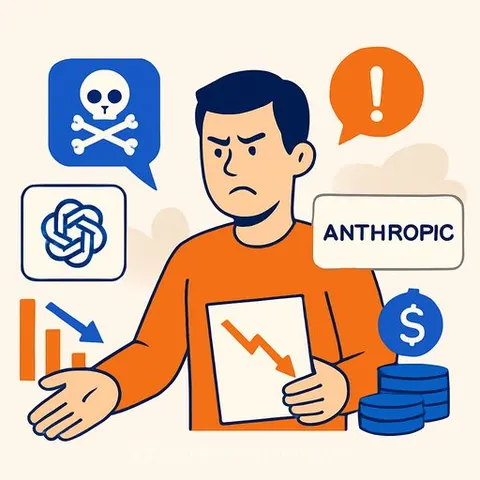
OpenAI Questions Anthropic's Revenue Claims in Internal Memo
OpenAI's new chief revenue officer, Denise Dresser, sent an internal memo over the weekend that was supposed to outline the company's strategy but instead focused heavily on attacking rival Anthropic's financial reporting. The memo, reported by The Verge, contained direct criticism of how Anthropic calculates and presents its revenue figures.
Dresser claimed Anthropic uses "accounting treatment that makes revenue look bigger than it is." She specifically objected to the company "grossing up" revenue-sharing agreements with Google and Amazon rather than reporting net revenue figures.
The Numbers in Dispute
Bloomberg recently reported Anthropic's annualized revenue run rate at over $30 billion. OpenAI disputes this figure, claiming Anthropic overstates its situation by roughly $8 billion, which would put the company at $22 billion annually.
That calculation matters because it positions OpenAI ahead. The company's reported run rate sits around $24 billion. The $2 billion gap between the two companies hinges on how Anthropic accounts for its partnership revenue.
Context on OpenAI's Own Partnerships
The timing of Dresser's memo is noteworthy. Amazon recently announced plans to invest up to $50 billion in OpenAI, a deal that comes as the company's position as the industry leader faces pressure from competitors including Anthropic.
In the memo, Dresser cited OpenAI's partnership with Microsoft as a constraint that "limited our ability to meet enterprises where they are." The Amazon investment appears designed to address that limitation.
Beyond the Revenue Fight
Dresser acknowledged that Anthropic holds advantages in certain areas. The company has a significant lead among enterprise customers, particularly in coding capabilities. But Dresser argued that emphasizing revenue generation is a strategic mistake for Anthropic.
"You do not want to be a single-product company in a platform war," she wrote in the memo.
Dresser also criticized Anthropic's leadership and stated the company is "built on fear, restriction, and the idea that a small group of elites should control AI."
The Irony
That critique inverts OpenAI's own public positioning. When OpenAI launched, CEO Sam Altman said, "I sleep better knowing I can have some influence now." In recent years, OpenAI has spent significant lobbying resources fighting federal regulations that would impose guardrails on its products.
The disagreement over who should control AI development appears less philosophical and more about which group gets to lead.
For executives evaluating AI vendors and competitive positioning: These public disputes over accounting methods and strategic direction reflect deeper questions about how AI companies measure success and what capabilities matter most. Understanding these differences requires looking past the rhetoric to the actual capabilities and customer relationships each company maintains. For strategy professionals in organizations considering partnerships or investments with these companies, the accounting dispute highlights the importance of independent verification of performance claims and run rates.
Learn more about AI for Executives & Strategy or explore Generative AI and LLM resources to stay current on industry developments.