OpenAI reportedly targets 2027 for an AI smart speaker - here's what product teams should plan for now
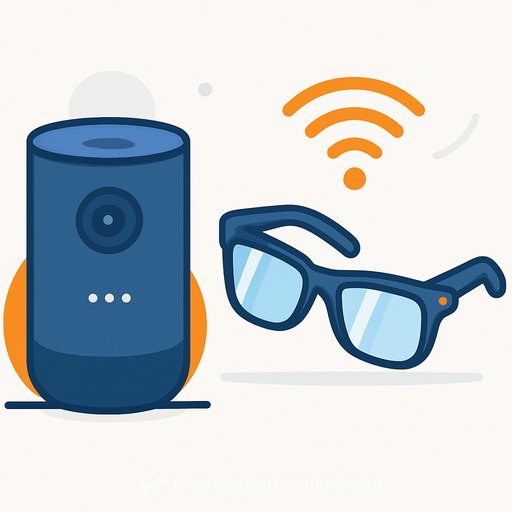
OpenAI is reportedly building a hardware lineup: a camera-equipped smart speaker, smart glasses and a smart lamp. The speaker is said to be first, priced around $200-$300, with the earliest ship date in early 2027. A team of 200+ employees is working on the effort, with smart glasses eyed for 2028 and the lamp still uncertain.
Prototypes exist, delays have hit, and concerns span privacy, technical hurdles and the computing power needed to run mass-market AI devices. That combination signals a long road of product, design and operations work before scale.
What's reportedly coming
- Smart speaker (earliest 2027): Built-in camera to capture context (objects on a table, nearby conversations), plus Face ID-style facial recognition for purchase authentication. Expected price: $200-$300.
- Smart glasses (2028): Entering a category currently led by Meta's offerings. See context on the category here: Meta Ray-Ban smart glasses.
- Smart lamp: Prototyped, unclear if it ships.
Design signal: Jony Ive's team is in the mix
OpenAI acquired Jony Ive's AI-focused design firm, io Products, for $6.5 billion. Expect exacting industrial design, tight hardware-software integration and strong brand framing around trust and safety. That also raises the bar for materials, tolerances and manufacturability across variants.
Privacy and trust need to be core features, not footnotes
Always-listening mics and an on-device camera push right up against consumer comfort. The product has to make privacy obvious, controllable and verifiable. Clear indicators for recording, physical shutters, local processing defaults and easy data wipes are table stakes.
For biometric authentication, study proven patterns like Apple's Face ID approach to secure, on-device matching: Face ID overview. Publish a simple, visual data flow showing where audio/video goes, how long it's stored and how users can opt out.
Compute, cost and architecture
Reports point to delays tied to compute. Expect to balance on-device inference for latency and privacy against cloud offload for heavier models. This choice will drive BOM, thermals, acoustics, battery (for glasses) and ongoing inference costs.
- Define which tasks must run locally (wake words, presence, basic vision) vs. which can tolerate cloud latency (rich multimodal reasoning).
- Model size, quantization and accelerator choice will set your unit economics. Prototype with multiple silicon paths to avoid single-vendor risk.
- Instrument real-world inference cost early; it's easy to ship at margin and lose it in month three due to usage patterns.
Go-to-market timing and price discipline
A $200-$300 speaker price bracket is crowded and price sensitive. Hitting that range while adding a quality camera, secure biometric auth and capable on-device compute will press your margin without disciplined scope. Lock a "must work perfectly" core and push everything else to software updates.
Risks and unknowns to track
- Regulatory and compliance: Biometric authentication and always-on sensors trigger regional rules and retailer requirements.
- Social acceptance: Cameras in living spaces and wearables on faces face pushback without obvious controls and social cues.
- Supply and yield: Camera modules, depth sensors and NPUs can bottleneck production and inflate COGS.
- Reliability: Wake-word accuracy, false triggers and poor far-field performance ruin trust fast.
- Product line clarity: If the lamp ships, make sure it's not a confused duplicate of the speaker's value.
Action plan for product development teams
- Pick a privacy stance you can explain in one sentence, then design the hardware to prove it (shutters, LEDs, toggles, on-device defaults).
- Split features by latency and privacy needs; map each to local vs. cloud to control cost and user experience.
- Prototype trust signals with users: light behaviors, sounds, and UI that clearly show when the device is listening or watching.
- Pre-negotiate silicon options and build test images for multiple NPUs/accelerators to avoid late-stage pivots.
- Run end-to-end "day in the life" tests in noisy homes and small rooms; optimize mic arrays, beamforming and noise suppression early.
- Define an accessories and mounts strategy (kitchen, living room, desk) to make placement-and therefore performance-predictable.
- Publish a security whitepaper before launch; include threat models, update policy and a public vulnerability intake.
- Treat the $200-$300 target as a hard constraint; scope features to hit it with margin, then layer upgrades in software.
Level up your team's playbook
If you're building AI-enabled hardware, align your roadmap, prototyping and go-to-market around the constraints above. These resources can help:
Bottom line: the reported devices are ambitious. Success will come down to trust, clear scope and ruthless execution on compute, cost and user comfort.
Your membership also unlocks: