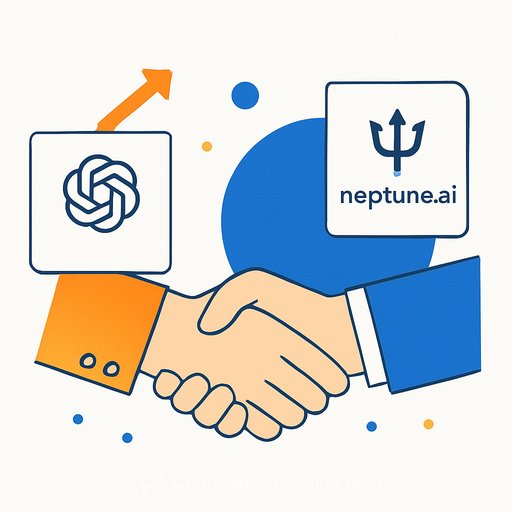
OpenAI to acquire Neptune to tighten its model training stack
OpenAI has reached a definitive agreement to acquire Neptune, a company known for tools that track, manage, and debug AI model training. OpenAI is already a major Neptune customer. Neptune also serves large enterprises including Samsung, Roche, and HP.
OpenAI said the deal strengthens its research tooling and infrastructure. Neptune gives researchers a clear way to track experiments, monitor training in real time, compare runs at scale, and surface issues across model layers-capabilities that shrink iteration cycles and improve decisions during training.
Deal terms and integration
Financial terms were not disclosed by OpenAI. Reporting from The Information, cited by Reuters, puts the deal at under $400 million in stock. The plan is to fold Neptune's technology into OpenAI's core infrastructure to speed up training workflows and improve experiment visibility end to end.
For enterprises, this points to a tighter, more opinionated MLOps stack from OpenAI. Expect closer coupling between experimentation, monitoring, and production deployment as OpenAI productizes these capabilities.
Why this matters for executives
- Consolidation in MLOps: Expect more "single-vendor" AI stacks. This can cut integration overhead but raises lock-in risk.
- Faster iteration: Better experiment tracking translates into shorter model cycles and reduced wasted compute-important as GPU costs stay high.
- Quality and governance: Lineage, comparability across runs, and layer-level metrics make compliance reviews and post-mortems faster.
- Enterprise pull: With Neptune's footprint in companies like Samsung, Roche, and HP, OpenAI moves closer to enterprise workflows and procurement norms.
- Budget impact: If OpenAI bundles advanced experiment tooling, expect pricing and packaging shifts across the AI stack.
Context: scale, capital, and deal flow
The acquisition follows OpenAI's October valuation of $500 billion after a secondary sale involving current and former employees. The company has also taken a stake in Thrive Holdings to embed AI into traditional industries such as accounting and IT services-part of a broader push to extend distribution and enterprise use cases.
What to do now
- Audit your MLOps stack: Identify overlaps with Neptune-like capabilities (experiment tracking, run comparison, model monitoring) and map areas to consolidate.
- Plan for procurement shifts: If you rely on OpenAI services, prepare for bundled offerings and new SKUs covering experimentation and monitoring.
- Reduce lock-in risk: Keep model artifacts portable, standardize metadata schemas, and maintain data egress paths.
- Strengthen governance: Require experiment lineage, reproducibility, and policy checks before promotion to production.
- Control compute costs: Tie experiment tracking to budget thresholds and enforce early-stop policies on underperforming runs.
- Upskill teams: Ensure product, data science, and platform teams understand experiment management patterns and MLOps handoffs.
Sources and further reading
Build capability inside your organization
If you're aligning teams around experiment tracking, model evaluation, and AI product delivery, curated learning paths can help. See role-based options here: AI courses by job role.
Your membership also unlocks: