Racing Toward AI Doctors: OpenAI's Health Chatbot Surge and Google's Brewing Counterplay
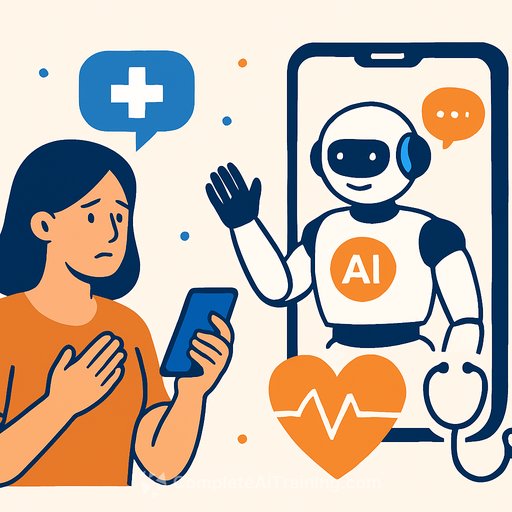
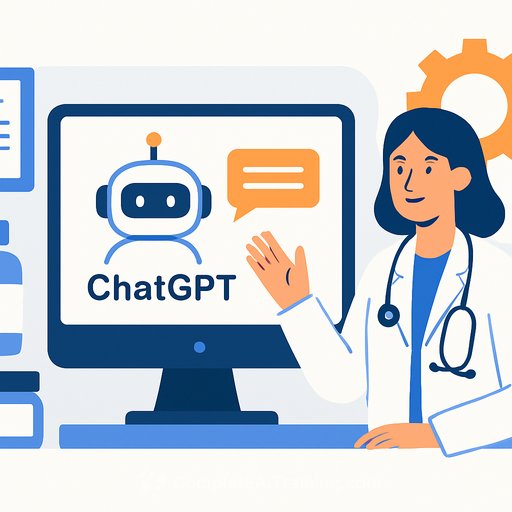
Healthcare is getting a new layer of software. OpenAI's ChatGPT Health now lets patients connect portals, wearables, and apps like Apple Health or MyFitnessPal, then get plain-language explanations, visit prep questions, and fitness guidance. The company positions it as an aid, not a diagnostic engine, and says health chats aren't used to train models.
The scale is hard to ignore: reports cite roughly 230 million health questions hitting ChatGPT each week. Early access is limited, with a wider rollout planned across web and iOS, and availability varying by region. The pitch is simple-turn static health data into a conversation patients can follow.
Why this matters for healthcare teams
- Pre-visit prep: Patients arrive with clearer questions and context, reducing time spent decoding labs and notes.
- Post-visit reinforcement: Summaries and reminders help close the comprehension gap that fuels readmissions and no-shows.
- Care navigation: Guidance on forms, referrals, and benefit use lowers administrative friction.
- Wellness coaching: Basic activity and nutrition nudges keep patients engaged between visits.
- Population health triage: Surface "call your clinic" flags for symptoms or out-of-range results, with human follow-up.
Privacy, security, and compliance-non-negotiables
Linking PHI to an AI assistant raises obvious questions: Is there a signed BAA? Where is data stored? How is access logged and audited? What de-identification, encryption, and retention controls apply?
If you're U.S.-based, map every feature against HIPAA Security Rule requirements. Get explicit patient consent, disclose data use limits in a clear notice, and confirm you can disable training on health data-per OpenAI's claims-at the tenant level. Validate breach notification and incident response timelines in writing.
Clinical accuracy and safety
General-purpose models still hallucinate. That's unacceptable in care contexts without controls. Require evidence-backed answers with citations, visible uncertainty, and strict escalation for red-flag symptoms. Keep a human in the loop for anything diagnostic or treatment-related.
Set boundaries: patient education, visit prep, and lifestyle goals are fair game; diagnosis and medication changes are not. Monitor for drift by auditing samples weekly and tracking error rates, latency, and deflection outcomes.
Google's brewing counterplay
Reports point to a modular "Personal Health Agent" that orchestrates sub-agents for symptom checks, tracking, and education. The promise is fewer errors through specialization and physician-designed guardrails. Google's data from Fitbit and past work in clinical AI could make integration with Android and provider systems attractive.
The flip side: regulatory scrutiny and lessons from past health projects will slow any splashy release. Expect an enterprise-first posture with evaluation data, governance hooks, and partnership-led pilots.
OpenAI vs. Google: practical differences you'll feel
- OpenAI (ChatGPT Health): Patient-first experience, conversational clarity, fast setup for education and visit prep. Strong for front-door engagement.
- Google (modular agents): Depth via specialized agents, tighter ecosystem integration, and enterprise controls. Strong for provider workflows and B2B.
90-day blueprint to test safely
- Weeks 1-2: Pick two use cases (e.g., lab explanations, appointment prep). Define "must-not-do" clinical boundaries. Draft consent and patient messaging.
- Weeks 3-4: Stand up a sandbox. Integrate read-only data via FHIR. Configure logging, PHI masking, and no-training settings.
- Weeks 5-8: Pilot with one clinic and 50-200 patients. Measure comprehension, call volumes, and staff time saved. Audit 10% of sessions.
- Weeks 9-12: Close gaps, add escalation rules, and publish a go/no-go with clear KPIs and governance.
Questions to put in every RFP
- Do you sign a BAA and support tenant-level data isolation?
- Is health data used for training or metrics beyond my account? Can I disable all secondary use?
- What medical guardrails, citations, and uncertainty disclosures are built in?
- Show external evaluations on clinical accuracy and bias. What are the known failure modes?
- How do you handle incident response, breach notification, and right-to-delete requests?
- What is the red-team process for safety across high-risk scenarios?
Risks to plan for now
- Over-reliance: Patients treating suggestions as care plans. Counter with disclaimers, clear "call your clinician" triggers, and staff reinforcement.
- Bias: Skewed advice for underrepresented groups. Use representative test sets and measure disparities.
- Consent drift: Data reuse expanding quietly over time. Lock policies, version notices, and re-consent for any scope change.
- Security: Token leakage, prompt injection, and session hijacking. Use short-lived tokens, input sanitization, and anomaly detection.
- Liability: Clarify responsibility with vendors, insurers, and counsel before patient exposure.
What to watch next
- Regulatory signals on AI decision support and Software as a Medical Device (SaMD). Track FDA digital health policy updates here: FDA Digital Health Policy.
- Enterprise integrations with EHRs, payer portals, and wearables. Look for FHIR-based connectors and audit packs.
- Transparent benchmarks on accuracy, hallucination rates, and safety escalations in real clinics.
Practical takeaway
Use these tools for what they do well: explain, educate, and nudge-while keeping clinical decisions with licensed professionals. Start narrow, measure hard outcomes, and expand only when the data proves it.
Level up your team's AI fluency
If you're building internal capability, these resources can help your staff get up to speed on safe, workflow-aware AI use:
- ChatGPT Courses for patient-facing assistants and clinician-facing prompt design
- AI Learning Path for Business Unit Managers on governance, pilot design, and outcome measurement
Bottom line: OpenAI is pushing patient-facing clarity. Google is angling for modular depth. Healthcare leaders should pilot with guardrails, insist on evidence, and keep humans accountable where it counts.
Your membership also unlocks: