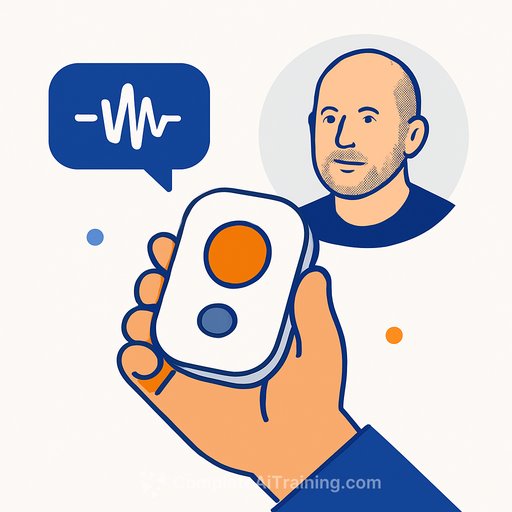
OpenAI's Pocket AI Device: What Product Teams Should Plan For
OpenAI is building a dedicated pocket AI device, with Sam Altman confirming a working prototype and Jony Ive leading design. Launch is targeted for late 2026 to early 2027. The concept leans into calm technology-ambient help without a screen or constant notifications.
Early reports say the device is tiny (think iPod Shuffle-sized), voice-first, and equipped with a sensitive microphone and camera to interpret context in real time. That means the user experience centers on intent, not taps and swipes. If it lands, it points to a post-smartphone interface pattern product teams should prepare for.
What's reportedly in scope
- No screen; voice as the primary interface.
- Pocket-sized hardware, similar to an iPod Shuffle's footprint (reference).
- Always-available mic and camera for environmental context and real-time understanding.
- Design led by Jony Ive; launch window late 2026-early 2027.
- Hiring spree includes former Apple leaders such as Tang Tan and Evans Hankey.
- Manufacturing partnerships with Luxshare and Goertek, both key Apple suppliers.
Why this matters for product development
A screenless, context-aware assistant flips typical product assumptions. Instead of UI screens and gestures, you're designing intents, prompts, and system behaviors. It's a move toward calm, ambient computing where interaction hides in plain sight (calm technology).
Product and engineering implications
- Voice UX: Treat prompts like your primary "UI." Map core jobs-to-be-done to concise voice commands and confirmations. Build graceful follow-ups and error recovery.
- Context models: Define how the device interprets location, people, time, and objects. Decide which tasks need camera input and which rely on audio only.
- Privacy by default: Hardware kill-switches (mic/cam), status LEDs, and clear consent flows. On-device redaction where possible before cloud calls.
- Latency budgets: Sub-300 ms for acknowledgments; tier responses (instant cue → short reply → longer synthesis). Cache personal context for speed.
- On-device vs. cloud: Offload heavy reasoning to the cloud; keep wake-word detection, safety filters, and sensitive transforms local where feasible.
- Battery and thermals: Continuous listen + intermittent camera spikes require power gating and efficient silicon. Expect aggressive duty-cycling of sensors.
- Edge safety: Real-time guardrails for vision and audio, especially in public or sensitive spaces. Clear opt-in for any recording or summarization.
- Developer surface: If an SDK ships, expect intent APIs, context adapters, and permission scopes instead of traditional UI components.
- Accessibility: Voice-first can be freeing, but plan for quiet or noisy environments. Offer haptics and subtle audio cues; consider optional companion app.
Go-to-market questions to answer early
- Primary use cases: Quick capture, reminders, summaries, wayfinding, messaging, photo-to-action? Pick a few and make them effortless.
- Subscription model: Hardware + AI services likely bundle. What's the free tier vs. paid tier, and how do you message value?
- Data boundaries: Who owns captured moments? Provide export, delete, and auditing by default.
- Ecosystem fit: Integrations with calendars, notes, home devices, and productivity suites will make or break daily retention.
- Regional compliance: Voice/vision consent laws vary. Bake in locale-specific defaults and disclosures.
Risks and unknowns
- Social friction: Wearable microphones and cameras raise trust issues. Clear, visible indicators and strict defaults will be mandatory.
- Ambient error costs: Misheard commands or misread context can be costly. Invest in confirmation loops and safe failure modes.
- Hardware transition: Software-first companies often stumble on supply chain, QA, and support. Partnerships help, but execution still decides.
- Competition: Apple, Google, and others can ship similar agents via phones or wearables. Differentiation must live in speed, reliability, and use-case depth.
What to prototype now
- Voice-only flows for your top 3 user jobs. Ship a shadow mode in your mobile app to test it.
- Latency experiments: Measure retention impact at 200 ms, 500 ms, and 1 s response starts.
- Privacy UX: LED patterns, audio chimes, and consent phrasing that users actually trust.
- Context ladders: Define exactly which signals improve outcomes and the minimum viable set to start.
Bottom line
If OpenAI pairs ChatGPT's intelligence with Jony Ive's taste and disciplined hardware partners, a pocket assistant without a screen could set a new bar for personal computing. For product teams, the opportunity is clear: design for voice, context, and trust. Those who build useful, low-friction agent workflows now will be ready when the hardware ships.
If you're upskilling your team on agentic UX, prompt design, and AI product strategy, explore our AI learning paths by role: Complete AI Training - Courses by Job.
Your membership also unlocks: