OpenAI's two-track push into healthcare: institutional stack and consumer app
OpenAI is moving into healthcare with a split approach. "OpenAI for Healthcare" targets hospitals and health systems, while "ChatGPT Health" gives consumers answers based on their own health data.
This isn't generic health Q&A. The enterprise stack plugs into clinical workflows and policies. The consumer side taps medical records and wellness apps-bringing new privacy questions that stretch beyond traditional HIPAA boundaries.
Key takeaways
- Two products: an institutional platform for clinical, research, and operations use, and a consumer feature that connects to personal health data.
- Enterprise focus: evidence-cited answers, policy conformity, reusable templates, centralized access controls, and HIPAA-aligned options.
- Consumer focus: personalized health responses with extra protections, but privacy and governance will be under scrutiny.
Inside "OpenAI for Healthcare"
The platform bundles ChatGPT for Healthcare with the OpenAI API to help teams scale care, cut administrative work, and build custom solutions. Early adopters include AdventHealth, Baylor Scott & White Health, Boston Children's Hospital, Cedars-Sinai, HCA Healthcare, Memorial Sloan Kettering, Stanford Medicine Children's Health, and UCSF.
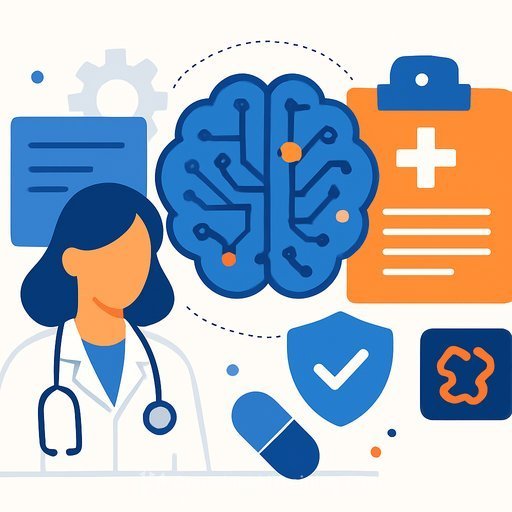
ChatGPT for Healthcare offers a secure workspace for clinicians, administrators, and researchers using GPT-5-based models tuned and evaluated for clinical, research, and operational workflows via HealthBench and GDPval. Highlights include:
- Evidence retrieval with transparent citations from peer-reviewed Research, guidelines, and public health sources
- Conformity with institutional policies and care pathways via integrations with tools like SharePoint
- Reusable templates for discharge summaries and patient instructions
- Centralized access management: SAML SSO, SCIM, audit logs, data residency options, customer-managed keys, and BAAs
The OpenAI API is already used for ambient listening, automated clinical documentation, scheduling, and care team coordination at companies like Abridge, Ambience, and EliseAI. Eligible customers can obtain BAAs for HIPAA-aligned use.
All offerings are supported by GPT-5.2. OpenAI says the system has been iteratively tuned with feedback from more than 260 licensed physicians, reviewing hundreds of thousands of outputs across 30 focus areas, plus real-world deployments such as Penda Health's clinical copilot study.
ChatGPT Health for consumers
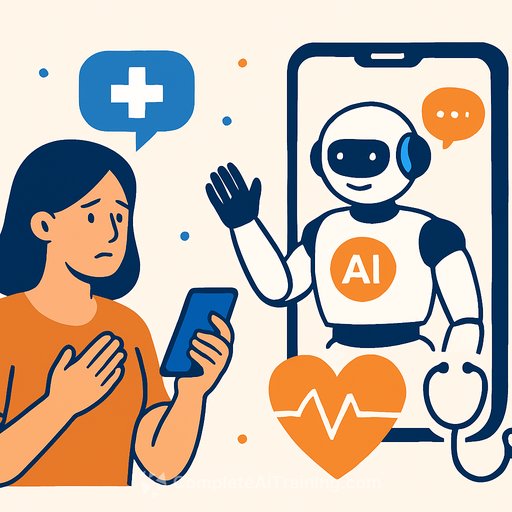
ChatGPT Health lets users connect medical records and wellness apps (Apple Health, Function, MyFitnessPal) so responses reflect their data. People can ask about test results, appointment prep, diet and exercise trade-offs, or even compare insurance options with answers grounded in their records and activity.
Access starts with a subset of ChatGPT Free, Go, Plus, and Pro users outside the EEA, Switzerland, and the UK. Some US health record integrations and apps are available at launch, with a broader web/iOS rollout planned.
OpenAI says health conversations are isolated with purpose-built encryption. Content in Health is not used to train foundation models. The feature supports care and is not intended for diagnosis or treatment.
Data connectivity is provided by b.well Connected Health, which aggregates sources across more than 2.2 million providers and 320 health plans, labs, and other endpoints.
Adoption and the privacy gap
OpenAI reports roughly 800 million regular ChatGPT users. About a quarter submit at least one health prompt per week, and more than 40 million ask health questions daily. Expect consumer demand to pull more workflows into AI interfaces.
Privacy will be the sticking point. The US lacks a general privacy law, and HIPAA applies only to covered entities and business associates. For reference, see HIPAA basics from HHS: HIPAA Overview.
Many AI and app companies may fall outside HIPAA. The Center for Democracy & Technology has warned that data could flow based on company policies rather than law, especially as personalization expands. Learn more about their work here: Center for Democracy & Technology.
If ChatGPT Health sits next to broader ChatGPT features (like memories or personalization), the separation must be airtight to prevent misuse or accidental linkage of sensitive information.
What this means for healthcare leaders
Healthcare AI is becoming dual-sided: institutional and consumer. The enterprise stack (ChatGPT for Healthcare plus HIPAA-aligned API options) meets internal needs, while the consumer interface (ChatGPT Health) rides on b.well's data fabric. Treat them as one ecosystem that exchanges data through governed APIs and explicit consent-not as disconnected channels.
Governance is shifting from model selection to data-plane control. Evidence-cited answers, policy conformity, data residency, auditability, and BAAs on the enterprise side-combined with consumer-mediated access and SDK-level controls-signal a new standard: traceable data flows, verifiable provenance, and clear consent.
Consumer LLM front doors will pressure incumbents. Patients may start with general AI interfaces instead of provider portals or payer apps. To stay present in those conversations, provider and payer systems need safe, scoped access for scheduling, benefits, billing, and even supply signals-without overexposure.
Action checklist
- Map data flows end-to-end: EHR, ERP, CRM, care coordination, and consumer apps. Define what can and cannot leave your boundary.
- Require BAAs where applicable and verify SAML SSO, SCIM provisioning, audit logs, data residency, and customer-managed key options.
- Enforce policy conformity: connect pathways, formularies, and institutional content (e.g., SharePoint) and test for consistency.
- Demand evidence: surface citations and provenance for clinical responses, and log the sources used.
- Operationalize consent: use granular scopes, session-bound permissions, expirations, and revocation paths for consumer connections.
- Segment data strictly: keep ChatGPT Health data separate from other assistants, memories, and analytics. Validate separation with red-team tests.
- Update incident response: include AI prompts, outputs, and third-party connectors in your breach playbooks.
- Prepare patient communications: set expectations that AI assists care, does not diagnose, and show how to control data sharing.
If you're planning staff upskilling for clinical, ops, and IT teams on AI usage and governance, explore role-based training: AI for Healthcare.
Your membership also unlocks: