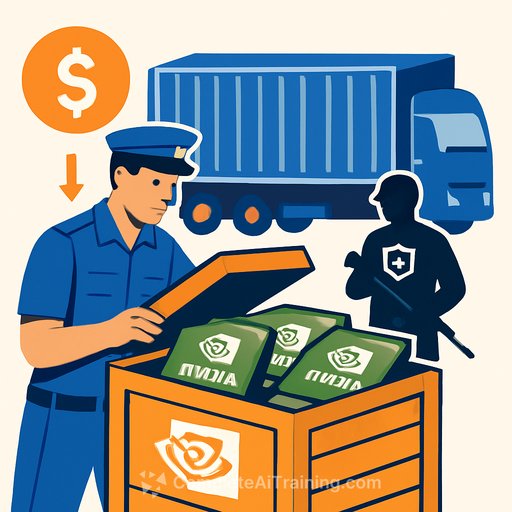
Operation Gatekeeper: Feds Seize $50M In AI Super-Chips, Disrupt Smuggling Network
Federal agents have broken up a scheme to route restricted AI hardware to China, seizing more than $50 million in Nvidia GPUs and cash. The joint FBI and Homeland Security Investigations probe-dubbed "Operation Gatekeeper"-targeted illegal exports of Nvidia's H100 and H200 Tensor Core chips. These chips fuel large-scale AI systems and advanced defense applications, making them a top priority for U.S. export enforcement.
Unsealed filings show a guilty plea from Alan Hao Hsu, 43, of Missouri City, Texas, and his company, Hao Global LLC. Prosecutors say Hsu tried to export roughly $160 million in restricted GPUs between October 2024 and May 2025, using falsified shipping manifests and more than $50 million in wire transfers from entities in the People's Republic of China to finance the buys.
The investigation widened with the arrests of Benlin Yuan and Fanyue "Tom" Gong. Gong, a PRC citizen living in Brooklyn, is accused of running a straw-purchaser operation that acquired Nvidia GPUs under the guise of domestic use, stripped the branding, re-labeled them as "SANDKYAN," and shipped them as generic parts to Hong Kong and mainland China. Yuan, a Canadian citizen and Virginia-based CEO, allegedly directed false statements about end destinations and helped craft cover stories to reclaim gear detained by U.S. authorities.
"The country that controls these chips will control AI technology; the country that controls AI technology will control the future," said U.S. Attorney Nicholas J. Ganjei for the Southern District of Texas. National security officials underscored that America's lead in AI is the product of engineering and policy-and that exporting restricted hardware illegally puts that lead at risk.
Why operations leaders should care
High-end AI chips are now compliance-sensitive inventory. Diversion threats don't just trigger fines-they stall production, burn working capital, and pull teams into months of audits. If your org touches AI hardware, plan for export control risk the same way you plan for safety and quality.
Red flags your team should watch
- "Domestic use" orders followed by requests to ship to forwarding warehouses or re-route through Hong Kong or other transshipment hubs.
- Unusual re-labeling or white-label branding; requests to remove manufacturer logos or alter part numbers (e.g., Nvidia identifiers).
- Straw purchasers: small resellers placing outsized, urgent orders with vague end-use or end-user details.
- Payment patterns that involve unrelated PRC entities, split wires, or mismatched billing/shipping data.
- Pressure to change manifests, HS codes, or declared values; mismatched insurance coverage.
- Third parties offering to "recover" shipments detained by authorities using new documentation or alternate stories.
- Inconsistent or recycled end-use/end-user declarations across multiple orders.
Controls to implement now
- Stand up an export controls playbook: end-user verification, end-use screening, and denied/restricted party checks on every order.
- Enforce serial-level traceability: capture chip serials/UUIDs at receipt, kitting, and ship, with photo proof and chain-of-custody logs.
- Lock down labeling: no re-branding, no logo removal, and no alterations to part numbers or HS codes without legal approval.
- Automate routing checks: flag transshipment hubs, high-risk geographies, and freight forwarders for secondary review.
- Dual-approval on all exports of controlled items; require legal sign-off for any manifest change.
- Train warehouse, procurement, and customer support teams to spot diversion attempts and escalate quickly.
- Run quarterly audits: sample orders, verify end-use declarations, and reconcile serials against WMS/ERP records.
- Tighten contracts with distributors and integrators: no re-exports, no resale without written approval, immediate reporting of diversion attempts.
- Maintain records for at least five years; prepare a clear incident response path and voluntary self-disclosure protocol.
Procurement outlook
Expect stricter allocation, serial tracking, and deeper diligence from manufacturers and distributors. Lead times may swing and gray-market offers will look tempting-avoid them. Stick to authorized channels, build buffer stock based on verified demand, and document the chain from PO to install.
Case status
Hsu faces sentencing on February 18 and up to 10 years in prison. Yuan faces up to 20 years; Gong up to 10 years. More actions are possible as the case develops and agencies continue targeting AI hardware diversion.
Resources
Optional training
If your ops or compliance teams need a refresher on AI systems and risk, consider the AI Learning Path for Training & Development Managers.
Your membership also unlocks: