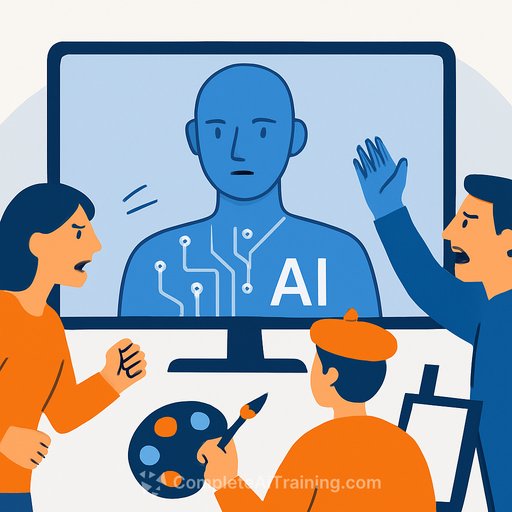
Backlash to Darren Aronofsky's AI series is a good sign for creatives
AI has pushed into every corner of culture. It burns through staggering resources, it can spit out confident nonsense, and it feeds on the work of the very people it tries to replace. Data centers can drain millions of gallons of water a day. Large models still invent "facts" because they're guessing the next word, not checking reality; for creators who want deeper context on model behavior and training data, see AI Research Courses.
Now we're watching that tension spill into prime time. Darren Aronofsky's new series, "On This Day…1776," leans on an AI pipeline to recreate moments from the American Revolutionary War. The reaction has been loud and clear - and that's exactly the signal creatives needed.
What this project is - and why people are pushing back
Reports say the show is produced by Aronofsky's AI studio, Primordial Soup, with tech from Google DeepMind, and will roll out on TIME's YouTube channel. Visuals are AI-generated; humans handled voice acting and editing. The first episode dropped Jan. 29.
Here's the problem. Viewers are flagging obvious quality issues (including a misspelling of "America") and eerie lookalikes that veer close to real actors. The work feels cheap and impersonal - like it was built to hit a date, not a standard.
At a bigger level, it stacks on top of concerns creatives have raised for years: training on copyrighted material without consent, muddying history with AI "hallucinations," and the resource cost of pushing out soulless content at scale. It's the cost of doing it fast instead of doing it right.
The good news: the audience is rejecting it
This series isn't just taking heat from critics - long-time fans are unhappy, too. Social threads, tech outlets, and comment sections are aligned: this isn't it. When the crowd speaks that clearly, studios listen.
We've seen this play out. McDonald's Netherlands pulled an uncanny AI holiday ad after instant backlash. Gamers have pressured studios to cancel titles or rethink AI usage. Even speculation that a major show leaned too hard on AI sparked outrage and questions about falling writing quality. The pattern is simple: people can feel when the human touch is missing.
What this means for working creatives
The market is giving you leverage. Audiences are voting for craft, taste, and lived experience - the things AI can't fake. Use this moment. Tighten your positioning. Make your process visible. Protect your rights.
Action steps you can take now
- Make the human obvious: Share sketchbooks, table reads, contact sheets, style tests, and BTS. Show the hand behind the work.
- Codify your taste: Build a visible reference library and style guide that frames your judgment, not just your output.
- Update your contracts: Add no-training clauses, dataset disclosure, and synthetic-likeness restrictions. Define how references and comps can be used.
- Protect your image and voice: Register your works where possible and set clear terms for likeness and voice usage.
- Price the process, not the pixels: Charge for discovery, direction, and revisions - the thinking clients actually want.
- Use AI like spellcheck, not a ghostwriter: Previz, mood boards, and alt concepts? Fine. Final creative voice and key decisions stay human.
- Track environmental impact: Batch renders, cap iterations, and prefer vendors that publish water and energy data.
- Build direct audience channels: Newsletter, community, or membership beats chasing algorithmic reach with generic content.
- Stand with peers: Align with unions, collectives, and orgs pushing for consent, credit, and compensation.
How to talk about this with clients
- Lead with outcomes: "If you want durable IP and brand trust, you need human creative judgment. Here's how we deliver that."
- Show the delta: Put an AI mock next to your real draft. Explain taste, story logic, and detail choices the model can't make.
- Offer options: Human-only package, hybrid assist, or AI board-only - with clear risk, rights, and quality notes.
- Add a quality clause: If AI is used anywhere, specify human review points and non-negotiable standards (accuracy, likeness, typography, cultural context).
Quality beats speed - and the audience knows it
The crowd is already trained to spot AI shortcuts: plastic eyes, messy hands, off-brand faces, flat prose, and details that don't track. That's why backlash lands so fast. People want work with point-of-view, constraint, and care.
That's your advantage. Your story, your taste, your scars - that's the value. Machines can riff on a dataset. They can't live a life.
Use the moment to strengthen your position
- Publish a public AI policy on your site: what you use, what you refuse, and how you protect clients.
- Create a "process proof" reel for pitches that makes your thinking tangible.
- Offer a "human-grade" certification on deliverables: research verified, fact-checked, likeness-cleared.
- Ship fewer, better pieces - and make them unmistakably yours.
Want structured training to stay current without losing your voice?
If you're looking for practical, creator-first ways to work with AI (without handing it the keys), explore a role-focused learning path here: AI Learning Path for Training & Development Managers. Use the tools to support your craft, not replace it.
The signal from this backlash is clear: audiences still value human creativity. Keep your standards high. Make your process visible. Protect your rights. The market is on your side.
Your membership also unlocks: