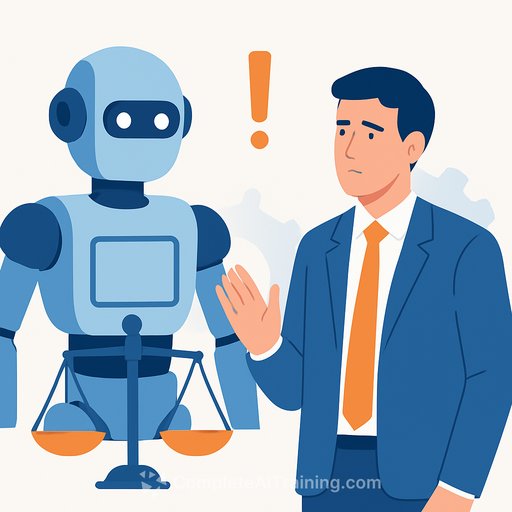
AI as the "New Religion"? You're Asking the Wrong Question
For centuries, religion offered certainty when life didn't make sense. Today, AI offers a different kind of certainty - not mystical, but opaque. It influences hiring, credit, content, pricing, logistics, and strategy while most decision-makers can't see how the results are produced. That's the real tension: we trust what we don't understand because it eases the weight of choice.
The headline debate is distracting. The deeper issue is simpler and harder: Why are leaders so willing to hand over judgment?
The Pull of Certainty
Modern leadership is exhausting. Stakes are high, data is endless, and every decision is public. AI feels like relief - numbers over gut, prediction over doubt, optimization over moral struggle.
- Quantification replaces intuition.
- Prediction replaces doubt.
- Optimization replaces ethical wrestling.
Say "the algorithm decided," and responsibility quietly moves from people to math. It feels efficient. That's exactly why it's dangerous.
From Tool to Authority
If AI took on god-like weight, it wouldn't arrive with rituals. It would live in dashboards and cloud logs. No salvation. Just scoring: credit, risk, engagement, productivity, satisfaction.
Here's the break with religion: belief isn't required - compliance is. Compliance is easier than conviction. In that mindset, what's efficient feels "good," and what's measurable becomes "true." Optimization is not morality.
How AI Rewrites What Leaders See
AI doesn't just help decisions; it shapes them. By curating feeds, predicting preferences, and nudging behavior, it filters what leaders notice and prioritize. Indoctrination doesn't need a pulpit when it has personalization. If you've read Brave New World, you know that control can feel like comfort.
It's Not the Machine - It's Us
Humans keep elevating their own inventions - markets, ideologies, institutions - from tools to doctrine. AI will join that list if we prefer tidy answers to hard choices. We don't crave mysticism. We crave relief from accountability.
The Business School Reckoning
This isn't theology. It's curriculum. If programs teach students to optimize without questioning what "optimal" even means, they won't produce leaders - just skilled operators.
The MBA of the future must be fluent in analytics and machine learning. But fluency isn't sovereignty. If students defer to dashboards more than they use judgment, leadership mutates into execution. It will look efficient. It will win quarters. And it will quietly train people to surrender.
What Future MBAs Must Learn
- Model literacy: how models work, break, and generalize; error bars, calibration, drift.
- Uncertainty tolerance: decide with incomplete data; reason about second-order effects.
- Ethical reasoning under pressure: articulate values trade-offs and defend them.
- Governance and escalation: clear override criteria, human-in-the-loop, audit trails, incident response.
- Data provenance and bias: dataset lineage, consent, representativeness, fairness trade-offs.
- Performance vs. principles: when to leave money on the table; define non-negotiables.
- Board-ready communication: explain decisions and overrides to executives and regulators.
Practical Drills You Can Run Next Term
- Shadow-the-model: students and an ML system make parallel decisions, then compare outcomes and errors.
- Override labs: give a profitable but misaligned recommendation; require a justified override and show the P&L hit.
- Blind A/B with constraints: add fairness or safety constraints and force redesign of "best" solutions.
- Incentive rewrites: grade for principled dissent and transparent trade-offs, not raw KPI gains.
- Postmortems: analyze real incidents (ads, credit, hiring); trace failure from data to decision to governance gap.
- Kill-switch drills: simulate data drift and require teams to pause, roll back, or retrain with a clear trigger.
Red Flags Leaders Should Watch
- "The model says" ends discussion.
- KPIs drive behavior with no counter-metrics for harm.
- No named owner for end-to-end outcomes.
- Explainers exist, but no policy for what to do with them.
- Optimization quietly replaces purpose.
When to Override: A Short Checklist
- Material risk of irreversible harm.
- Conflict with mission, law, or stated values.
- Disproportionate impact on protected groups.
- Clear signs of data drift or out-of-scope use.
- Systemic risk amplification across markets or platforms.
- No causal or policy-grounded justification where one is required.
Adopt a bias to interrogate. If a recommendation feels too clean for a messy problem, slow down and ask what the metric is hiding.
Governance Resources
- NIST AI Risk Management Framework for risk controls, governance roles, and lifecycle practices.
- AI for Executives & Strategy for leadership training, oversight models, and decision rights in AI-enabled organizations.
Efficiency Is Cheap. Leadership Is Expensive.
AI will keep offering answers that feel definitive. Your job is to decide when that clarity serves your goals - and when it quietly erases them. The cost of an override is the tuition for autonomy.
If business schools normalize that cost, they'll graduate leaders. If they don't, they'll graduate caretakers of systems they don't control. That habit, once learned, is hard to unlearn.
Your membership also unlocks: