Oracle's AI Capital Bet Connects Bond Markets With Hospital Workflows
Oracle (NYSE:ORCL) just closed a record multi-billion dollar bond sale to fund more cloud and AI infrastructure. That capacity is being positioned for heavy hitters like OpenAI, AMD, Meta, NVIDIA, TikTok, and xAI.
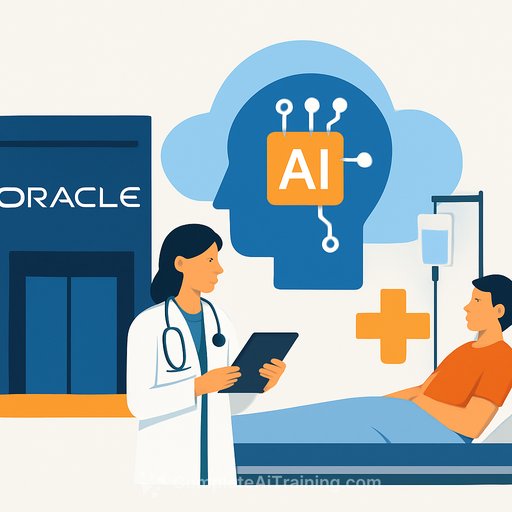
At the same time, Oracle's Health Clinical AI Agent is rolling out across a consortium of Canadian hospitals to speed up clinical documentation inside a shared EHR. It's the rare case where data center financing meets bedside workflow.
Why this matters for healthcare leaders
This isn't just another AI press release. If Oracle converts capital into stable capacity fast, your clinicians could see faster note creation and fewer clicks-without adding risk or hidden costs. The Canadian rollout is a live test of whether AI can hold up under real clinical load, across multiple sites, with all the privacy, latency, and change-management hurdles that usually slow things down.
If you're evaluating similar tools, this deployment is a useful proxy: same vendor stack, multi-hospital governance, and documentation as the first use case most systems try.
The setup in plain terms
- Funding: Oracle issued large, long-dated bonds (with maturities reaching 2036, 2046, 2056, and 2066) and signaled plans to raise up to US$50b in 2026, including up to US$20b via at-the-market equity.
- Use: Build hyperscale data centers tuned for AI workloads; support named demand from OpenAI and other large customers.
- Healthcare angle: Turn that capacity into recurring software use via the Health Clinical AI Agent embedded in EHR workflows.
What this could mean inside your hospital
- Documentation relief: Ambient tools that capture patient-clinician conversations and draft notes can cut after-hours work-if accuracy holds up and review time stays low.
- Integration first: Real value shows up when notes, orders, and codes flow into your existing EHR without breaking downstream billing or quality reporting.
- Privacy and residency: Canadian sites will pressure-test data residency, PHI handling, and audit trails under provincial rules.
- Uptime and latency: If Oracle's new capacity reduces lag, clinicians will notice. If it doesn't, adoption stalls.
- Costs: Long-lived infrastructure can stabilize pricing at scale-or push vendors to recoup spend. Watch contract terms and usage tiers.
To see Oracle's clinical product positioning, review the company's overview of its assistant for documentation and orders: Oracle Health Clinical Digital Assistant.
How this fits Oracle's AI story
Oracle is moving from legacy enterprise software toward AI-heavy infrastructure and application stacks. The financing supports superclusters and cloud services that, in theory, feed agents embedded in products like healthcare records. The Canadian deployment ties the headline capacity build to an everyday clinical task-documentation.
Risks and rewards investors-and healthcare buyers-are weighing
- Risk: Big fixed coupons through 2036-2066 increase interest obligations. If AI spend doesn't translate into cash flow, pressure follows.
- Risk: Up to US$20b of at-the-market equity can dilute existing shareholders if executed at weaker prices.
- Reward: The range of instruments (senior unsecured notes, convertible preferreds) signals deep capital access-useful when competing with Microsoft, Amazon, and Alphabet.
- Reward: Live deployments of the Health Clinical AI Agent and life sciences platforms suggest the money is tied to use cases that can deepen stickiness across infrastructure, data, and apps.
What to watch next (from a healthcare seat)
- Speed from financing to usable capacity (regions, SLAs, residency options).
- Adoption beyond pilots: number of live units, note volume per day, and clinician opt-in rates.
- Quality signals: note accuracy, time-to-sign, coding integrity, and handoff clarity.
- Safety and governance: error reporting, human-in-the-loop review, audit logs, rollback paths.
- Total cost of ownership: usage-based pricing, integration effort, and support model.
Questions to put in your RFP
- Where is PHI processed and stored? Can we enforce data residency per site?
- What model versions are used? How often do they change, and how are changes validated clinically?
- What's the documented note accuracy for our specialties? Include benchmarks and sample notes.
- How are errors handled, escalated, and audited? Who is liable for clinical or billing mistakes?
- Can we control prompts, redaction, and consent flows? Is there a human-in-the-loop by default?
- What are the latency and uptime SLAs during peak clinic hours?
- Pricing: seat vs. usage, rate caps, and triggers for price changes over contract life.
- Security: log retention, access controls, and third-party attestations.
- Localization: support for bilingual documentation in Canada and specialty-specific vocabularies.
- Exit plan: data portability, model rollback, and non-renewal constraints.
Bottom line
Oracle is tying long-dated financing to near-term clinical workflows. If capacity comes online quickly and documentation performance holds up under real conditions, hospitals get time back and cleaner data. If it lags-or costs creep-adoption will stall. Keep contracts flexible, measure outcomes weekly, and push for transparent SLAs tied to clinical quality and cost.
If your team is skilling up on practical AI for clinical ops and IT, consider these role-focused learning paths: AI Learning Path for CIOs, AI Learning Path for Technology Managers, and AI Learning Path for Software Engineers.
This article is for information only and is not financial advice or clinical guidance.
Your membership also unlocks: