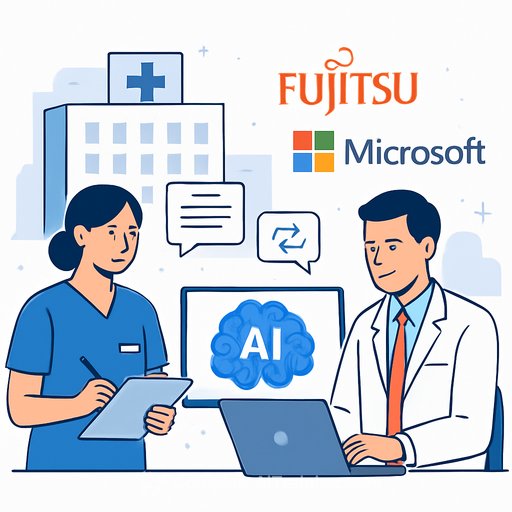
Osaka Hospital to safely operationalize generative AI across clinical workflows by June 2026
Osaka, Kawasaki, Tokyo, Japan - February 19, 2026. Japan Community Healthcare Organization Osaka Hospital (JCHO Osaka Hospital), Fujitsu Japan Limited, and Fortience Consulting Inc., with the support of Microsoft Japan, have launched a project to safely embed generative AI across hospital operations. The agreement, signed February 13, 2026, targets work style reform, quality improvement, and sustainable hospital management through governed AI adoption.
Since November 2024, JCHO Osaka Hospital has already piloted generative AI for non-clinical tasks like meeting minutes and an internal RAG-based staff chatbot. With strong results, the team is now moving into clinical documentation and nursing workflows.
What's going live (June 2026)
- Discharge summaries: AI-assisted drafting for about 16,000 cases per year using electronic medical record (EMR) data to speed creation and improve consistency.
- Nursing handovers: Summaries of key points to support accurate, efficient shift transitions.
The goal: cut admin time, lift documentation quality, and reduce cognitive load on clinical teams without compromising safety.
Governance first: security, privacy, compliance
Given the sensitivity of medical information, JCHO Osaka Hospital will run the system on Microsoft Japan's AI platform under strict operational rules. The framework focuses on data handling, PHI protection, access control, auditing, and legal/ethical compliance to support continuous and safe utilization.
- Systematized operational governance for generative AI outputs and data flows.
- "DX Ambassadors" - a cross-functional group of doctors, nurses, and admin staff - will identify on-site needs, validate use cases, and guide adoption at the point of care.
Organization-wide enablement
Fortience Consulting will lead policy creation, usage guidelines for healthcare professionals, and hospital-wide education to raise digital literacy. The program is designed to make adoption sustainable and repeatable, with materials that other medical institutions can reuse.
Built to scale across public hospitals
The partners intend to share their approach as a model for public and general hospitals nationwide and extend the service to other facilities within the Japan Community Healthcare Organization. EMR integration will be expanded while maintaining strict personal information protection.
Dr. Ryuji Hamamoto, Representative Director of the Japanese Association for Medical Artificial Intelligence, commented: "This is an excellent project that safely implements generative AI for clinical document creation and integrates governance and education. Ensuring safety, reducing the burden on those working in the field, and improving quality is extremely important. I look forward to this project's nationwide expansion."
Who's doing what
- JCHO Osaka Hospital: Provide the clinical environment to establish safe generative AI use across operations and demonstrate work style reform; plan expansion to other public hospitals.
- Fujitsu Japan: Deliver generative AI services for medical document creation and nursing handovers; support EMR data utilization and implementation.
- Fortience Consulting: Build governance and education programs; create guidelines for appropriate AI use; support scaling to other public hospitals.
- Microsoft Japan: Provide the underlying AI platform and expertise.
Key dates
- Agreement signed: February 13, 2026
- Operational start: June 2026
Leaders at the signing ceremony included Hiroya Kuwahara (Fujitsu Japan), Toshirou Nishida (JCHO Osaka Hospital), Norihiro Shimizu (Microsoft Japan), and Takuya Shigenobu (Fortience Consulting).
Practical checklist for healthcare IT and development teams
- Define clinical use cases with clear metrics (minutes saved per discharge summary, handover omission rate, rework rate, staff satisfaction).
- Codify data handling on the AI platform (role-based access, PHI boundaries, logging, retention, and review workflows).
- Start with a pilot unit; use multi-disciplinary champions (nurses, clinicians, HIM, IT) to refine prompts, templates, and UI.
- Keep human-in-the-loop for clinical outputs prior to EMR commit; document escalation paths for corrections.
- Close the loop with continuous QA - sample audits, bias checks, and incident reporting feeding back into model prompts and policy.
Resources
- Microsoft Azure OpenAI Service - reference for governed enterprise deployment patterns.
- Fujitsu (global site) - background on healthcare AI solutions and services.
- AI Learning Path for Medical Records Clerks - practical upskilling for teams working on clinical documentation and EMR workflows.
Your membership also unlocks: