
AI news ·
Oscars AI ban leaves artists and filmmakers unsatisfied with its limited scope
The Academy banned fully AI-generated performances and scripts from Oscar contention, but left AI open in visual effects, music, and animation. Critics say the rule targets work that was never likely to win anyway.
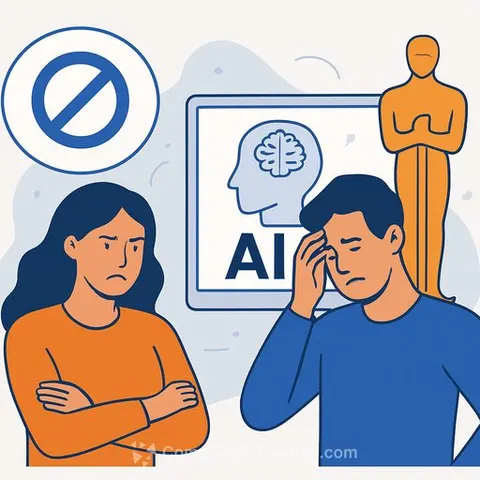
The Oscars' AI ban leaves the door wide open
The Academy has banned generative AI from acting and screenwriting categories ahead of next year's 99th Oscars ceremony. But the restriction applies only to entirely AI-generated performances and scripts-a narrow prohibition that permits AI use across visual effects, music, animation, and the creative tools used in production.
The updated rules require that acting roles be "demonstrably performed by humans with their consent" and that screenplays carry "an explicit screenwriting credit" and be "human-authored." These changes sparked immediate debate among creatives about whether the Academy is actually addressing the issue or merely creating the appearance of doing so.
What the ban actually covers
AI remains fully eligible in visual effects, sound design, music composition, and animated features. The Academy also clarified that generative AI used as a "digital tool in the making of the film" will neither help nor harm a film's nomination chances.
This distinction matters. AI technology already refined Adrien Brody's Hungarian accent in The Brutalist, which won Best Actor in 2025. De-aging effects in films like Here and Indiana Jones and the Dial of Destiny relied on AI. Background generation, upscaling, and visual optimization all use the technology routinely.
The skepticism is warranted
Critics argue the Academy chose the easiest targets. "It only removes purely generated movies that were never really gonna win in the first place," one observer noted on X. A screenplay authored by a human could still incorporate AI-generated dialogue or scenes, raising questions about enforcement.
Detecting AI use in screenwriting poses a practical problem. If a human writer refines an AI-generated script or uses AI as a drafting tool, how would the Academy identify it? The rulebook reserves the right to request information about generative AI use, but doesn't explain how that audit would work.
Some see the move as preemptive. "Most likely they are aware of what the techbros are saying to executives and are preemptively blocking them by removing the prestige factor," someone suggested. "You can't advertise the effectiveness of an AI actor if it can't compete for awards against real people."
Two sides, neither satisfied
Some creatives welcomed the gesture as a necessary boundary. Others dismissed it as performative-a rule that cannot realistically be enforced and doesn't actually restrict AI's role in filmmaking.
AI advocates argue the Academy risks irrelevance through what they view as an anti-innovation stance. One person described the ban as "institutionalized bio-elitism," claiming the Academy is protecting human ego rather than addressing legitimate concerns.
The real question ahead
Whether audiences will watch films where AI use is obvious enough to distract them may matter more than whether the technology can win an Oscar. The Academy's flexible approach acknowledges that generative AI is already embedded in production pipelines across multiple disciplines.
How the industry credits AI tools as they become standard practice remains unresolved. That question will shape how creatives and audiences understand what they're actually watching.
For those working in creative fields, understanding generative art and AI design tools is increasingly essential-whether the Oscars recognize them or not.