
AI news ·
Otter.ai faces federal class action over claims its AI notetaker records meetings without consent
Four lawsuits against Otter.ai are consolidating into a federal class action, alleging its AI meeting tool records audio and captures biometric data without participant consent. Penalties under three privacy laws could reach thousands per violation.
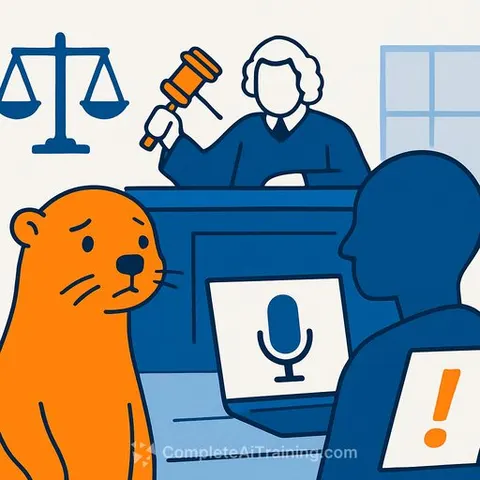
Otter.ai Faces Consolidated Class Action Over Meeting Recording Practices
A federal class action in San Jose is consolidating four lawsuits against Otter.ai, alleging the company's meeting transcription tool records conversations and captures biometric data without participant consent. The litigation, filed in 2025, centers on how Otter Meeting Agent integrates into users' calendars to automatically log audio, transcripts, and voiceprints.
Plaintiffs claim the company violates the federal Electronic Communications Privacy Act (ECPA), California's Invasion of Privacy Act, and Illinois's Biometric Information Privacy Act. They argue that Otter functions as an unauthorized third party, recording attendees who never agreed to participate.
Potential Damages
The financial exposure is substantial. ECPA violations carry penalties of either $10,000 per violation or $100 per day. California's statute allows $5,000 per violation, while Illinois's biometric law ranges from $1,000 to $5,000 per violation.
Otter.ai has not directly addressed the litigation. CEO Sam Liang told TechCrunch that the company views consent as the account holder's responsibility. "If they accuse us, then they could accuse everyone else," he said, noting the broader implications for AI meeting assistants across the industry.
Consent and Third-Party Recording
The core dispute centers on whether Otter functions as a third-party eavesdropper. In states like California and Illinois, which require all-party consent for recording, this distinction carries legal weight. Workplace privacy attorney Joseph Lazzarotti described treating Otter as an unauthorized eavesdropper as a "risky" interpretation under those statutes.
Similar litigation has already targeted Fireflies.ai. Other AI meeting tools, including Read AI, face university bans due to consent concerns.
Legal Timeline and Industry Impact
A motion-to-dismiss hearing is scheduled for May 20, 2026. The outcome will establish how existing privacy and biometric laws apply to AI tools that operate quietly during meetings.
For legal teams, the case raises immediate compliance questions. Organizations using AI meeting assistants should review consent mechanisms, state-specific recording laws, and biometric data handling policies. The litigation will likely influence how vendors disclose their data practices and obtain participant approval.
Otter Meeting Agent remains operational during the legal proceedings.
Learn more about how AI intersects with privacy and compliance issues through AI for Legal resources.