America's War Readiness Has a Supply Chain Problem. AI Might Be the Fastest Fix
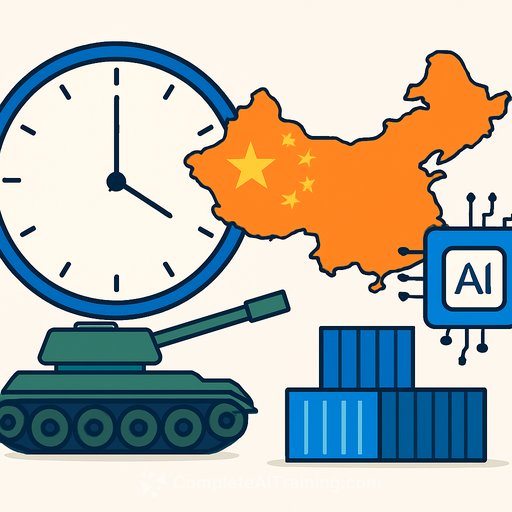
Defense leaders are sounding the alarm: in a high-end fight with China, the U.S. could burn through key munitions in days. China, meanwhile, appears structured to stretch the conflict and drain U.S. stockpiles.
This isn't about headlines. It's about production capacity, logistics speed, and the cost curve of future systems.
What the data says
Tara Murphy Dougherty, CEO of Govini, warned that U.S. stockpiles for specific munitions could be exhausted in under a week in a Taiwan scenario. Independent analysis backs that directionally: a CSIS war game found long-range and precision-guided munitions are the likely pinch point.
Context matters. The U.S. maintains the world's second-largest nuclear arsenal, far ahead of China's estimated 600 warheads per the International Campaign to Abolish Nuclear Weapons. But nuclear parity doesn't solve day-to-day industrial shortfalls or attrition in a conventional fight.
The bottlenecks executives should recognize
Stockpiles are thin. Production has been offshored for decades. Lead times for complex systems are measured in years, not months.
Operational availability is another drag. As Dougherty noted, too many platforms sit in depots or at dock when they're needed most. Ukraine has shown that logistics agility and repair velocity decide who keeps fighting.
Policy pressure is rising
The Trump administration and Department of War secretary Pete Hegseth pushed the Pentagon to restructure acquisition and shut down redundant programs. That direction is clear: reduce bloat, shorten cycles, and point resources at what actually deters.
AI's role: cheaper, faster, more attritable
Gary Steele, CEO of Shield AI, expects aerospace and defense to look very different within two decades: software-led, lower-cost systems at scale, not a handful of exquisite platforms that are easy to disable. Autonomy, sensing, and decision support can compress kill chains and widen the magazine by making cheaper systems far more capable.
For leaders, the takeaway is simple: AI won't just sit in labs. It will decide unit cost, deployment tempo, and how quickly you can surge.
An executive playbook for readiness
- Industrial readiness audit: map critical munitions, subsystems, and Tier-2/3 suppliers; quantify single points of failure and days-of-supply at surge rates.
- Dual-source and nearshore: lock in second sources and regionalize critical components to cut geopolitical and logistics risk.
- Surge contracts and vendor-managed inventory: pre-negotiate volumes, prices, and delivery windows for crisis conditions; fund buffer stock strategically.
- Design for manufacturability: simplify BOMs, standardize components, and pre-qualify substitutes to speed throughput under stress.
- Raise operational availability: deploy predictive maintenance and parts forecasting to lift mission-capable rates by double digits.
- AI-enabled wargaming: simulate contested logistics, attrition, and repair cycles to set realistic reorder points and production targets.
- Portfolio shift: balance "exquisite" programs with attritable, software-upgradable systems that can be fielded in quantity.
- DevSecOps and MLOps at the edge: continuous integration for autonomy stacks; telemetry pipelines for model retraining and validation.
- Governance: define human-on-the-loop standards, safety cases, and test ranges for autonomous systems before scale-up.
- Measure what matters: time-to-surge, days-of-supply by class, supplier on-time performance, MTTR, mission-capable rate, acquisition cycle time.
Capability-building for leadership teams
Most organizations don't have the operating knowledge to evaluate AI concepts of operations, data pipelines, and model risk. Close that gap so decisions move faster than the problem.
If your team needs a structured, role-based path to build those capabilities, consider the AI Learning Path for Supply Chain Analysts, the AI Learning Path for Plant Managers, or the AI Learning Path for Vice Presidents of Operations.
The strategic takeaway
The window to retool is measured in quarters, not decades. Stockpiles, surge capacity, and software-driven systems are the new deterrent math.
Plan for a long fight, price in supply risk, and build the AI stack that makes cheaper systems smarter. That's how you stay in the fight-and how you avoid one in the first place.
Your membership also unlocks: