
AI news ·
Over 500 US jurisdictions block data center construction, threatening AI race with China
More than 500 U.S. localities have banned or paused data center construction, threatening AI competitiveness with China. New York and Texas enacted state-level moratoriums, and Goldman Sachs estimates only 50-60% of planned capacity will come online on time.
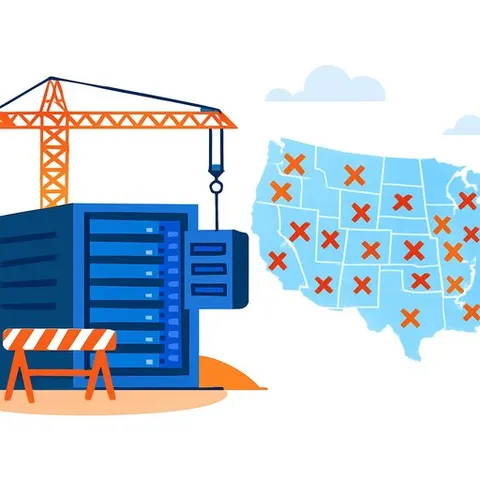
More than 500 local jurisdictions across the US have enacted bans or moratoriums on data center construction, threatening the country's ability to compete with China in the AI race, according to a new analysis from The Information. Over 150 localities passed bans last month alone, as opposition to the massive facilities spreads from rural Virginia to suburban Texas.
The backlash comes as tech giants and developers face a wave of public protests over energy consumption and environmental impacts. In the past year, activists have demonstrated against planned data centers in Fredericksburg, Virginia, and Tyler, Texas, among other communities.
"There's a pretty strong sense that local people want to oppose these and part of it is the tech bros are forcing AI on us," Paul Triolo, a partner at consulting firm DGA-Albright Stonebridge Group, told the New York Post. "The popular message around AI is pretty negative. Part of the game is changing that public narrative."
The state-level response
Two states have taken direct action. New York Governor Kathy Hochul, a Democrat, enacted a one-year moratorium on new data centers. Texas Governor Greg Abbott, a Republican, implemented a pause so state agencies can audit projects, with no fixed end date.
Texas, however, remains business-friendly overall. Energy companies in the Permian Basin are exploring leasing land to data centers and selling water and construction materials, betting on the region's cheap energy and available land. Chevron signed an agreement with Microsoft in June for what could become one of the country's largest AI data centers in West Texas.
The opposition there is still rising. Gina Hinojosa, the Democratic nominee for Texas governor, has criticized data centers as "owned by the richest men in the world … We're all footing the bill. There are no rules. It is the Wild West of data centers."
Delays threaten capacity goals
Goldman Sachs Commodities Research estimates that only 50 to 60 percent of planned data center capacity will come online on time over the next two years due to delays and cancellations. JPMorgan reports that roughly 60 percent of capacity targeted for 2027 has not yet even started construction, even as companies have announced about $750 billion in AI infrastructure investments this year alone.
Triolo said that business at his firm advising tech clients on "layers of bureaucracy and local concerns" has exploded. DGA-Albright recently launched a practice dedicated solely to helping energy companies and server infrastructure firms cut through permitting and public-relations challenges.
Developers face public pressure
Robert Loftin, a lawyer who represented a data center developer in a Northern Virginia dispute, told Bloomberg: "A lot of folks who challenge any kind of development project, they think developers and the nefarious lawyers like us want to come in and just bulldoze people."
The Associated Press reported in April that one data center developer endured vicious online attacks, lawsuits and death threats while building a project in southern California. The fiery opposition has delayed the facility, which would be California's largest data center.
Trump and Washington enter the fray
President Trump, who has said data centers "could be bigger than oil," convened a voluntary pledge last month where governors and electricity companies agreed to shield consumers from higher utility bills. "AI is probably the biggest thing anybody's ever seen, and whoever wins that race is probably going to win, period," Trump said at the Environmental Protection Agency.
The White House has also drafted a ban on US imports of new models of Chinese data center components, Reuters reported earlier in the month.
Why this matters for real estate and construction professionals
The data center construction pipeline for your industry is large but increasingly uncertain. There were 5,427 data centers in the US at the end of last year, according to Stanford University's AI Index Report. Developers have announced plans for about 4,000 new US data centers, per research firm Aterio, and 802 of those are currently under construction.
But the growing number of local bans, combined with state-level moratoriums, means that many of these projects will face extended approval timelines, redesign costs, and potential cancellations. AI for Real Estate & Construction professionals who work on site selection, permitting, or project financing must factor in a higher-than-expected risk of community opposition and regulatory delays in 2025 and beyond. The most practical approach includes early community engagement, proactive energy-efficiency planning, and staying current on which jurisdictions are shutting down new construction. Those who build relationships with local governments early may have an edge in the race to deliver capacity.
Operational planning and logistics around these delays also require attention. Construction firms should reassess schedules and subcontractor commitments given the Goldman Sachs estimate that only half of planned data capacity will come online on time. AI for Operations offers strategies to manage these uncertainties, from supply chain coordination to project-lifecycle planning.