Army Tests Autonomous Vehicles in Large-Scale Combat Operations at JRTC
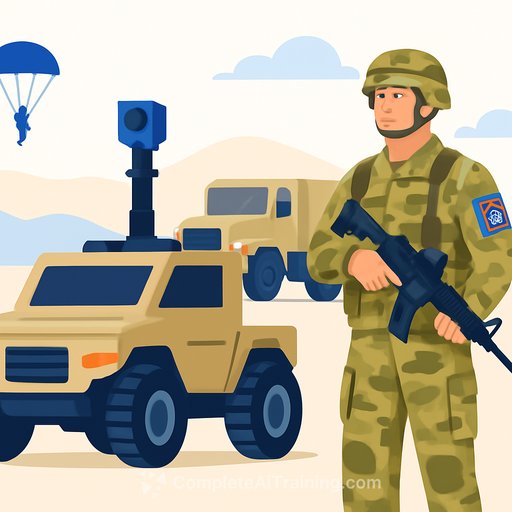
Overland AI completed a month-long operational deployment with the 3rd Brigade Combat Team, 82nd Airborne Division at the Joint Readiness Training Center in Fort Polk, Louisiana. Four ULTRA autonomous ground vehicles were integrated into the brigade's combat operations, executing logistics, reconnaissance, and counter-drone missions across more than 10 kilometers in day and night conditions.
The rotation marks the first validation of autonomous ground vehicles at brigade level under realistic large-scale combat operations conditions, with observation by Army Chief of Staff Gen. Randy George.
What the Vehicles Accomplished
The autonomous vehicles demonstrated measurable operational value across multiple mission types:
- Contested Logistics: Resupply operations reduced distribution timelines by approximately 50%, allowing the brigade to sustain operations faster.
- Deception Operations: One ULTRA vehicle traveled 8 kilometers to resupply a sniper team in an active combat area. Soldiers improvised a tactic using one vehicle as a decoy to reduce risk to the resupply vehicle.
- Forward Reconnaissance: Following direct orders from the Brigade Commander, ULTRA vehicles conducted route reconnaissance that identified obstacles and informed engineer breach planning.
- Command Post Movement: Three vehicles covered 12 kilometers to support a brigade command post relocation, demonstrating autonomous convoy capability at operational tempo.
- Counter-UAS Operations: Equipped with counter-drone payloads, the vehicles detected and tracked aerial threats in the operational environment.
What This Means for Operations
Byron Boots, co-founder and chief executive officer of Overland AI, said soldiers expanded the vehicles' mission sets on their own, indicating the technology addresses real operational problems. "The bar for what autonomous ground vehicles can do inside a military formation is being set right now," Boots said.
The rotation confirmed that operational units will adopt autonomous capability when it solves actual problems. The demand signal from field commanders is strong enough to drive programmatic adoption at scale, according to the company.
For operations professionals, this deployment demonstrates how autonomous systems integrate into existing command structures and maneuver plans. The vehicles operated under soldier control, not independently, with soldiers planning missions and adapting tactics in the field.
Learn more about AI for Operations or explore the AI Learning Path for Operations Managers to understand how autonomous systems fit into modern operational planning.
Your membership also unlocks: