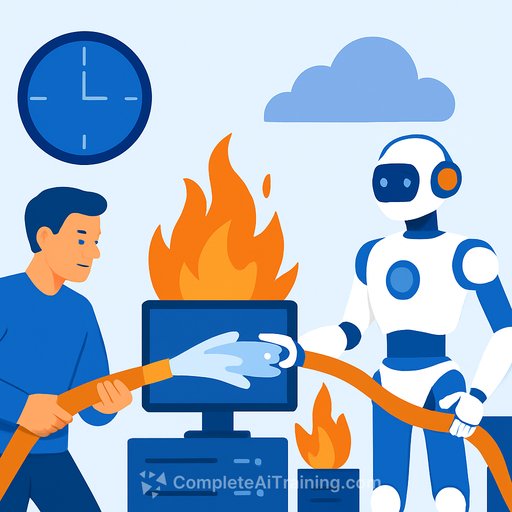
Pace brings autonomous AI agents into insurer operations as multi-agent systems replace BPO workflows
Pace is rolling out autonomous AI agents that log into carrier portals, read and interpret documents, and complete back-office work once sent to BPO teams. For operations leaders, this shifts repetitive, rules-driven tasks to software that works 24/7 and leaves people to handle exceptions and high-context decisions.
The practical question isn't "if," but "where to start" and "how to control risk." Here's how to evaluate the fit, pilot fast, and scale without breaking your SLAs.
What this means for Operations
- Higher throughput without adding headcount. Agents process queue-based work continuously with consistent standards.
- Shorter cycle times on routine tasks (data entry, reconciliations, status checks) that stall in handoffs.
- Fewer keystroke errors and stronger audit trails, assuming proper validation and logging are in place.
- Resilience during surges. When volumes spike, you scale agents, not seats.
Where agents fit first
- Intake: submission scrubbing, FNOL capture, document classification, indexing.
- Policy ops: data entry for quotes/endorsements, bordereaux processing, billing changes, commission adjustments.
- Claims ops: triage, coverage checks against policy terms, subrogation triggers, medical bill line-item checks.
- Compliance and controls: sanctions screening, licensing/appointment checks, audit prep, reconciliation against source-of-truth systems.
- Portal work: retrieving loss runs, updating status, downloading forms, uploading required docs.
How multi-agent systems run the work
Think of a small digital team with clear roles and a dispatcher. One agent breaks a workflow into steps, other agents specialize, and guardrails keep everything within policy.
- Orchestrator: breaks tasks into steps, assigns work, monitors progress.
- Portal operator: logs in, navigates menus, submits forms, handles MFA via approved methods.
- Document analyst: reads PDFs, emails, ACORD forms, and extracts fields with OCR + language models.
- Validator: checks data against rules, policy systems, and reference tables.
- Exception handler: routes edge cases to humans with context and suggested next actions.
- QA auditor: samples completed work, compares to SOPs, flags regressions.
Implementation plan that actually ships
- Pick a narrow, stable workflow with high volume and clear rules (e.g., loss-run retrieval or endorsement data entry). Define the exact start/stop conditions.
- Document the "golden path" and the top 10 exceptions. Convert them into machine-checkable rules.
- Integrate safely: least-privilege credentials, separate dev/test/prod, masked data in lower environments, and explicit rate limits on external portals.
- Pilot in parallel. Run agents alongside your current process for a few weeks and compare outputs, timing, and error types.
- Move to phased rollout: a percentage of volume, then majority, then full coverage once KPIs stabilize.
Controls, risk, and compliance
- PII handling: encryption at rest and in transit, field-level masking, and automatic redaction in logs.
- Access control: SSO, scoped service accounts, credential vaulting, MFA handling approved by security.
- Model risk: define acceptance thresholds, human review gates, and a rollback plan. Track prompt/model versions.
- Auditability: immutable activity logs, screenshot evidence where allowed, and full input/output capture with retention policies.
- Third-party risk: vendor assessments, DPAs, and evidence of controls (e.g., SOC 2, ISO 27001).
For governance structure and evaluation criteria, see the NIST AI Risk Management Framework here.
Metrics that matter
- Cycle time by step and end-to-end.
- First-pass yield and exception rate (by reason code).
- SLA adherence and backlog age.
- Cost per transaction and rework rate.
- Straight-through processing rate and audit findings per 1,000 transactions.
People impact and operating model
- Shift analysts to exception management, QA, and process engineering.
- Update SOPs to reflect agent-assisted workflows, including cutover steps and fallbacks.
- Set clear RACI: who owns prompts, rules, credentials, and approvals for changes.
- Train teams on overseeing agents, reading logs, and giving structured feedback to improve rules.
Build vs. buy questions to ask
- How well does the solution work with your core admin platform and document systems?
- Can it operate reliably across multiple portals with variable layouts and MFA?
- What guardrails, audit logs, and rollback options are native vs. custom?
- How are prompts, models, and rules versioned and tested?
- What's the vendor's support model during volume spikes or portal changes?
A short checklist for your first pilot
- One process, one success metric, one owner.
- Document your top exceptions and define the auto-escalation path to humans.
- Turn on full logging from day one and review a daily sample.
- Agree on stop conditions (error rate, SLA breach) and a clean rollback plan.
- Communicate the purpose to teams: reduce grunt work, increase quality, and make room for higher-value tasks.
Pace's move signals a shift: routine, rules-based insurance work is becoming software-first. With a tight pilot, strong controls, and clear metrics, operations teams can cut friction and improve reliability without risking compliance.
If you need structured upskilling for your team on AI automation governance and implementation, explore these resources:
AI Automation Certification * AI courses by job function
Your membership also unlocks: