Researchers Find Water, Not Surface Charge, Guides Protein Assembly
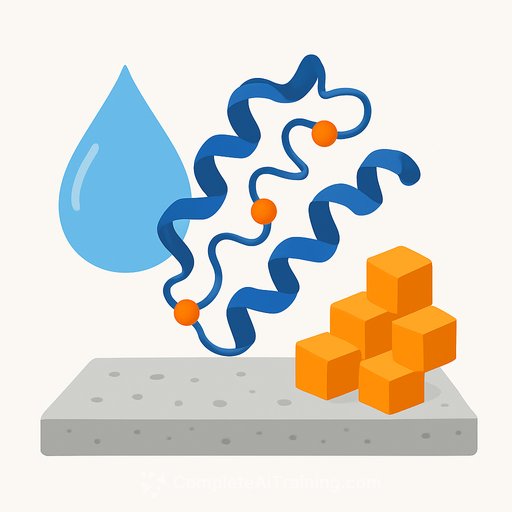
Scientists at Pacific Northwest National Laboratory used machine learning to study protein nanoribbons and discovered that water molecules on surfaces-not the underlying mineral lattice-direct how proteins align and organize.
The finding challenges how researchers currently design proteins meant to assemble on surfaces. The team tracked the orientation of nanoribbons designed by Nobel laureate David Baker using a machine learning tool called AtomAI. The proteins aligned in a single direction and organized into parallel rows, but not for the reason the researchers expected.
The original hypothesis was that negatively charged proteins would align with positively charged potassium ions embedded in mica-a common mineral substrate. Instead, the data showed water on the mica surface was the organizing force.
Why This Matters for Materials Science
The results have direct applications in biomineralization and the development of bioinspired materials. James De Yoreo, co-lead author of the study, cited the mantis shrimp shell as a model: a composite of nanofibers, proteins, and minerals that is both lightweight and crash-resistant.
"Proteins designed to assemble on surfaces must explicitly include the role of solvents, and that physics-informed machine learning is essential to account for solvent effects when designing proteins," De Yoreo said.
The study was published in Nature Communications in April 2026.
What Comes Next
The research team plans to continue exploring how solvents influence protein design and to develop machine learning tools that account for these effects. The work suggests that future protein design algorithms will need to factor in solvent behavior from the start, not treat it as secondary.
For researchers working on materials science or protein engineering, understanding solvent effects opens a new design dimension. AI for Science & Research training can help teams apply machine learning methods like those used here to their own experimental work.
Your membership also unlocks: