Palantir-HD Hyundai: AI Moves From Pilots to Plant-Floor Reality
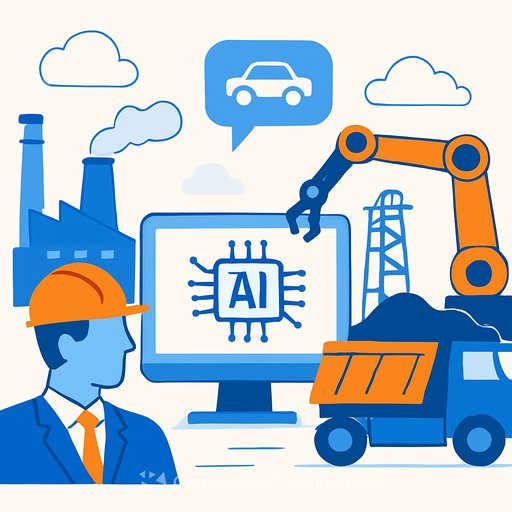
Palantir Technologies has expanded its partnership with South Korea's HD Hyundai into a multi-year rollout across electric systems, robotics, marine services, and construction equipment. The two companies will also establish a Center of Excellence to speed delivery and standardize AI projects across the group.
Translation for operations leaders: this isn't another proof-of-concept. It's a push to embed AI into day-to-day decisions across a broad industrial ecosystem - see AI for Operations for practical guidance on operationalizing models.
What the agreement covers
- Group-wide rollout of Palantir's Foundry and AIP across multiple HD Hyundai affiliates.
- A Center of Excellence to codify best practices, templates, data models, and governance.
- Stronger integration with digital twins and 3D modeling, with Palantir acting as the orchestration layer for workflows and decisions.
If you want a primer on the platform capabilities mentioned, see Palantir's overview of AIP and Foundry here. For context on digital twins and standards, the Digital Twin Consortium is a solid starting point here.
Why operations teams should care
- Closer to the line: Use cases already cited include crude selection, predictive maintenance, shipyard efficiency, and construction equipment pilots moving to production.
- One data backbone: Common models and workflows reduce duplicated effort across affiliates, speeding deployment and improving comparability of KPIs.
- From reporting to action: Foundry/AIP can trigger decisions in near real-time (e.g., maintenance windows, scheduling, materials planning) rather than stopping at dashboards.
How this fits Palantir's strategy
The deal reinforces Palantir's push beyond government into heavy industry, embedding the software deeply into core workflows, not just analytics on the side. The setup favors long-term usage as more processes, data products, and teams plug into the same operating layer.
For operators, that means fewer bespoke tools and more reusable building blocks that scale across plants, vessels, and equipment lines.
Risks to watch
- Concentration risk: Large contract value tied to one industrial group. If priorities shift or implementations stall, impact could be meaningful.
- Execution risk: Group-wide rollouts can slow under data quality issues, siloed systems, or weak change management.
- Adoption risk: If the Center of Excellence doesn't get buy-in from line employees, models won't influence daily work.
- Vendor dependency: Deep platform integration can make switching costly. Negotiate clear SLAs, portability, and exit paths.
- Valuation expectations: For context only: investors already expect a lot; another big contract helps the story, but the bar is high.
Playbook for operators: make it stick
- Data readiness: Inventory key sources (SCADA, MES, ERP, historian), define golden records, and lock data ownership. Bad inputs kill momentum.
- Pilot-to-production criteria: Commit to go/no-go gates: impact (throughput, downtime, yield), reliability (alert precision), and ops effort (minutes saved per shift).
- COE that ships: Staff with one product owner, one data engineer, one SME per plant area. Central templates, local tuning. Publish weekly release notes.
- Workflow integration: Embed decisions where work happens (CMMS tickets, scheduling boards, control room views). No swivel-chair analytics.
- Change management: Train supervisors first, then crews. Pair training with live use cases and a 30-60-90 day adoption plan.
- Governance: Model registry, versioning, lineage, and rollback procedures. Track model drift and set re-training triggers.
- Security and compliance: Map data residency, access controls, and audit trails. Stage red-teaming for high-impact automations.
- Contracts: Lock SLA uptime, incident response, and clear pricing for scale. Add off-ramp clauses and data export guarantees.
What to track next
- Speed from pilots to full deployments across new affiliates.
- Adoption of the Center of Excellence by supervisors and line teams.
- Evidence that workflows connect to digital twins and 3D models at scale.
- Similar multi-year industrial deals in other regions, signaling broader traction beyond government work.
Quick numbers (context only)
At the time of this agreement, Palantir's shares traded near $168.5767. The stock rose roughly 23x over the past 3 years and 130.7% over the past year, with year-to-date performance around 0.4%. Short-term moves showed a 12.8% decline over 30 days and 5.8% over 7 days.
Upskilling your team
If you're building internal capability to run AI in production (not just pilots), you may find these learning paths useful: AI Learning Path for Plant Managers and AI Learning Path for Supply Chain Analysts.
This content is for general information only and is not financial advice. It does not consider your objectives or financial situation.
Your membership also unlocks: