AFRL Awards Palladyne AI Contract to Sync Swarms Across Space, Air, Sea, and Land
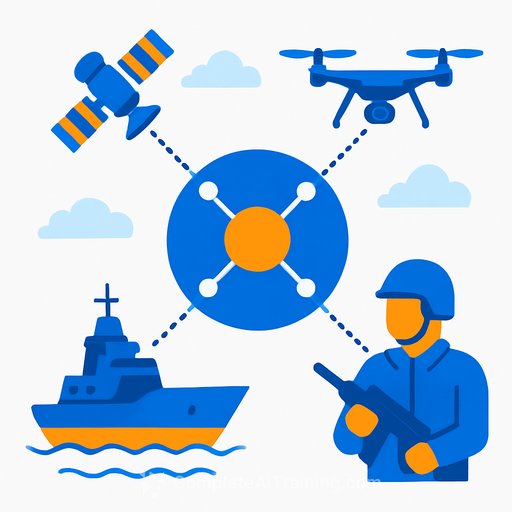
Palladyne AI has secured an Air Force Research Laboratory (AFRL) contract-codenamed HANGTIME (Hierarchical Adaptive Networked Game-Theoretic Integration of Multiple Echelons)-to make mixed fleets of autonomous systems operate as one team. The key shift: pulling satellites into the loop so ISR and mission execution can coordinate across domains without pause.
At the center is SwarmOS™, Palladyne AI's embodied AI platform for collaborative autonomy. The goal is straightforward: reduce latency from sensing to action, keep humans on the loop, and close gaps between platforms that rarely talk to each other today. For background on multi-domain AI orchestration and human-on-the-loop approaches, see Research.
Why this matters for Operations
- Cross-domain tempo: Satellites, drones, surface vessels, and ground units share intelligence and maneuver in sync, shrinking decision cycles.
- Resilience in the field: Edge-native autonomy keeps missions moving through comms loss and contested environments.
- Common playbook: One AI framework coordinates assets instead of juggling multiple vendor-specific tools.
- Actionable ISR: Integrated sensing pushes fused insights to commanders who can act faster with higher confidence.
"This isn't about replacing humans-it's about giving them sharper, faster insight," said Ben Wolff, President and CEO, Palladyne AI. "By connecting satellite, aerial, and ground systems using the patented SwarmOS embodied AI platform as a foundational technology, we're helping the warfighter make better decisions in real time."
"For the first time, a single AI framework can coordinate assets across multiple domains, including satellites," added Dr. Denis Garagic, CTO. "These systems can now think and act together as a team, sharing what they see and learning as conditions change."
What HANGTIME sets out to solve
- Interoperability: Link disparate unmanned systems and high-altitude assets under a single coordination layer.
- Adaptive teaming: Use game-theoretic planning to re-task assets as conditions shift.
- Human-on-the-loop control: Keep operators in supervisory control with clear, auditable decision paths.
- Degraded-comms operations: Push intelligence and autonomy to the edge to sustain missions under jamming or loss of link.
Inside the stack (what Ops leaders should care about)
- Sensor fusion at the edge: Merge feeds from satellites, UAVs, UGVs, and maritime platforms for a single operating picture.
- Platform-agnostic integration: Reduce vendor lock-in risk and shorten onboarding for new assets.
- Policy and compliance: U.S.-developed and operated software aligned to data sovereignty, security, and government standards.
- Orchestration: Distributed tasking with role-based control and rules of engagement baked into mission logic.
Operational playbook: steps to prepare now
- Inventory interoperability: Map current platforms, data formats, comms links, and control stations. Flag proprietary choke points.
- Standards and schemas: Define minimal message sets, time sync, and metadata for cross-domain ISR. Enforce at the edge.
- Comms architecture: Plan primary and fallback paths (SATCOM, LPI/LPD waveforms, mesh). Test for contested environments.
- Human-on-the-loop training: Rehearse supervisory control, escalation paths, and kill-switch procedures.
- Metrics that matter: Track decision latency, comms dropout impact, asset re-task time, and autonomy confidence scores.
- Validation pipeline: Use simulation and live trials to verify behaviors before fielding; log everything for after-action learning.
- Security review: Lock down supply chain, firmware, and key management. Validate data sovereignty requirements.
What to watch next
- Satellite integration milestones: How quickly SwarmOS links on-orbit sensing into live missions.
- Field exercises: Evidence of reduced sensor-to-shooter time and fewer operator handoffs.
- C2 compatibility: Smooth integration with existing command-and-control tooling and TTPs.
- Scalability: Performance as asset counts grow and mission complexity increases.
AFRL summarized the intent clearly: coordinated execution in challenging environments. If you're responsible for ops readiness, this is the signal to get your interoperability and training plans in order.
Learn more
- Palladyne AI
- Air Force Research Laboratory (AFRL)
- DoD JADC2 overview
- Build team AI fluency (courses by job)
Contract reference: HANGTIME | Originator Reference Number: RIE-26-001 | Case Number: AFRL-2026-0324
Your membership also unlocks: