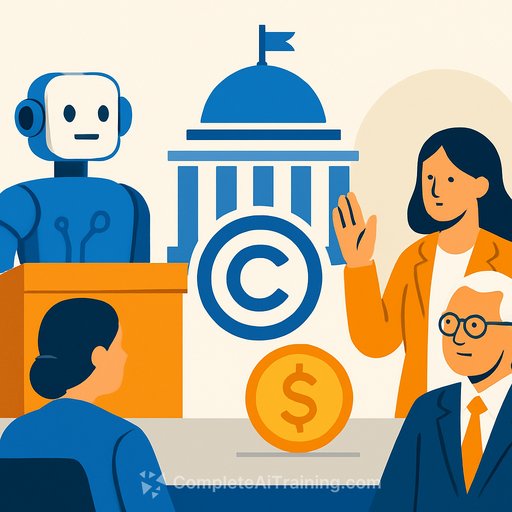
EU committee backs update to copyright rules for AI - what legal teams should do next
Brussels, January 29, 2026 - A European Parliament committee passed a report on January 28 calling for updated EU copyright rules to address AI training transparency and fair compensation for creators. The text highlights transparency in training data, consent mechanisms, payment to rights holders, and stronger enforcement.
Campaigns such as Creators for Europe United have pressed the European Commission for a package built on four pillars: transparency, consent, payment, and enforcement. With artists and songwriters voicing similar demands, the political signal is clear: align AI development with existing copyright expectations and create predictable routes to licensing.
What the committee backed
- Transparency: clear disclosures about whether and how protected works were used to train models.
- Consent and control: practical ways for rights holders to opt out or license use of their works for training.
- Remuneration: mechanisms to ensure artists and songwriters are paid when their works feed commercial AI systems.
- Enforcement: tools to address unauthorized use and AI-generated abuses (including deepfakes), plus better takedown pathways.
Key legal hooks already in play
The AI Act sets transparency obligations for general-purpose AI providers and requires respect for EU copyright law. Expect training-data summaries and policies designed to honor rights holder choices.
The Copyright in the Digital Single Market (DSM) Directive introduced text-and-data mining rules with a machine-readable opt-out for rights holders. Any new measures will likely build on, not replace, that framework.
Implications for rights holders (labels, publishers, CMOs, studios)
- Inventory and marking: keep an authoritative list of works, apply machine-readable TDM opt-outs where desired, and track where those signals are deployed.
- Licensing strategy: define pricing and terms for training use; consider collective licensing for efficiency and auditability.
- Contractual updates: add clauses on AI training, synthetic content, and moral-rights integrity; require disclosure of downstream AI uses.
- Evidence and enforcement: maintain logs, hashes, and reference fingerprints to support notices, claims, and settlement discussions.
Implications for AI developers and platforms
- Data provenance: document sources, legality, and license terms; maintain reproducible dataset builds and retention schedules.
- Respect opt-outs: honor machine-readable signals under the DSM Directive and keep auditable controls to prevent ingestion.
- Licensing at scale: prepare playbooks for collective deals and per-sector terms; budget for compensation.
- Transparency deliverables: publish training-data summaries and policy statements; keep internal registries that map datasets to rights status.
- Notice and action: strengthen workflows to handle AI-related infringements and deepfakes under existing EU rules.
What legal teams can do now
- Gap assessment: compare current data and model documentation against AI Act transparency and DSM TDM requirements.
- Governance: establish approval gates for data ingestion, with automated checks for opt-outs and licensing.
- Templates: update NDAs, licenses, and contributor agreements to cover training use, synthetic outputs, and attribution.
- Monitoring: deploy content fingerprinting and prompt-output testing to detect training on protected catalogs.
- Playbooks: pre-draft notice letters, settlement ranges, and escalation paths for repeat offenders.
What's next
The report now moves toward a plenary vote. If momentum holds, the Commission could be pressed to table legislative proposals that clarify training transparency, consent routes, compensation models, and enforcement.
Timelines aside, enforcement risk is already rising. Align internal policies with the AI Act and DSM Directive today so you can prove compliance - or assert your rights - as new rules arrive.
Further resources
- AI Learning Path for Regulatory Affairs Specialists
- AI Learning Path for CIOs
- AI Learning Path for Data Scientists
Bottom line: Treat training-data transparency, opt-out compliance, and licensing as core controls - not afterthoughts. The policy direction is set, and documentation will be your strongest defense and your best lever for remuneration.
Your membership also unlocks: