AI Is Already in Your Exam Room
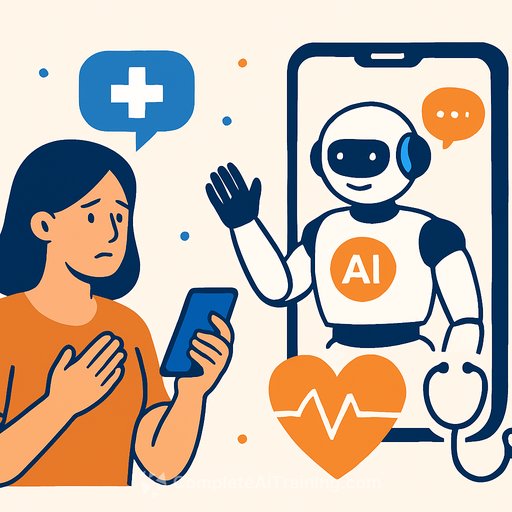
Patients are using AI to research symptoms, treatments, and clinical studies before they see you. They show up with summaries, screenshots, and pointed questions.
The risk isn't AI itself. The risk is poor guidance, weak data hygiene, and unchecked outputs. Your job is to set the rules, pick the right use cases, and prove value fast.
High-Value Use Cases You Can Deploy Now
- Clinical documentation: Draft notes, discharge summaries, and prior auth letters. Keep humans in the loop for final sign-off.
- Patient education: Generate plain-language after-visit summaries and condition explainers tuned to reading level.
- Triage support: Intake chat assistants that route cases with clear escalation rules and audit trails.
- Research synthesis: Summarize guidelines and studies with citations, then verify against trusted sources.
- Imaging and signal review: Assist with pattern detection and prioritization. Maintain clinician oversight.
- Revenue cycle: Draft appeals, scrub codes, and reduce denials with consistent documentation.
Guardrails That Keep You Safe
- Use vendors with a signed BAA, access controls, and audit logs. No PHI in tools without clear protections.
- Prefer de-identified data and on-platform processing where possible. Minimize data sent to external APIs.
- Bias testing on your population. Track performance by age, sex, race, and language.
- Human review for clinical outputs. No fully autonomous decisions in high-risk care.
- Version control and change logs for prompts, models, and datasets.
- Clear incident response: what triggers a rollback, who approves, how you notify stakeholders.
Start Small, Prove Value, Then Scale
Pick one workflow where delays or admin work hurt outcomes. Define a simple baseline: time per task, error rate, wait time, or denial rate.
Run a 4-6 week pilot with a single team and tight metrics. Keep scope narrow and feedback loops short.
- Time saved per note (minutes)
- Reduction in prior auth denials (%)
- Average triage response time (minutes)
- Patient comprehension scores (teach-back)
- Clinician satisfaction (quick pulse surveys)
Procurement Checklist (No Surprises Later)
- Security: BAA, encryption, data retention, PHI handling, audit logs.
- Interoperability: FHIR/HL7, EHR integration path, SSO support.
- Validation: prospective results, peer-reviewed data, real clinical KPIs.
- Total cost: license, tokens/usage, integration, training, support.
- Controls: prompt templates, whitelists/blacklists, content filters.
- Data ownership: who can train on your data, opt-out options, deletion SLAs.
- Reliability: uptime SLA, rate limits, rollback plan, sandbox access.
Risk Tiers Keep Decisions Clear
- Admin-only: Scheduling notes, reminders, coding drafts. Post-go-live audit is enough.
- Clinical support: Summaries, education, suggestions. Mandatory human review.
- High-risk automation: Anything that could change diagnosis or therapy. Require formal approval, documented validation, and continuous monitoring.
Patient-Facing AI: Set Expectations Upfront
- Disclose AI use and how data is protected.
- Explain limits: outputs can be wrong; emergencies go to clinicians.
- Offer a clear handoff to a human for red flags and complex cases.
- Collect feedback and publish quality metrics patients can understand.
Common Pitfalls
- Overtrusting outputs without a verification step.
- Shadow IT: staff using unsanctioned tools with PHI.
- Messy prompts and no templates, leading to inconsistent results.
- No plan for drift: models, data, and guidelines change over time.
- Skipping change management and training, then blaming the tech.
What Good Looks Like at 90 Days
You have one live use case with a clear KPI lift and a second in pilot. A small governance group meets weekly and owns risk, rollout, and metrics.
Prompts are standardized, audit logs are active, and staff can report issues in one click. Patients see better explanations, faster responses, and cleaner follow-up.
Helpful Resources
Upskill Your Team
If your staff needs practical training on prompts, evaluation, and safe rollout, consider these options: AI Research Courses. Short, hands-on, and easy to apply in clinical workflows.
Your membership also unlocks: