
AI news ·
Patients armed with AI overtake doctors in healthcare power shift
73% of Mexican patients now use AI to interpret lab results before seeing a doctor, while only 9% of physicians use AI in practice.
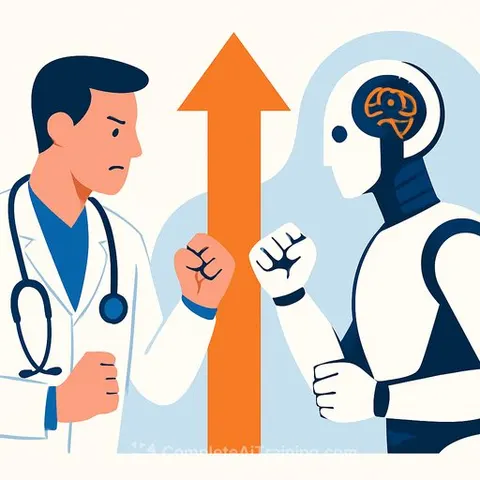
A patient walks into the office, sits down, and opens with: "I think I have this - I checked with AI." Three years ago that was unusual. Now it is routine. And for anyone who has led technology rollouts in healthcare, the shift is unmistakable: the entire system is reorganizing around a patient who no longer arrives blank.
The data is concrete. In Mexico, 73% of patients already use AI or digital tools to interpret lab results and test findings before stepping into a doctor's office. That number is climbing toward self-diagnosis. Meanwhile, barely 9% of physicians use AI in their practice. The patient got there first. That is not a cute detail. It is the map of where power in healthcare is moving.
What is actually breaking
For centuries, medicine ran on one thing: information asymmetry. The doctor knew, the patient didn't. That asymmetry organized everything - the physician, the pharma company, the insurer, the lab. Each earned its place by being, in one way or another, the front door to medical knowledge. Today, that door is an AI the patient already consulted from their phone. When the entry point to knowledge moves into the patient's pocket, every player's position is up for renegotiation.
The consultation itself changes first. The patient no longer asks, "What do I have?" but "Is what the AI told me true?" The doctor stops being the oracle and becomes the interpreter: the one who contextualizes, corrects, and guides. That feels like losing authority. But the physician who dismisses what the patient brings from AI loses the patient. The one who sits down to review it with them becomes more valuable.
Technology, used well, plays in the human's favor here. Ambient documentation assistants that listen to the visit and draft the clinical note are already reducing physician burnout, returning roughly half an hour a day that used to disappear into paperwork. This is not AI replacing clinical judgment. It is AI pulling the keyboard out from between doctor and patient so the physician can do what matters most: look the patient in the eye and interpret. Once the patient already has a hypothesis, the scarce asset stops being data and becomes trustworthy judgment.
The pharmaceutical industry feels the pressure too
In Mexico the blow lands on a model that was already cracking. The old playbook - influencing the prescription through the physician and the rep - assumes the patient passes through a formal consultation. That stopped being the rule long ago. 41% of people respond to an ailment with home remedies or self-medication first. Of those who buy medication without a prescription, 22% do so because they "already recognize their symptoms." AI acts as an accelerant. Now that patient also shows up with the name of a molecule the machine suggested.
The instinct might be to push the product into that AI layer. But with prescription-drug advertising banned to the general public in Mexico, that shortcut does not exist. The way through is to inform better, not advertise better. The only legal entry point is scientific information - unbranded disease awareness, clinical evidence aimed at professionals - built with enough rigor that an AI finds and cites it. That layer, once a forgotten corner subordinate to the commercial team, becomes the company's most valuable asset. It is the only thing that puts the brand in the conversation without crossing the line.
Insurers face a reversal
For years, information asymmetry let insurers deny care in bulk. In the United States, several face class-action suits over algorithms that rejected care en masse, with human reviews of barely over a second per claim. Now that same patient armed with AI uses it to fight and appeal the denials they once accepted. The insurer that used AI to shield itself against the patient finds a patient using AI to defend themselves. That arms race, combined with new regulation, is lost on reputation.
Four different effects, one single cause. The patient is gaining control. Patient-centricity stops being a brochure line and becomes the structural logic of who wins and who loses. A key finding sums up the leadership challenge: executives' confidence in AI tends to run far higher than the front line's. The boss is convinced. The person seeing the patient is not. Bringing people into the decision before it is made, running quiet pilots, being honest about limits, and measuring value in something that matters to the person using it - that is what works.
Why this matters for healthcare professionals
The shift redefines your role. You are no longer the sole gatekeeper of medical knowledge; you are the interpreter of information the patient already found. The asset you bring that no AI can replicate is trustworthy judgment and clinical context. Doctors who review the AI-generated hypothesis with the patient - rather than dismissing it - become more, not less, central. For healthcare professionals across clinical, pharma, and insurance roles, the action is the same: your credibility will be built not on what you know that others don't, but on how well you guide them through what they already know.