Patients Still Trust Doctors Over AI: 73% Seek Info From Clinicians, Only 16% Ask Chatbots
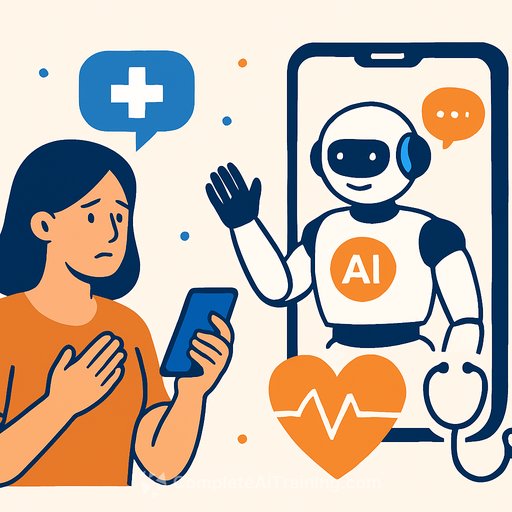
AI health chatbots are multiplying, but patients still want a clinician's voice. A new Gallup report shows 73% of U.S. adults go to their doctors or other medical professionals for health information. Only 16% say they consult AI chatbots.
That gap is your advantage. As AI tools enter care journeys, trust remains anchored to clinical expertise. The job now is to guide how AI gets used-so it supports care, not sidetracks it.
New Healthcare Chatbots Are Here-Trust Still Belongs to Clinicians
Recent launches like ChatGPT Healthcare, Claude for Healthcare, and Amazon One Medical's Health AI assistant promise faster answers, record uploads, and care navigation. None claim to replace a doctor, yet overreliance is a real concern across the industry.
The Gallup data suggests patients aren't abandoning clinicians. They're sampling new tools while keeping providers at the center.
What Gallup Found
Based on the probability-based Gallup Panel, patients still prioritize clinicians and authoritative medical sources. Methodology details are publicly available via Gallup's panel documentation.
- 73% go to their doctor or another medical professional first.
- 53% use medical websites backed by hospitals or public health agencies.
- 30% rely solely on their personal doctor.
- 11% lack a usual source of care but lean on medical websites or family/friends who are medical professionals.
The "Health Media Oriented"
This group skews mostly female and still trusts clinicians-but blends in other sources. AI remains a minority input.
- 51% read books on health and medicine.
- 38% consume health-related social media.
- 37% watch health reports on TV news.
- 30% listen to health podcasts.
- 16% consult AI chatbots.
The "Health Self-Navigator"
More likely to use AI and non-institutional sources-yet they still circle back to clinicians.
- 39% use AI chatbots.
- 51% consult family and friends who aren't medical professionals.
- 49% read websites not affiliated with medical institutions.
- 74% still consult a doctor or medical professional.
What This Means for Healthcare Leaders and Clinicians
Patients want clinical judgment first, then supplemental input. Your role is to set the guardrails: which tools are acceptable, what they're good for, and how to validate what patients bring in from outside sources.
The right move isn't to block AI-it's to channel it. Meet patients where they are, then bring them back to evidence and your clinical plan.
Practical Steps To Use AI Without Losing Trust
- Publish an approved sources list: Link your website/portal to vetted content from your system, major medical societies, and public health agencies. Make it easy to find.
- Add an "AI use" note to AVS and portal messages: Encourage patients to share chatbot outputs with you, double-check medication and dosing questions with the clinic, and flag urgent symptoms for same-day care.
- Stand up inbox protocols: Route AI-related questions to RN/MA first review. Use templates to correct misinformation and reinforce your plan of care.
- Limit scope: If you pilot a chatbot, start with stable, low-risk use cases (pre-op instructions, vaccination FAQs, admin logistics) and point back to your clinical content.
- Build guardrails: Use institution-authored content as the source of truth, set red-flag escalation rules, and display clear disclaimers that it's not a diagnosis or a substitute for care.
- Protect privacy: Get a BAA, verify data retention settings, restrict PHI unless covered, and maintain audit logs. Review HIPAA requirements for digital tools and patient communications. HIPAA Privacy Rule overview
- Train the team: Give front desk, MAs, and RNs a short script: "What did you read or use? Let's look at that together." Normalize bringing outside info to visits.
- Measure impact: Track portal volume, time-to-response, patient satisfaction, and documentation quality. Adjust scope as data comes in.
For Patients Without a Usual Source of Care
This is where misinformation spreads fastest. Offer a clear digital front door: a clinician-authored education hub, nurse advice lines, symptom checkers with strong triage rules, and simple pathways to establish care.
If you explore clinical assistants or patient-facing tools, see training and implementation resources under AI for Healthcare. Teams handling uploads and records workflows may also benefit from the AI Learning Path for Medical Records Clerks.
Bottom Line
AI is here, but trust is still human. Keep the clinician at the center, make AI useful and safe at the edges, and you'll raise patient confidence while reducing noise.
Your membership also unlocks: