Would you pay an AI to read your book?
Amara's law says we overestimate tech in the short run and underestimate it in the long run. That's a useful lens for writers looking at large language models. Today's noise is plagiarism scares, essay mills, and AI slop. The long game is distribution, discovery, and who gets read.
The short-term chaos vs the long-term shift
LLMs already influence how readers search, learn, and buy. If answers live in chatbots, then attention flows to what those systems have "read." That means your work either lives inside their knowledge, or it's invisible at the point of decision.
Like the early web, there's plenty of mess. There are quality issues, ethics debates, and a lot of hype. But the trend line is clear: AI is becoming a major reading interface.
The 'shadow library' wake-up call
Reports have surfaced about a "shadow library" of roughly 500,000 books used or scraped in connection with AI training. Legal challenges are underway, and courts are starting to test what counts as fair use, what counts as infringement, and what compensation looks like. The details will keep changing, but the direction is obvious: rights, licensing, and data access are moving to the center of the writing business.
As uncomfortable as it is, this is the new distribution question. In the web era, search engines determined what got found. In the AI era, models and their retrieval layers will do the same.
The contrarian idea: authors may pay for inclusion
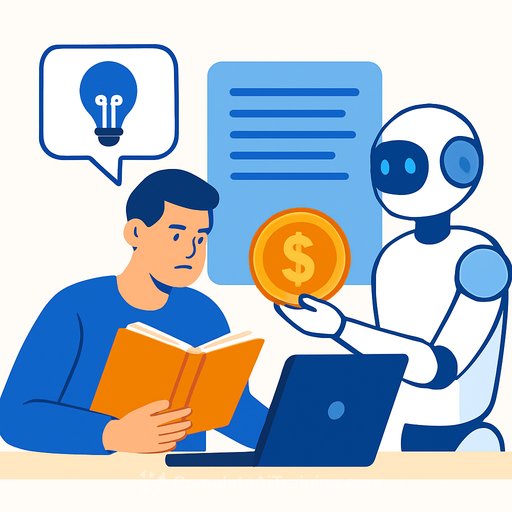
One prominent tech author argues that writers will pay to have their books included in AI training so their ideas appear in answers people actually read. It sounds backwards until you consider the search analogy: if you weren't indexed, you were invisible. The same dynamic could emerge with LLMs.
This isn't about bowing to machines. It's about placing your work where readers now spend time. If AIs are a dominant interface, then access to those systems is distribution.
LLMs as cultural tech, not "digital brains"
Psychologist Alison Gopnik has described these systems as a new kind of cultural technology-tools that help people use what other people have created. Think printing, libraries, and the web. When you see them that way, the question changes from "fight vs embrace" to "how do I participate on my terms?"
What this means for working writers
- Decide your stance: opt out where possible, license selectively, or pursue broad inclusion. There's no single right answer-only trade-offs between control, reach, and revenue.
- Get your rights in order: audit contracts, add explicit AI training and retrieval clauses, negotiate revenue shares, and keep audit rights.
- Create an AI-ready package: clean digital files, summaries, glossaries, FAQs, key excerpts, and high-quality metadata (topics, tags, ISBNs, URLs). That's what models and retrieval systems ingest best.
- Offer clear licenses: permissive for discovery, paid for training, premium for derivative uses (summaries, lesson plans, narrations). Make it easy to do the right thing.
- Monitor presence: ask major chatbots questions your readers ask. Note where your work is missing or misrepresented. Adjust metadata and public excerpts accordingly.
- Use retrieval to your advantage: publish canonical answers on your site. Short, structured, and quotable content is more likely to be cited and surfaced.
- Join collectives: author societies and licensing groups can negotiate better terms than any solo writer.
- Protect and promote: remove pirate PDFs, set up alerts for unauthorized copies, and publish sample chapters you control to guide what gets referenced.
Should you pay for inclusion?
Maybe-if three conditions are met. First, you get attribution or discoverability back to your books. Second, there's transparent reporting so you can see usage. Third, there's a real commercial upside (sales lift, licensing fees, or subscription access).
If those are in place, paying a reputable aggregator or platform to prioritize your catalog could be smart marketing. If they're not, hold your ground and license on your terms.
Ethics and money
Consent, credit, and compensation matter. The writers who win will treat AI like any major distributor: insist on clear terms, track performance, and renegotiate as the market matures. It's the same logic authors used with bookstores, Amazon, and streaming-applied to models.
A 12-month playbook
- Month 1-2: Inventory your catalog, rights, and existing digital copies. Draft your preferred AI license (discovery, training, derivative tiers).
- Month 3-4: Build your AI-ready package (clean EPUB/PDF, summaries, Q&A, glossary, topics). Publish canonical pages on your site.
- Month 5-6: Run an "AI visibility check" across major chatbots. Document gaps and inaccuracies.
- Month 7-8: Join or form a licensing collective. Start outreach to platforms that accept opt-in catalogs with reporting.
- Month 9-10: Pilot a retrieval assistant for your readers using your own content. Measure newsletter signups and book sales lift.
- Month 11-12: Decide: stay opted out, license selectively, or fund inclusion. Tie the choice to measurable outcomes (sales, leads, speaking, courses).
Legal context to watch
Expect more court decisions to set boundaries for consent and removal, similar in spirit to the "right to be forgotten" dynamic that once reshaped search visibility. The core lesson still applies: if the interface doesn't surface you, most readers won't find you.
For background on the original search case, see the European "Right to be forgotten" overview here.
If you want hands-on training
Practical courses for writers exploring AI tools and licensing exist. A good starting point is this curated list by job role: AI courses by job.
The bottom line
AI systems are becoming readers with influence. You can fight inclusion, license it, or fund it-but you can't ignore it. Treat models like a new distribution channel and make a clear, numbers-driven choice that serves your work and your audience.
Your membership also unlocks: