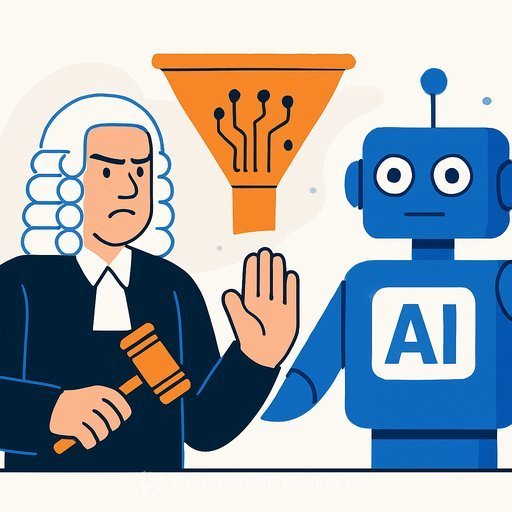
Perplexity's "no volition" defense: smart shield or long shot?
Two newspaper lawsuits accuse Perplexity AI of pulling from paywalled journalism and returning it to paying users, sometimes nearly verbatim. Instead of leaning first on fair use, Perplexity leads with a threshold defense: it claims the company did not "make" the copies at issue and therefore engaged in no volitional conduct required for direct infringement. The core citation is the 2nd Circuit's decision in Cartoon Network v. CSC Holdings (2008), which pinned direct infringement on the party who initiated the copying-there, the DVR user.
What "no volition" actually argues
Direct infringement requires a volitional act of copying. In Cablevision, that act was the subscriber pressing "record" to create a user-specific copy. Perplexity argues its system passively responds to user prompts; the user triggers any copying, not the company. Courts have not yet tested that theory against a generative answer engine that synthesizes and outputs text.
Why this is a tough sell at the pleading stage
At the motion to dismiss stage, causation and control questions usually survive. Unlike a DVR making user-specific recordings of identified works, Perplexity's pipeline allegedly crawls restricted articles, indexes and stores text, instantiates data during retrieval, and sometimes outputs protected expression. Those are design decisions, not one-off user clicks.
That matters because post-Cablevision cases often look past "who pressed the button" to "who built the machine that predictably does the copying." A public statement from plaintiffs' counsel Steven Lieberman emphasized alleged paywall circumvention and real-time delivery-features that highlight upstream design choices, not just user prompts. That framing weakens the analogy to Cablevision.
Direct vs. secondary liability: why the split matters
Direct infringement is strict liability: if the defendant made the copy, intent is irrelevant. For an answer engine producing countless outputs, that's heavy exposure-each work can carry statutory damages. Secondary liability (contributory and vicarious) adds knowledge, control, and benefit requirements-harder to knock out early and more fact intensive. Trimming direct claims would still narrow the case meaningfully, even if it doesn't end it.
The fair use fight may decide the case
Fair use assumes copying and asks whether it's excused. Here, market substitution is front and center. If an answer engine serves detailed summaries or near-verbatim text from paywalled articles in response to requests for the same information, factor four-market harm-becomes concrete. That kind of dispute rarely gets resolved on a motion to dismiss, and the facts will drive it. See 17 U.S.C. § 107.
What courts will likely examine
- System design as volition: Did the provider build a pipeline that crawls restricted content, retains it, and can reproduce protected expression in outputs?
- Control at query time: Guardrails, filters, paraphrasing, deduplication, and citation behavior that could reduce verbatim reproduction.
- Knowledge and benefit: Internal awareness of paywalled sourcing, logs showing behavior, and whether the product monetizes outputs that substitute for the original works.
- How to define the "copy": Crawling, indexing, RAM instantiation, or the user-facing output-where does proximate causation land in a generative workflow?
- Substitution evidence: Traffic diversion, reduced conversions, and user intent (e.g., prompts requesting specific articles or paywalled content).
Plausible outcomes to plan for
- Partial win for Perplexity: Court pares back direct claims or forces more specific pleading on volitional acts; case continues on secondary theories.
- Motion denied: Discovery into paywall access, data retention, retrieval design, and output controls-followed by summary judgment battles on volition and fair use.
- Settlement pressure: Driven by substitution risk under factor four and the scale of potential damages if direct liability survives.
Practical steps for counsel now
- For publishers: Preserve technical logs (paywall hits, bot traffic, unusual referral patterns), document subscription impact, and map articles to alleged outputs with timestamps.
- For AI providers: Inventory crawler behavior and robots/billing interactions, retention policies, prompt/output filters, and escalation paths when paywalled content appears.
- For both sides: Frame proximate cause clearly-what is the actionable "copy," why that step, and whose design or conduct made it predictable.
- Build the fair use record early: Substitution metrics, user intent, and any market harm (or lack thereof) tied to specific prompts and outputs.
The precedent at stake
If courts find that upstream system design can satisfy volitional conduct, automation won't shield generative systems from direct liability. If user prompts break the causal chain, plaintiffs will lean harder on contributory and vicarious theories that hinge on knowledge, control, and financial benefit. Either path will set expectations for AI products that ingest and reproduce text at scale.
Filed cases: Chicago Tribune Co. LLC v. Perplexity AI Inc. (1:25-cv-10094) and The New York Times Co. v. Perplexity AI Inc. (1:25-cv-10106), S.D.N.Y.
For ongoing context on how legal teams are adapting to AI, see AI for Legal.
Your membership also unlocks: