
AI news ·
Pharmaceutical laboratories struggle to scale artificial intelligence pilots due to poor data quality and workflow integration
Pharma AI pilots fail from poor data integration, not weak models. Lab managers must answer six governance questions before deploying research tools.
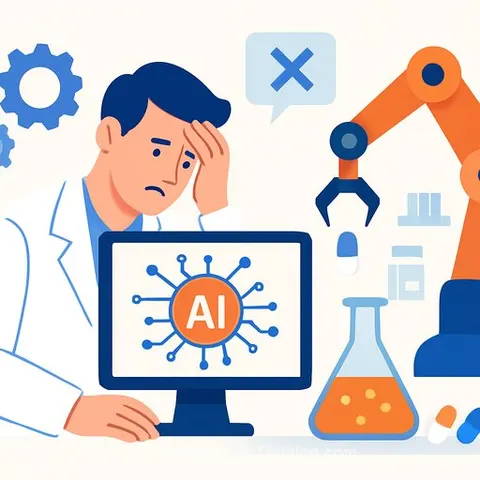
Many pharmaceutical laboratories run AI pilots, but few of those experiments make it into daily R&D workflows. Andreas Matern, an expert in lab AI adoption, explains the integration and data hurdles that stall progress, where agentic systems can deliver practical value today, and how lab managers can ready their organizations for more advanced tools.
"In the lab, AI pilots often fail because, despite looking impressive, they don't integrate with existing lab systems," Matern said. "The blocker to integration is rarely the chosen AI model. Instead, poor-quality data and an incompatibility with workflows stop AI projects from delivering real value and achieving scale." Lab-specific information from electronic lab notebooks, LIMS, assays, literature, and inventory systems sits in disconnected silos with inconsistent schemas and vocabularies. Production systems cannot reliably access the historical data they need without constant manual work.
What agentic AI actually means for R&D
Agentic AI describes systems that can plan and execute multi-step tasks within defined goals, data permissions, and guardrails. Today, agents handle single steps-searching prior ELN entries, checking literature, comparing compounds, or flagging safety data. Reliable orchestration that chains those steps together is still emerging. Matern gave an example: pulling LIMS data, cross-checking it against published research, and drafting a protocol for review while keeping sources traceable at each stage. He cautioned that "most pharma labs are still at an early stage, so lab managers must avoid promising unsupervised, fully machine-led decision-making. Drug discovery will always require a human in the loop and clear audit trails, no matter how advanced agents become."
Workflows that benefit most from early AI
Repetitive, evidence-heavy tasks are the strongest candidates. ELN searches, protocol comparisons, and flagging protocol deviations produce outputs that humans can check easily. Agents also accelerate work when scientists face large datasets-compound lookups, assay data extraction, or toxicity data reviews. These discrete, well-defined assignments keep outputs verifiable and risk low. Repetitive, evidence-heavy tasks are ideal early candidates, a topic covered in AI for Science & Research training.
Common missteps in AI readiness
"A common stumbling block, more than a mistake, is moving to AI before the data layer is ready," Matern said. The issue is not a shortage of data but the absence of infrastructure that makes data interpretable to AI models. Labs need to standardize inconsistent terminology, reconcile compound identifiers and assay metadata, apply controlled vocabularies, and build ontologies and knowledge graphs tied to specific workflows. Beyond the data layer, teams often underestimate change management, fail to define validation metrics and checkpoints early, and treat governance as a late-stage compliance step rather than a design requirement.
Six governance questions lab leaders must ask
Matern's team has identified six questions that should be answered before any AI tool interacts with research data:
- What data can the tool access, what stays off limits, and how are proprietary research, patient data, and IP protected?
- Can every output be traced back to its source, with provenance preserved across ELNs, literature, and internal datasets?
- Who reviews AI-generated recommendations before action is taken?
- What are the guardrails for tool use, lab automation, or workflow changes?
- How will bias, drift, errors, and outdated scientific knowledge be monitored?
- Can the tool meet security, quality, and compliance requirements?
These questions form the foundation for safe, compliant adoption. Additional governance needs will vary by lab, data maturity, and research focus.
Lessons from teams that moved beyond experimentation
"AI success in the lab stems from identifying a single problem or workflow and finding a purpose-built research-grade AI tool that can transform it," Matern said. A problem-led approach involves domain experts from the start because they are invested in solving their own role-specific challenges. It also embeds AI into existing processes instead of adding complexity. Measurable outcomes-fewer errors, time saved, outputs that pass validation-give teams an objective baseline to compare manual and AI-led workflows.
Preparing for more advanced systems
Matern recommends lab managers start with an audit of existing AI use, including any unsanctioned tools. That insight reveals workflows where AI can deliver quantifiable value. Next, they must make historical and newly generated data AI-ready by building ontologies, knowledge graphs, and semantically enriched data layers. Many organizations seek external expertise at this stage because the data layer is highly complex. The final step is defining clear guardrails: training scientists on where AI can and cannot be used, and setting firm boundaries for human review so that AI never compromises a lab's outputs. Lab managers preparing for more advanced systems should follow a structured approach, as detailed in AI for Management resources.
Why this matters for management
Lab leaders who wait for perfect data or a fully formed AI strategy will keep watching pilots stall. The path to production starts with a single, well-bounded workflow, a ready data layer, and governance built in from day one. Concrete steps taken now-auditing existing tools, standardizing data, and setting human review checkpoints-determine whether AI becomes a reliable part of R&D operations or remains a demo that never ships.