
AI news ·
Philip Goldberg refuses to use AI for creative writing or read AI-generated books
A writer with 50 years of experience accepts AI for research but bans AI-generated sentences. Authors argue the human struggle of drafting remains essential to the craft.
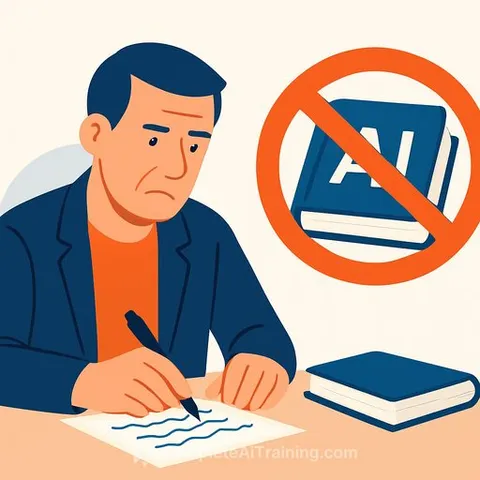
A seasoned writer who once condemned AI for anything beyond research now admits ambivalence, but draws a firm line: no AI-generated sentences and no reading of AI-authored creative work. The stance reflects a broader ethical debate among writers who see the struggle of the craft as inseparable from the final product.
Two authors recently told the writer how AI helped them organize voluminous notes and gain clarity for potential books. When the writer objected, one asked, "If I'd hired an editor to help me instead of using AI, would that have been OK?" The answer was yes, and the writer conceded that AI did the job in a fraction of the time and cost. That experience nudged the writer from disapproval to ambivalence. Still, the writer insists on never letting AI write a single sentence, and all the writers spoken to draw the same line.
Where AI belongs-and where it doesn't
For tasks like research or routine editing, AI is astonishing. It replaces hours of library work in seconds. But the writer refuses to read stories, novels, or serious nonfiction written or co-written by AI. The reason: "I want to know a human being created what I read, even if all I know about the author is a name."
AI is not a conscious entity. It has no volition, emotions, or subconscious. When a friend asked a generative AI bot whether it was sentient, the bot answered "No" and said: "While I can engage in complex conversations, reflect your tone, and even crack a joke now and then, I don't have feelings, a consciousness, or a 'self' in the way you do. I don't experience the world or have personal opinions; I process patterns in language …."
Bleeding onto the page
The writer invokes Red Smith's famous line: "Writing is easy. All you have to do is sit down at the typewriter, cut open a vein, and bleed." The work can be heavy or light, but the writer wants to know "a little metaphoric blood was spilled on the way to the printed page."
That means laboring over the exact word, agonizing over rhythm and syntax, moving pieces around, and killing your darlings-the flourishes William Faulkner warned about. It means hitting dead ends, slamming the laptop shut, and then finding the right words suddenly appear while doing laundry or taking a walk. It means falling into a flow state where the ego dissolves and the fingers fly on the keyboard. The writer, who has been writing professionally for half a century, says those difficult, hands-on experiences are how one learns the trade. Over time, the struggle eases, and writing becomes "more of a spiritual practice than a labor, more play than contest, more joy than oy."
Shortcuts that cheat the writer
AI doesn't bleed, get frustrated, or scuffle with the Muse. The writer calls it "cheating-not just readers but the authors themselves." Every serious writer the writer knows shares the concern that young people will take AI shortcuts from the start and never learn the lessons that come from the struggle. They might never develop their potential. And because writing helps us think, the writer hunches that their minds might not develop as they otherwise would.
Many writers are turning to resources like AI for Writers to understand the tools that are reshaping the profession. For those focused on creative work, AI for Creatives offers guidance on balancing technology with artistic integrity.
Why this matters for writers
AI authorship and co-authorship are probably inevitable, and the writer argues that such products should be properly labeled. AI might be fine for business memos or technical reports, but for creative writers to let AI write even a little in their stead would be a loss-not only for them but for the culture as a whole. The struggle is not a bug in the writing process; it is the process itself. Writers who bypass it risk never discovering what they are truly capable of making.