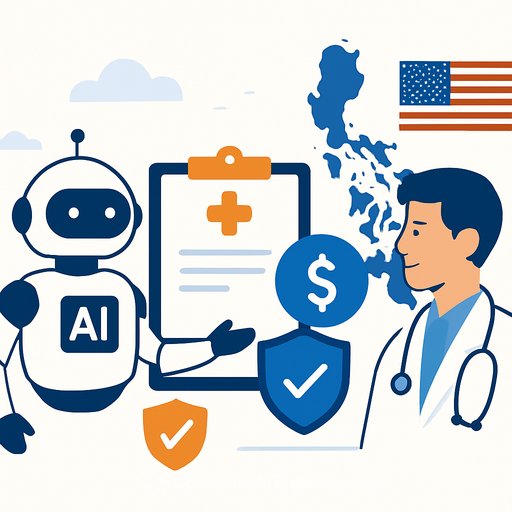
Medical Billing and Coding Outsourcing to the Philippines: AI-Driven Results and 50-60% Cost Savings
Revenue cycle inefficiencies cost the industry an estimated $262 billion each year. For many US insurers and healthcare providers, the fix is clear: shift medical billing, coding, and claims operations to HITRUST-certified teams in the Philippines that pair certified experts with AI automation.
The outcome is consistent and measurable-50-60% cost savings, 99.6% coding accuracy with AI assistance, faster reimbursements, and fewer denials. With 75% of carriers and health systems planning to expand AI-led automation by 2026, waiting 18-24 months to build the same capability in-house is a strategic risk.
The Operational Crisis You Can't Ignore
Insurers face persistent backlogs, rising fraud exposure, and manual workflows that won't scale-especially during catastrophic events. Healthcare providers face double-digit denial rates, coder shortages, and constantly shifting payer rules.
The global insurance BPO market hit $7.8 billion in 2025 and should pass $9.2 billion by 2027. Philippine providers are taking share because they combine certified talent, proven playbooks, and AI-enabled platforms that deliver speed and accuracy for both payers and providers.
Why the Philippines Leads
More than 65,000 certified specialists in the Philippines serve US insurers, TPAs, hospitals, and health systems. The broader IT-BPM sector employs 1.9 million professionals and generated $40 billion in export revenue in 2025, with dedicated delivery centers for insurance and healthcare operations.
Teams bring insurance and clinical backgrounds to the same table-CPC, CCS, RHIA, CIC, CPCU, AIC, and CFE-plus deep familiarity with ICD-10, CPT, and HCPCS; learn more about Coding and payer-specific rules.
Certified Expertise That Moves the Needle
- Insurance: CIC, AIC, CPCU, CFE credentials, plus specialization in medical, pharmacy, dental, workers' comp, and P&C.
- Healthcare: CPC, CCS, RHIA, CRCS credentials; many with nursing or allied health backgrounds.
- Training: Ongoing education for ICD-10/CPT updates, state regs, and payer policy changes.
- Savings snapshot: Typical role-by-role savings land between 56-62% vs US in-house costs.
"The dual expertise available in Philippine operations surprises insurance and healthcare executives," says John Maczynski, CEO of PITON-Global. "Claims processors in the Philippines understand both insurance carrier requirements and healthcare provider documentation-improving accuracy for both sides of the transaction."
AI Platforms + Human Judgment
Providers in the Philippines run hybrid models: AI for speed and pattern recognition, humans for policy interpretation and clinical nuance. That balance cuts cycle times and errors while elevating quality.
- Automated claims processing: NLP analyzes claims, records, and policy text; routine work is straight-through with 99.6% accuracy and 55% faster handling.
- AI-assisted coding: Code suggestions for ICD-10/CPT/HCPCS; certified coders validate and finalize to reduce retrospective denials.
- Fraud analytics: ML flags upcoding, unbundling, duplicates, and phantom providers-reducing losses by 35-45% vs rule-only systems.
- Denial prediction: 92% accuracy predicting denials; teams fix issues pre-submission.
- RPA: Eligibility checks, payment posting, and data entry with up to 80% time savings.
"AI hasn't removed the need for skilled professionals-it's made them more productive," notes Ralf Ellspermann, CSO of PITON-Global. "With AI assistance, Filipino claims processors handle 3-4x the volume while maintaining or improving accuracy."
Case Study: Mid-Size US Health Plan
A regional carrier serving 2.3 million members faced 18-day processing times for complex claims, low fraud hit rates, and 38% annual examiner turnover. They partnered with a Philippine provider in Q1 2024.
- Setup: 25 certified processors covering medical, pharmacy, dental; AI adjudication; ML fraud detection; coding-led appeals; real-time dashboards.
- 10-month results: Processing time cut from 18 to 6 days; fraud detection rose from 12% to 41% of suspicious claims; accuracy to 99.2%.
- Cost impact: Admin cost per claim dropped from $8.50 to $3.20 (62% reduction); annual savings of $3.4M; attrition fell to 4%; member satisfaction climbed from 3.6 to 4.4/5.
They hit full ROI in eight months and gained pricing flexibility that wasn't possible before.
What Gets Done: End-to-End Service Coverage
Insurance claims processing:
- Claims intake and data entry
- Medical, dental, and specialty adjudication
- Fraud, waste, and abuse analytics
- Appeals and grievances
- Provider credentialing and contract-aligned reconciliation
Healthcare revenue cycle management:
- ICD-10/CPT/HCPCS coding by certified specialists
- Clearinghouse-ready submissions to commercial, Medicare, Medicaid, and WC
- Denial analysis and appeals with 68-75% overturn rates
- AR follow-up and payer outreach
- Payment posting and variance reconciliation
Performance Benchmarks That Matter
- Claims adjudication accuracy: 99.2% vs 94-96% industry average
- Fraud detection: 38-45% suspicious pattern hit rate vs 15-22%
- Medical coding accuracy: 99.6% with AI vs 95-97% manual
- Appeals overturns: 68-75% vs 55-65%
- Provider credentialing accuracy: 99.8% vs 96-98%
- AR collection efficiency: 92-96% vs 85-90%
Operating Advantages You Can Bank On
- 24/7 throughput: Time zone alignment clears queues overnight and meets SLAs.
- Surge capacity: Scale 200-300% within 72 hours during catastrophic events.
- Specialized pods: By line of business and clinical specialty to reduce errors and speed complex case handling.
Cost example (annual, equivalent output): US in-house at $2.595M vs Philippines at $1.062M-a 59% reduction across claims, coding, fraud analytics, denial management, and shared tech.
Security: HITRUST CSF as the Baseline
Security is non-negotiable. Leading Philippine providers carry HITRUST CSF certification in addition to HIPAA, SOC 2 Type II, and ISO 27001. This raises the bar above HIPAA alone by aligning with PCI-DSS, NIST, and state requirements.
- Third-party assessments, 156 control objectives, continuous monitoring
- Zero Trust architectures, AES-256 encryption, dedicated SOC, DR sites
- BAAs, incident response, breach notification, and annual audits
Learn more about HITRUST CSF here: HITRUST Alliance.
"HITRUST certification separates serious providers from the rest," says Maczynski. "Many offshore teams now exceed the security maturity of domestic operations that haven't invested at the same level."
AI in Practice: Where Value Shows Up Fast
- Generative AI for adjudication: Extracts facts from claims and clinical notes, proposes determinations, flags edge cases; humans finalize.
- Automated prior auth: Cuts turnaround from 5-10 days to 24-48 hours with policy-aligned decisions and documented rationale.
- Predictive analytics: 92% denial prediction for providers; fraud prediction and subrogation opportunity spotting for carriers.
Implementation Roadmap (Low-Risk, High-Return)
- Phase 1: Assess and Select (30-60 days) - Define scope, certifications, tech, and KPI targets; shortlist partners with proven payer/provider portfolios.
- Phase 2: Pilot (60-90 days) - Start with one claim type or function (e.g., denial management) at controlled volumes; validate metrics.
- Phase 3: Scale (4-6 months) - Expand to additional lines of business; tune AI models with your data; lock in QA and governance.
- Phase 4: Optimize (ongoing) - Quarterly reviews, analytics upgrades, and fraud strategy refreshes.
"Treat Philippine teams as part of your operation, not a vendor," Ellspermann advises. "Include them in policy changes and share trend data. The performance lift compounds."
Expert FAQ
How do teams stay current on regs and coding updates?
"Mandatory continuing education," says Maczynski. "Annual ICD-10/CPT updates, state regs, and payer policy changes-often through partnerships with AAPC and AHIMA."
What if there's a data incident?
"HITRUST-certified providers maintain incident response plans, breach notification per BAA, and cyber liability coverage," notes Ellspermann. "Their certification programs demand it."
Can offshore teams handle complex claims and specialties?
"Yes," says Maczynski. "Specialized pods by claim type and clinical area routinely outperform generalist teams on accuracy and throughput."
How fast is ROI?
"Most see impact in 90-120 days; full ROI in 6-9 months," Ellspermann adds. "Savings, revenue lift, and reduced hiring churn stack up quickly."
The Move That Pays for Itself
For carriers and providers squeezed by denials, staffing gaps, fraud, and backlog risk, Philippine partnerships deliver the mix that works: certified talent, AI platforms, and audited security. The numbers are hard to argue with-50-60% lower costs, 55% faster processing, and near-perfect accuracy where it counts.
The longer you wait, the wider the gap with early adopters who already re-based their cost structure and cycle times. If you're building an AI-enabled revenue cycle or claims operation, the Philippines offers a head start you can measure in quarters, not years.
Next Steps
- Review internal KPIs: denial rates, processing time, admin cost per claim, fraud recovery.
- Shortlist HITRUST-certified Philippine providers with payer and provider portfolios.
- Launch a 60-90 day pilot in a high-impact area (e.g., denials or pharmacy claims).
If your team is leveling up AI skills to run these programs well, explore the AI Learning Path for Medical Billers.
Your membership also unlocks: