Philippines climbs seven spots in Government AI Readiness - but infrastructure still lags
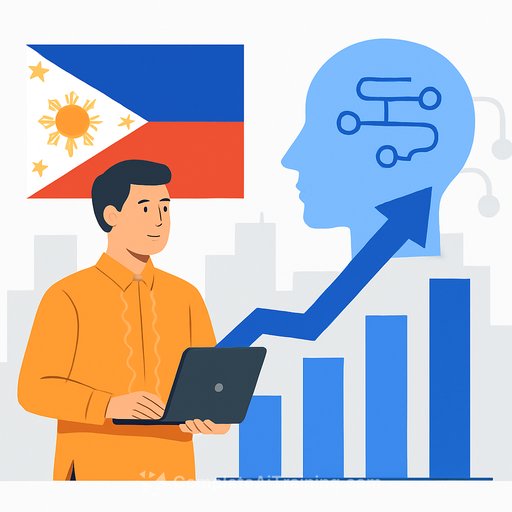
The Philippines moved up seven places in the latest Government AI Readiness Index from Oxford Insights, ranking 49th out of 195 countries with a score of 57.76. That's above both the regional average (49.11) and the global average (41.40), and ninth in Asia-Pacific.
The message is clear: policy is strong, execution has gaps. The country scored well in policy capacity (84.50), governance (70.84), and public sector adoption (69.17). The weak points are AI infrastructure (48.11), development and diffusion (42.46), and resilience (56.62).
Where the Philippines stands: the numbers and peers
The index measures effective and responsible AI integration across 69 indicators and six pillars: policy capacity, governance, AI infrastructure, public sector adoption, development and diffusion, and resilience.
- Top Asia-Pacific performers: China (6th, 75.55), Singapore (7th), South Korea (8th), Japan (14th), Taiwan (26th)
- Regional neighbors ahead: Thailand (32nd), Malaysia (37th), Indonesia (42nd)
- Philippines: 49th, ahead of Vietnam (57th), Brunei (94th), Mongolia (100th), Cambodia (118th), Laos (130th), North Korea (171st), Myanmar (173rd), Timor-Leste (180th)
Local experts point to the same friction most agencies feel day to day: infrastructure and on-the-ground adoption. Policy is outpacing delivery.
Source: Oxford Insights Government AI Readiness Index
Why this matters for government leaders
If AI is meant to improve citizen services, the front line needs better pipes, compute, skills, and guardrails. The Philippines has momentum and a policy foundation; the task now is to translate it into reliable services people actually use.
- Infrastructure first: Expand modern data services, reliable connectivity in rural areas, shared compute (GPU) access for agencies, and energy-efficient data centers.
- Practical adoption: Focus on high-impact use cases in healthcare triage, education support, agriculture advisory, and disaster response. Build for low bandwidth, offline modes, and local languages.
- Procurement and platforms: Create a national AI sandbox, common model/API standards, and a vetted marketplace of tools. Make security, privacy, and auditability non-negotiable.
- Skills at scale: Launch civil service AI foundations (20-30 hours), role-based tracks, and hands-on labs tied to actual agency workflows.
- Governance and trust: Fast-track an AI code of conduct, algorithmic impact assessments, dataset transparency, and incident reporting. Protect citizens' data while enabling innovation.
- Partnerships that ship: Co-build with startups, universities, and civil society. Use challenge funds and outcome-based contracts to deliver pilots in months, not years.
Quick wins in the next 90 days
- Appoint an AI lead in every major agency with a clear mandate and budget access.
- Publish a one-page AI procurement checklist and a standard data-sharing agreement.
- Stand up three cross-agency pilots (health, agriculture, disaster response) with monthly public progress updates.
- Inventory compute, data assets, and skills across agencies; close the most critical gaps first.
- Kick off a civil service AI literacy program with simple guardrails and practical use cases.
12-month priorities
- Stand up a national secure model-hosting platform with logging, red-teaming, and content safety.
- Expand rural connectivity and community data hubs to reach schools, clinics, and LGUs.
- Publish and enforce an AI code of conduct for public sector systems.
- Fund multilingual datasets and voice interfaces that reflect Filipino contexts.
- Scale successful pilots into core services; measure citizen adoption and service quality, not just deployments.
Funding, jobs, and education
The planned P2.6 billion public investment through 2028 is a start; tie releases to concrete outcomes: uptime, response times, citizen satisfaction, and savings. Build shared infrastructure once, use many times across agencies.
Work with labor groups to protect workers while improving service delivery. Use AI to augment teams and redeploy talent to higher-value tasks, with clear training and transition paths.
Update STEM programs to include data, model basics, and responsible AI. Pair degrees with micro-credentials that map to real government roles and systems.
Design for the Filipino context
AI won't land if it ignores connectivity gaps or language. Prioritize tools that work in low-bandwidth settings, support local languages, and solve daily problems for MSMEs and far-flung communities. That's how pilots turn into habit.
The ASEAN moment
With the Philippines set to chair ASEAN next year, it can help define practical, people-first AI cooperation-interoperable standards, shared safety baselines, and joint capacity-building across the bloc.
Context: Association of Southeast Asian Nations (ASEAN)
Where to build capability fast
For structured upskilling tied to job functions, explore curated AI learning paths: AI Learning Path for CIOs, AI Learning Path for Technology Managers, and AI Learning Path for Procurement Specialists. Use them to bootstrap internal academies and role-based training inside agencies.
Bottom line
Policy is ahead of practice. Close the infrastructure, adoption, and skills gaps, and the Philippines can turn a higher ranking into services people feel-at the clinic, the farm, the classroom, and during the next typhoon.
Your membership also unlocks: