
AI news ·
Physics-informed neural network predicts drug release curves from minimal data and reduces lab time
Brown University researchers built an AI that predicts a 48-hour drug release curve from 120 minutes of data. The model cuts average prediction errors by 40 percent.
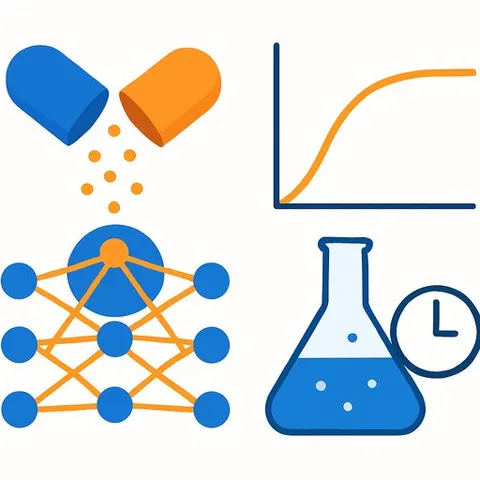
Researchers at Brown University have shown that an AI model can predict the full release curve of a controlled-release drug from just a fraction of the usual data. For a flat film, the model needed only about 120 minutes of readings to forecast the remaining 48-hour release with up to 40 percent less average error than standard math models, trimming close to a full day of lab time.
The model, described in the Journal of Drug Delivery Science and Technology, fuses a neural network with the physical law of diffusion. This Physics-Informed Neural Network (PINN) trains on a small set of early measurements and remains anchored to real-world physics, so it can call the drug's later behavior accurately even when data is sparse. The work is part of a broader push to apply AI for Science & Research, where hybrid models that encode physical laws are gaining traction.
How AI Predicts Drug Release From Less Data
Standard drug release models have anchored the field for decades, using math formulas to describe how a drug diffuses out of a carrier material. But those formulas assume perfectly smooth, uniform conditions. Actual delivery systems, like thin films, can be flat, wrinkled, or crumpled, and the geometry changes how the drug moves. Once the shape gets complicated, the old formulas start to slip.
PINNs get around this by training a neural network with the law of diffusion baked in. Every guess the model makes gets checked against that rule, which keeps it tethered to reality even when it has very little data to go on.
Three Film Shapes, One Model
The team borrowed data from an earlier published study that tracked a test compound seeping out of three ultrathin graphene oxide films: flat, wrinkled in one direction, and crumpled in two. Each shape releases the compound on its own schedule. The dataset held 15 measured time points per film. Researchers trained the AI on shrinking slices of it, from 14 points down to just 2, to find out how little data it needed to still forecast the rest of the release curve accurately.
For the flat film, the PINN reached solid accuracy with 9 data points, about 120 minutes of release readings. Older math models needed 12 to 13 points, or 1 to 1.5 days of lab time, to match it. For the wrinkled and crumpled films, the PINN hit the same mark at 11 points, roughly 12 hours in, while the classic models again wanted 12 to 13. Depending on the film, that adds up to 12 to 36 hours of testing saved.
Researchers also ran the process in reverse, using the AI to estimate how easily molecules travel through each film. That backward step relied on a simplified one-dimensional model, so its numbers are best read as rough, model-based estimates rather than an exact map of molecular movement.
Handling Messy Lab Data
Real lab readings are never spotless. Temperature drift, instrument limits, and plain human handling all nudge the numbers around. To mimic that, researchers deliberately spiked their data with simulated noise and watched how each model coped.
Standard PINNs wobbled a bit under noise, with wider swings in their predictions. So the team built a sturdier version, a Bayesian PINN, using a technique called Monte Carlo Dropout that produces a range of answers along with a confidence estimate for each one. Under noisy conditions it logged lower error and tighter, steadier confidence bands than an ensemble of 50 ordinary PINNs. The tradeoff, which the authors flag plainly, is that the Bayesian version costs more computing power because of the extra sampling it runs.
Why this matters for Science and Research
Drug development is slow and pricey, and early testing of delivery systems is one of the choke points along the way. Anything that shortens the lab clock without giving up accuracy earns a look. Forecasting the rest of a drug's release curve from only its first few readings is a real shortcut, not a rounding error. The authors say their framework may carry over to delivery systems beyond the three films tested here, though they stop short of claiming it has been proven there yet. Should the method hold up under wider testing, it could speed the trip from a promising compound to the patients waiting on it.