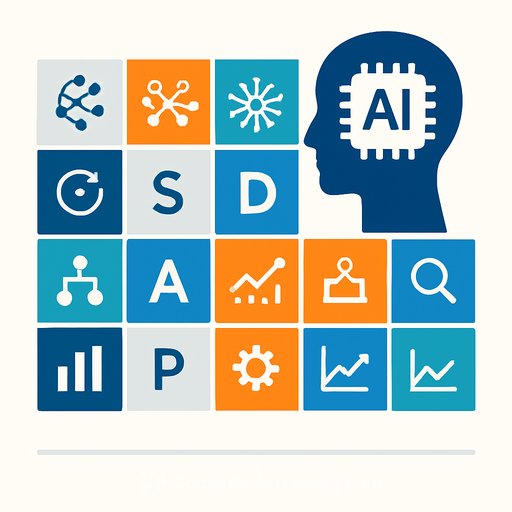
A physics-inspired "periodic table" for AI: a practical guide for researchers
Choosing the right algorithm for multimodal data is still a bottleneck for many research teams. A new framework from physicists at Emory University reframes that choice: decide what information to keep, what to throw away, and let the math do the sorting.
Published in The Journal of Machine Learning Research, their approach organizes AI methods by the information each loss function preserves or discards. Think of it as a structured map for building models that only keep the bits that actually predict your target.
The core idea: compress to what predicts
At the center is the Variational Multivariate Information Bottleneck (VMIB) framework. It formalizes a simple tradeoff: compress inputs from multiple modalities just enough to keep what's predictive, while discarding the rest.
In practice, VMIB acts like a control knob for your loss function. You "dial in" which relationships across text, images, audio, or signals should be retained to solve the task, and which can be safely ignored.
Why this matters for your lab
- Faster model selection: group candidate methods by the information they keep, not brand names or hype.
- Sharper loss design: derive problem-specific losses without reinventing them from scratch.
- Data budgeting: estimate how much training data you actually need for a given retention target.
- Predict failure points: see where mismatched information retention will break the task.
- Lower compute and footprint: by dropping non-predictive features, you train smaller, cleaner systems.
- Better interpretability: understand why a model works by inspecting the information it's optimized to keep.
How to apply the framework (practical workflow)
- Define the target: what precisely must the model predict across your modalities?
- Enumerate signals: list candidate features per modality and hypothesize which are likely predictive.
- Set the "bottleneck": choose retention weights that privilege cross-modal information linked to your target.
- Derive the loss: construct a VMIB-style loss that penalizes irrelevant information while preserving what predicts.
- Estimate data needs: simulate or validate how retention settings change sample complexity.
- Probe failure modes: stress-test with ablations to confirm you are keeping the right shared features.
- Iterate: adjust the knob, retrain, and compare performance vs. compute and data cost.
Evidence so far
The team reports that VMIB rediscovered shared, important features on test datasets without manual feature curation. They also mapped dozens of existing multimodal methods into the framework, showing many can be derived by choosing different information to retain.
A notable side effect: because the framework steers models away from irrelevant features, it can cut training data requirements and reduce computational load. That's good for budgets and for the environment.
What changes for multimodal AI practice
- Stop comparing methods in isolation. Compare what information their loss functions aim to preserve.
- Use VMIB to prototype losses that reflect your scientific question, not generic benchmarks.
- Treat compression-vs-reconstruction as a first-class hyperparameter, not an afterthought.
From physics to biology (and back)
The researchers are now exploring applications in neuroscience and biology, probing how brains compress and combine signals. Aligning machine objectives with biological information flow could reveal common principles-and make our models more grounded.
A quick human moment
After the breakthrough, one researcher's smartwatch tagged hours of whiteboard work as "cycling" because of elevated heart rate. Good science sometimes looks like that-focused, iterative, and oddly cardio.
Where to go next
- Read the publication in The Journal of Machine Learning Research for technical details.
- Explore practical adoption paths in AI for Science & Research resources.
The takeaway: build models by deciding which information matters for prediction, then formalize that choice in the loss. With VMIB, you can do that systematically-and ship models that are more accurate, more efficient, and easier to explain.
Your membership also unlocks: