How Sundar Pichai Is Strengthening Google Around AI
Alphabet's Q4 FY2025 earnings weren't just a beat; they were a blueprint. Sundar Pichai framed the quarter as proof that AI is reinforcing Google's core model. "It was a tremendous quarter for Alphabet," he said. "The launch of Gemini 3 was a major milestone and we have great momentum."
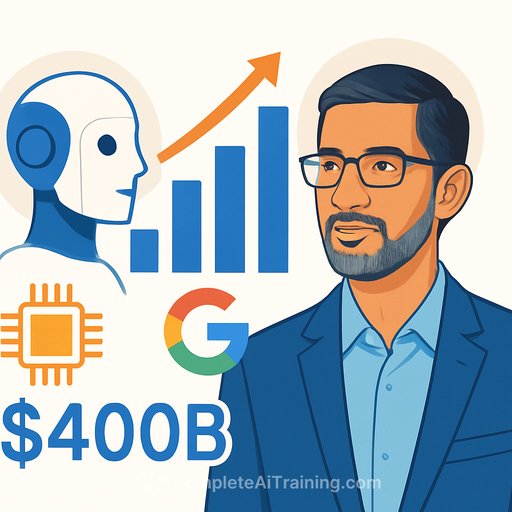
The results back it up: annual revenue crossed US$400bn, search grew 17%, YouTube topped US$60bn, and Cloud accelerated to 48% growth with a run rate above US$70bn. The signal is clear: AI isn't a side project-it's a multiplier across Google's biggest businesses.
A full-stack AI strategy built for scale
Pichai's thesis is simple: own the stack and drive down unit costs. Google is leaning on its infrastructure-NVIDIA GPUs alongside Google's Tensor Processing Units-to deliver performance and efficiency. "Our unrivaled infrastructure serves as the bedrock for our AI stack," he said.
The payoff: Gemini serving unit costs dropped 78% over 2025 through model optimizations, efficiency gains, and better utilization. That's vertical integration doing what it should-improving margins as demand climbs.
Gemini 3: from model to product to daily behavior
Released in November 2025, Gemini 3 has become Google's fastest-adopted model ever. Since launch, Gemini 3 Pro has processed roughly three times as many daily tokens on average as 2.5 Pro. That matters because token volume is a clean proxy for real usage.
On the consumer side, the Gemini app now serves 750 million monthly active users, with higher engagement per user since December. Google isn't treating Gemini as a silo-it's shipping AI features across the portfolio: Personal Intelligence in AI Mode, new AI in Gmail, Chrome reimagined as an "AI-first, agentic browser," and Project Genie for building interactive worlds in real time.
Where the money shows up: search, YouTube, cloud
Search saw "more usage in Q4 than ever before," supported by over 250 launches across AI Mode and AI Overviews. Pichai said these features are proving more helpful and driving greater usage-exactly the outcome you want when defending a high-margin franchise.
Cloud momentum is strong too: new customer velocity doubled versus Q1, and backlog reached US$240bn by year-end. That backlog plus the >US$70bn run rate gives management line-of-sight on future revenue, assuming delivery and unit economics hold.
Capex signals the next phase
To keep pace with demand, Google plans US$175-185bn in 2026 CapEx. The focus: capacity, efficiency, and distribution of AI across products. Pichai's closing note summed it up: "2025 was a fantastic year for the company. We're really well positioned going into 2026."
The executive playbook: how to read Google's move
- Own the stack where it counts. Infrastructure plus model plus product creates compounding advantages-especially when inference costs fall quarter over quarter.
- Make AI a feature, not a detour. Embed it into flagship products to lift engagement, then convert usage into revenue where the model is proven.
- Obsess over unit economics. Track serving costs per request/token and push them down with model and systems engineering.
- Index your bets to revenue engines. Google anchored AI to search, YouTube, and cloud-channels with clear monetization.
- Use backlog as a forecasting tool, not a victory lap. Conversion speed and margin quality matter more than headline totals.
- Design for scale. Efficiency gains should improve as usage rises; if they don't, revisit architecture and capacity mix.
Metrics to watch next
- Gemini cost curve vs. usage growth (tokens, MAUs, and engagement).
- Search engagement lift from AI Overviews and its impact on ads economics.
- Cloud backlog conversion timing and gross margin trajectory.
- Chrome's "AI-first" shift: user behavior changes and dev ecosystem uptake.
For primary source context, see Alphabet Investor Relations updates at abc.xyz/investor. If you're building an AI roadmap and need to upskill teams by function, explore curated options such as the AI Learning Path for Business Unit Managers, the AI Learning Path for VPs of Strategy, or resources tagged AI for Executives & Strategy.
Your membership also unlocks: