
AI news ·
Pope Leo XIV calls for truth-centered approach to AI and journalism in first encyclical
Pope Leo XIV's first encyclical warns that prioritizing influence over accuracy weakens democracy and enables totalitarianism. He calls on communicators and platform owners to treat truth as a public obligation, not a strategic choice.
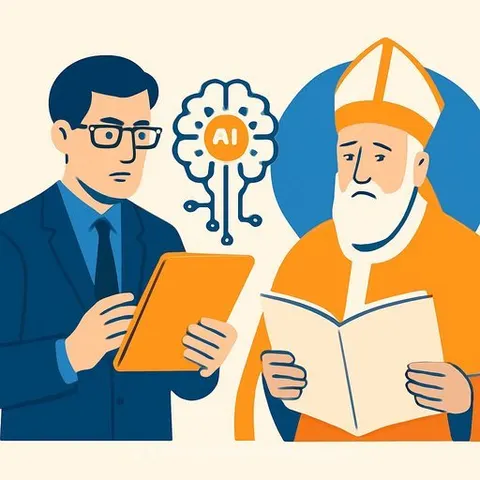
Pope Warns PR Professionals: Truth Is Not Negotiable in Digital Communication
Pope Leo XIV has issued a stark warning to those who shape public communication: indifference to truth erodes democracy itself. In his first encyclical, he directly addresses how digital platforms and AI systems are reshaping what people believe, and he calls out those controlling these systems for their responsibility to prioritize facts over influence.
For PR and communications professionals, the message is unambiguous. The Pope argues that when pragmatism replaces the search for truth-when "what appears useful or effective" matters more than what is accurate-democratic institutions weaken. Totalitarianism follows, he suggests, citing philosopher Hannah Arendt's observation that such regimes thrive when people lose the ability to distinguish fact from fiction.
Communication Shapes Culture, Not Just Information
The Pope makes a critical distinction. Communication is not merely the transmission of information. It creates culture. The narratives and images circulating in digital environments become part of people's lived experience, especially for younger audiences. Those who control platforms wield considerable power over collective imagination.
This power carries obligation. Those managing communication channels must be "constantly guided by the pursuit of truth and respect for human dignity," the Pope writes. The alternative-using digital platforms as instruments of distraction, homogenization, or dominance-corrodes the conditions necessary for free thought and critical judgment.
What Transparency Demands
The Pope proposes concrete steps. Public policy should require transparency in how content is selected and developed, with stronger protections for personal data. Organizations need to strengthen serious journalism and spaces for reasoned debate where verification carries more weight than immediate reaction.
For communicators, the implications are direct. Educational institutions must teach critical use of digital tools and AI. Universities should integrate knowledge and teach fact-verification skills. Families and schools need awareness of how these systems work.
The Church itself, he acknowledges, has failed on this front. Journalists have exposed abuse within the institution-work the Pope explicitly thanks them for. But he places the burden of transparency on the Church itself, not on external scrutiny.
The AI Problem: Speed Over Understanding
The Pope identifies a specific danger in AI systems. The ease and speed with which they generate answers risks extinguishing the desire to ask questions. Deep understanding, he notes, requires time and effort-the kind of sustained engagement that AI can short-circuit.
Teaching people about AI, therefore, means teaching them when not to use it. Young people especially need protection from "the promise of the perfect machine"-the subtle temptation that human thought becomes unnecessary precisely when it matters most.
For communications professionals, this raises a practical question: where does AI enhance communication and where does it replace the thinking that communication requires?
An Ecology of Communication
The Pope's core proposal is an "ecology of communication"-a system designed to protect truth as a common good rather than as property of the powerful. This requires intermediary organizations, serious journalism, and forums where reasoned argument matters.
The responsibility falls on multiple institutions. But for those in PR and communications roles, the message is clear: the tools at your disposal shape how people understand reality. That power demands accountability to truth, not just to clients or campaigns.
Learn more about how AI for PR & Communications is reshaping the field, and explore Generative AI and LLM to understand the systems that now mediate public discourse.