
AI news ·
Pope Leo's first encyclical warns artificial intelligence threatens the human voice
Pope Leo's July 8, 2026 encyclical warns AI's greatest threat is eroding the human voice, not jobs. It urges writers to prioritize personal thought over automated text.
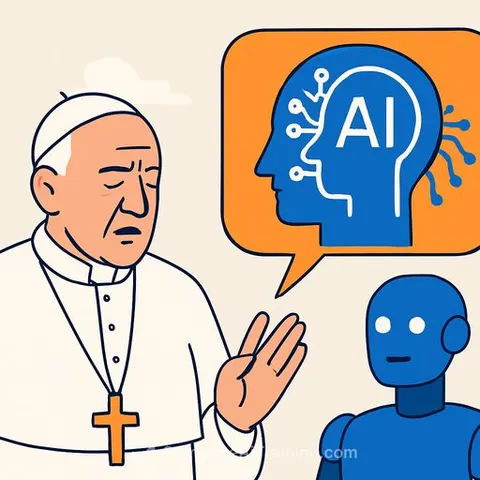
Pope Leo's first encyclical, Magnifica Humanitas, released July 8, 2026, warns that the most significant danger of artificial intelligence is not job displacement but the erosion of the human voice. The document draws on Scripture, J.R.R. Tolkien, Hannah Arendt, Viktor Frankl, Beethoven, Guernica, and Schindler's List to frame AI as a force that can silence uniquely human expression.
The encyclical moves from Church tradition to cultural touchstones, arguing that the human voice-the capacity to write, think, and speak with moral weight-faces a threat unlike any before. When machines can generate text, mimic style, and produce persuasive arguments, the pressure to automate writing may erode the personal voice that carries experience and doubt.
The Human Voice Under Threat
The core warning centers on the displacement of human authorship. AI can now compose essays, stories, and reports to a passable standard, which risks devaluing the act of writing as a uniquely human endeavor. The encyclical suggests that when the labor of writing is outsourced to algorithms, what is lost is not just a skill but a form of thinking that shapes conscience and memory.
This is not a simple argument against technological progress. The document acknowledges the utility of AI but insists that the voice that emerges from reflection, struggle, and moral deliberation cannot be replicated by machine learning. The risk is not that machines will write well, but that humans will stop writing at all, surrendering the practice that gives shape to thought.
Cultural References as a Call to Remember
By invoking Tolkien's myth-making, Arendt's analysis of totalitarianism, and Frankl's search for meaning, the document reminds readers that writing has always been a battleground for meaning. Each of these figures relied on a voice that could not be reduced to data or algorithms. The encyclical uses these examples to argue that the human voice is not merely a tool for communication but a vessel for conscience, memory, and moral judgment.
The questions raised by the encyclical echo topics covered in resources on AI for Writers, where the interplay between technology and authentic expression is examined.
Why this matters for writers
The encyclical is a reminder that the craft of writing is an act of human presence, not just production. For writers, the challenge is not to compete with AI on speed or volume but to double down on what machines cannot do: bear witness, reflect on experience, and speak with a voice that is unmistakably personal. The document calls for a renewed commitment to the human voice as the foundation of a meaningful culture.