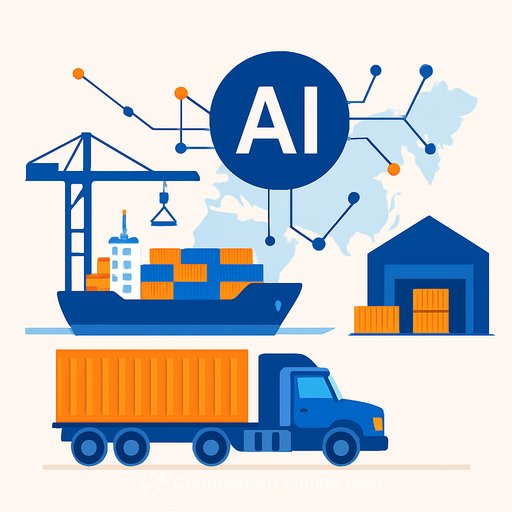
AI-Driven Sustainment for LSCO in the Indo-Pacific
Purpose
The Indo-Pacific is a complex operational theater. Distance, limited infrastructure, and active threats make sustainment the decisive edge in large-scale combat operations (LSCO). As logistics becomes contested across cyber, kinetic, and electronic domains, artificial intelligence (AI) offers a practical path to resilient, adaptive, and sustainable operations. This article breaks down how AI-driven sustainment supports multi-domain operations (MDO) and keeps combat power viable under pressure.
Why Logistics Will Decide the Fight
Shifting focus to LSCO in the Indo-Pacific reflects the reality of China's military modernization and anti-access/area denial (A2/AD) systems. Traditional hub-and-spoke models and predictable flows are easy to disrupt. Logistics can't be an afterthought-it's the center of gravity. AI-based sustainment helps move beyond fragile, centralized models and keeps forces supplied even when standard routes are denied or degraded.
Geography Doesn't Care About Your Timeline
The Indo-Pacific spans over 100 million square kilometers and 65% of the world's oceans. Moving materiel over 6,000 miles from the U.S. West Coast to forward nodes strains timelines and lift. Ports near dense coastal populations are exposed to both physical and digital disruption. In conflict, expect degraded or lost port access-making JLOTS, expeditionary throughput, and redundant routes essential.
Adversary Pressure on the Sustainment Enterprise
China's integrated A2/AD strategy targets logistics end-to-end: long-range precision fires against nodes, cyber attacks on sustainment systems, naval and air interdiction, and electronic warfare on GPS and comms. Logistics becomes a first-order target in LSCO. That reality demands contested logistics planning as a baseline, not a contingency.
Where Logistics Breaks Under Fire
- Cyber: Malware on sustainment databases, data poisoning, and C2 disruption.
- PNT/EM: GPS spoofing and jamming misdirect convoys and slow throughput.
- Kinetic: Precision strikes on ports, airfields, depots, and afloat staging.
- Maritime/Air interdiction: Blockades, submarines, and air superiority risks on key legs.
What AI Actually Delivers in Contested Sustainment
Predictive Demand and Precision Positioning
AI forecasts consumption for fuel, ammo, medical, and critical spares with higher fidelity. Planners can pre-position the right stocks near points of need, cut waste, and compress timelines. During amphibious or distributed operations, models simulate surge usage and recommend optimal staging plans.
Autonomous Delivery at the Edge
Unmanned air and ground systems extend reach in denied environments. Autonomous cargo drones and unmanned ground resupply platforms support last-mile delivery across island chains and dispersed units-reducing risk to people and keeping tempo high when manned convoys can't move.
Adaptive Routing Under Threat
AI fuses threat intel, terrain, and weather to optimize routes in real time. Convoys avoid missile engagement zones and known interdiction patterns. When a route closes, the system recomputes and pushes updates to platforms and crews immediately.
Course of Action Generation and Decision Support
Generative AI tools (e.g., Thunderforge, Stormbreaker) simulate multiple sustainment COAs under contested conditions. They compare throughput, survivability, and risk to recommend the best configuration-reducing planning cycles and improving clarity under uncertainty. Integrated with sensors, satellites, and enterprise systems of record, these tools keep the sustainment picture current.
MDO Integration
AI-driven sustainment supports MDO by accelerating logistics execution, enabling distributed operations, and improving data sharing across joint and coalition forces. The result is convergence: synchronized fires, maneuver, information ops-and logistics that keep pace with all three.
Ports Are Vulnerable-Plan Like They Won't Be There
Maritime access is the lifeblood of Indo-Pacific sustainment, but port capacity is limited and exposed. As stated at the 2025 Land Forces Pacific Symposium, effective sustainment is existential. AI helps by monitoring port conditions, forecasting degradation, and rerouting dynamically. When ports are offline, AI coordinates over-the-shore operations-optimizing beach schedules, vessel movements, and supply priority to sustain tempo.
AI-enabled cyber defense also detects and responds to intrusions on logistics C2, preserving continuity when it matters most.
Operational Integration: From Prototype to Standard Practice
- Embed AI at echelon: Put decision-support tools inside theater sustainment commands and at forward nodes.
- Train for data-driven ops: Upskill logisticians to interpret models, set thresholds, and act on alerts.
- Share with partners: Build joint and allied model-sharing and common data standards to speed interoperability.
For context on contested logistics, including Design considerations in the Indo-Pacific, see this perspective on the logistics triad by the Modern War Institute at West Point: Modern War Institute. For background on A2/AD concepts, CSIS offers a helpful primer: CSIS analysis.
Recommendations for Operations Leaders
- Accelerate adoption of AI in sustainment planning, training, and execution-start with forecasting, routing, and COA tools.
- Invest in autonomous delivery and maintenance platforms that can operate in denied environments.
- Build resilient data architectures: zero-trust, redundant comms, and secure integration with sensors and enterprise systems.
- Run joint exercises in-theater to validate AI-enabled logistics under realistic threat, distance, and weather constraints.
- Expand partnerships with industry and academia to pilot, test, and transition AI capabilities faster.
If you're building the skills pipeline for your teams, explore role-based AI upskilling paths: AI courses by job.
Bottom Line
In the Indo-Pacific, logistics will be contested across every domain. Legacy sustainment models won't hold under sustained cyber pressure, precision fires, and maritime interdiction. AI-driven sustainment-predictive logistics, precision delivery, autonomous systems, and adaptive routing-keeps combat power in the fight.
Prepare now. Integrate AI into planning and execution, harden data and comms, and rehearse under realistic constraints. The side that sustains under contact wins.
Your membership also unlocks: