AI MBA: Preparing Managers for a New Business Order
AI has moved from slide decks to the balance sheet. The winners in 2026 aren't the loudest adopters-their edge is pairing clear judgment with smart deployment.
If you manage people, budgets, or outcomes, your advantage isn't more tools. It's better decisions, tighter execution, and a responsible system your board can trust.
What managers need now
- Decision quality under uncertainty: Use base rates, premortems, and red teams. Make fewer big bets, but make them reversible where possible.
- AI fluency: Know model types (predictive vs. generative), trade-offs (quality, latency, cost), and failure modes (hallucination, drift, bias). You don't need to code, but you must call the shot.
- Product thinking with data: Tie every use case to a user, a workflow, and a number that moves. Kill nice-to-haves faster.
- People leadership: Redesign roles, not résumés. Automate tasks, upskill talent, and set clear expectations for human oversight.
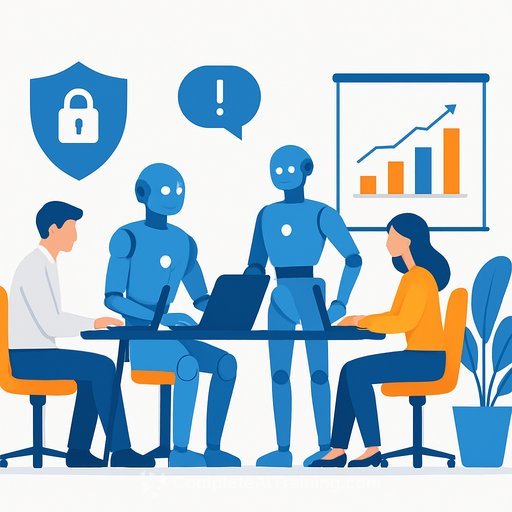
- Governance: Policy, privacy, auditability, and incident response. Assume your biggest risk is quiet and compounding, not loud and immediate.
How the MBA is changing
- Strategy: Moats now include data access, distribution, and speed of iteration. Defensibility beats bravado.
- Operations: Throughput, cycle time, error rates. Treat AI as capacity, not magic.
- Finance: Model inference is a variable cost. Tie savings and uplift to unit economics, not vanity dashboards.
- Marketing: Personalization with guardrails. Consent, brand voice, and message consistency matter more than volume.
- Ethics and risk: Bias, safety, and accountability are board topics now, not research topics.
Your 90-day AI plan (practical and defensible)
- Days 0-30: Assess
- List top workflows by volume, cost, and pain. Baseline metrics: cycle time, AHT, error rate, rework, CSAT/NPS, approval time.
- Shortlist 5-7 candidate use cases. Filter by data availability, policy risk, and expected ROI.
- Days 31-60: Pilot
- Run 2-3 pilots. Define a single owner, a weekly metric review, and a kill switch.
- Compare "AI vs. control" using matched samples. Capture edge cases for retraining or rules.
- Days 61-90: Scale or stop
- Productionize one winner with monitoring, access controls, and human review checkpoints.
- Document policy, failure handling, and audit logs. Stop what doesn't clear the bar.
Metrics that actually matter
- Efficiency: Cycle time, tickets per agent, cost to serve, first-contact resolution
- Quality: Error rate, rework, compliance hits, precision/recall for critical tasks
- Growth: Conversion, average deal size, activation, retention, cross-sell rate
- Unit economics: Margin per order, LTV/CAC, inference cost per transaction
Team topology that works
- Business owner: P&L accountability and decision rights
- Product lead: Outcome definition, backlog, adoption
- Data & platform: Integration, pipelines, monitoring
- Applied AI: Model selection, evaluation, fine-tuning
- AI Design Courses: Design & prompt craft - UX flows, instructions, evaluation rubrics
- Risk & legal: Policy, privacy, third-party assessments
Responsible use that stands up in a board meeting
- Document intended use, known limits, and human review points.
- Follow a risk framework and map controls to it. The NIST AI RMF is a solid baseline.
- Minimize data, anonymize where possible, log everything that matters.
- Set an incident playbook: who is paged, how to roll back, how to notify.
- Vendor diligence: model lineage, data sources, security posture, and terms on IP and training.
Interview prep for managers (what recruiters now ask)
- Which two use cases delivered ROI last year? Exact metrics, baseline, and payback.
- Buy vs. build vs. partner: give one example of each and why you chose it.
- How do you measure model quality beyond accuracy? Talk cost, latency, and user trust.
- Tell me about an AI pilot you killed. What signal told you to stop?
- What are your rules on data, attribution, and human oversight? Be concrete.
- How do you prevent brand or compliance drift at scale?
Three quick scenarios to practice
- Customer support triage: Goal: cut handle time 25% and raise FCR 10%. Guardrails: no free-text PII in prompts, human approval for refunds, automated profanity filter.
- Deal desk assistant: Goal: reduce quote turnaround from 48h to 6h. Guardrails: price floors, exception routing, versioned templates.
- Claims summarization: Goal: 30% faster adjudication with equal or better accuracy. Guardrails: medical privacy, audit log of model suggestions, random sampling for QA.
How to upskill without burning cycles
- Stay current with one trusted report each year. The Stanford AI Index is useful for directional trends.
- If you want structured learning and tool practice for management roles, explore AI courses by job or browse latest AI courses.
Bottom line
AI doesn't replace management. It exposes it.
Your advantage is simple: clear priorities, measurable wins, and a responsible system that scales. Do that, and you'll be the person everyone calls when budgets tighten and expectations rise.
Get Daily AI News
Your membership also unlocks:
700+ AI Courses
700+ Certifications
Personalized AI Learning Plan
6500+ AI Tools (no Ads)
Daily AI News by job industry (no Ads)