Printmaking's quiet defiance in the age of AI
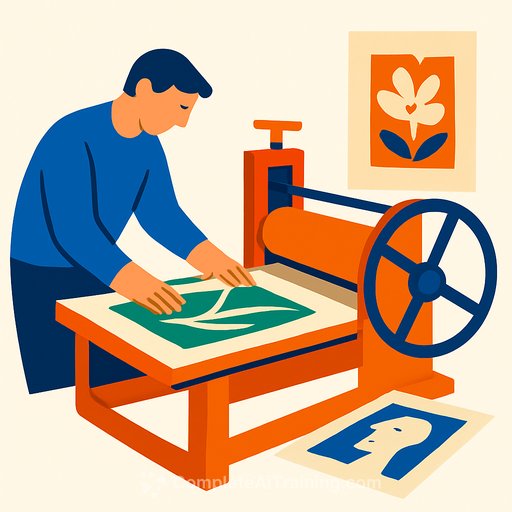
AI may be loud right now, but printmaking is steady, physical, and mobile - qualities that refuse to be replaced. From Mesopotamian cylinder seals to screenprints in protest movements, the medium has always moved with the times. That's why, in 2026, it feels more alive than ever.
On view: Kolkata and New Delhi
The third edition of the Print Biennale is underway in Kolkata at the Lalit Kala Akademi (till February 15), a survey of contemporary printmaking with 204 artists from around the world. The Akademi's new Regional Centre also offers state-of-the-art studios - a practical step that matters as much as the show itself. Lalit Kala Akademi
In New Delhi, Dhoomimal Gallery opens "Print Age - The Art of Printmaking in the Age of AI Reproduction" (February 3), in conjunction with the India Art Fair. Expect 156 original prints from 80 artists spanning eras and approaches - names like Pablo Picasso, Marc Chagall, Anish Kapoor, Jyoti Bhatt, and a strong group of contemporary Indian artists.
Why printmaking is thriving now
Constraints have built the muscle. As curator Krishna Setty notes, limited public awareness, scarce studios, and market hurdles have pushed Indian printmakers to innovate, collaborate, share equipment, and rethink the medium's conceptual and social range.
There's also history and memory. During the Quit India Movement, printmakers such as Chittoprasad, Bimal Roy, Zainul Abedin, and Somnath Hore produced leaflets and posters that moved people to action. That DNA - clear, repeatable messages, crafted at scale - still resonates.
AI isn't the enemy. It's a tool.
Printmakers have always worked with technology: etching, litho, woodcut, photo-transfer, digital processes. As curator and researcher Paula Sengupta points out, artists already mix digital processes with traditional techniques; AI is simply another input when used with intent.
Her exhibition, PURVAI: Printmaking in Eastern India - Pedagogy to Practice (at Emami Art, Kolkata, till March 7), maps this energy across the Northeast, West Bengal, Jharkhand, Odisha, and Chhattisgarh with 44 artists and collectives. The message is clear: versatility wins.
What creatives can take from printmaking
- Use constraints to refine concepts. Limited tools force stronger ideas.
- Combine methods. Analog texture plus digital prep equals richer outcomes.
- Editioning creates accessible price points for young collectors without diluting value.
- Build shared studios and equipment pools to lower cost and increase output.
- Focus on touch. Plates, paper, pressure, ink - human decisions you can feel.
A more democratic art scene
Prints are technically demanding yet financially reachable for new buyers, which keeps the market healthy. As gallery director Uday Jain notes, the process requires human skill at every step - that's tough for AI to mimic convincingly, even more than painting that can be screenshot and copied.
Collectors are paying attention to the material value of limited editions by master printmakers. As AI spreads across creative fields, scarcity with authorship becomes even more meaningful. For guides on positioning and promoting AI-informed exhibitions and market messaging, see AI for PR & Communications.
Studios and schools are the backbone
Support systems are growing. Lalit Kala backs the Biennale; the Delhi College of Art and the Maharaja Sayajirao University of Baroda have serious print departments; and the Sarvajanik School of Fine Arts in Surat runs deep-dive workshops in etching and reduction methods.
Printmaker Ananda Moy Banerji points to a larger network of studios, academic programs, and residencies worldwide. The takeaway: infrastructure plus community equals momentum.
If you want to act on this
- Visit the shows in Kolkata and Delhi; take notes on techniques that fit your practice.
- Prototype a small edition: start with linocut or drypoint, then layer digital color separations.
- Create a shared calendar with peers to book press time, split materials, and co-publish editions.
- Document process openly - plates, proofs, failures - to add credibility and collector trust.
- If you're integrating AI, keep it as a sketch or separation tool; let the plate and paper carry the final voice.
Bonus for AI-curious creatives
If you're building an AI-assisted workflow that still feels handcrafted, explore practice-first resources here: Research.
Closing thought
Printmaking isn't resisting technology - it's absorbing it on its own terms. The press keeps rolling because it gives creatives what they need right now: clarity of process, tangible outcomes, and a market that values the hand behind the work.
Your membership also unlocks: