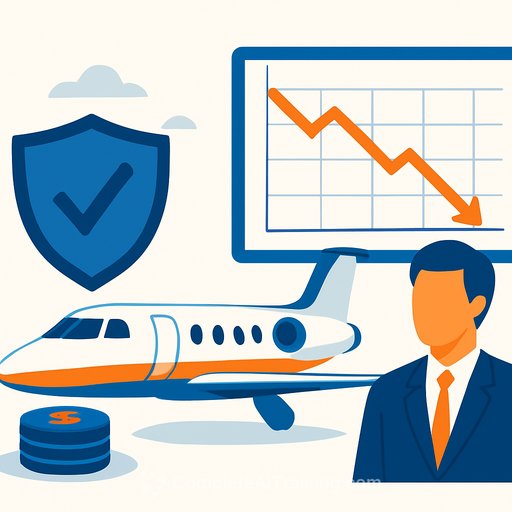
Private Aviation Insurance Faces Claims Headwinds as Market Softens
The private aviation insurance market is shifting back into softer conditions after a prolonged hard market cycle, but rising claims costs threaten to undermine premium relief.
Increased underwriting capacity is driving competition and pushing premiums down through 2026 and 2027, according to Jason Riley, managing partner at Acrisure Aerospace. Yet claims expenses continue to climb, creating a mismatch between what insurers are charging and what they're paying out.
"I don't think the market's very congruent," Riley said. "We have rising expenses in the aviation insurance claims world, but under these competitive pressures, we're still seeing declining premiums."
Cycles Within Cycles
Private aviation has endured dramatic swings for decades. A soft market that stretched from the early 2000s through 2019-2020 reversed sharply during the COVID-19 pandemic, when demand for private aircraft surged. That boom triggered a hard market cycle-marked by rising premiums and stricter underwriting-that lasted until late 2024 or early 2025.
Now the pendulum has swung back again.
Can Data Flatten the Volatility?
Riley sees potential for data analysis and automation to reduce the magnitude of these market swings. New entrants and existing carriers are tapping previously unused data sources and refining risk assessment through automation, which could mean more tailored coverage and fewer abrupt pricing shocks for policyholders.
But Riley cautions against overstating near-term impact. Aviation insurance is driven by unpredictable, high-severity events-the kind that data alone cannot predict.
"You can compile tons and tons of data, but you can't out-data a flock of ducks," Riley said. The industry may be "a couple, three, four years out" from understanding how data-driven approaches will reshape actuarial models.
Where AI Delivers Faster Value
Riley sees more immediate benefit on the brokerage side. Enhanced data tools and automation help brokers match risks with suitable carriers and present client information to underwriters more efficiently.
"I personally think AI is a better brokerage tool than an underwriting tool," he said.
With dozens of active markets in aviation insurance, brokers navigate varying carrier appetites daily. Technology can accelerate this by enabling brokers to "paint the best possible picture for every single client."
Still, aviation insurance remains fundamentally relationship-driven. Riley stressed that the business is "part art and part science." Automation handles the science. The art requires humans.
Advice for the Soft Market Window
Riley urged insureds to take advantage of current price reductions while also strengthening coverage. A return to hard market conditions could arrive quickly.
"Take advantage of price reductions where you can," he said, "but take a fair amount of that and allocate it to buy more limit, buy more coverage."
He also warned against spending accumulated savings too fast. "All those savings that accumulate over the next couple of years could evaporate pretty fast," Riley said.
Your membership also unlocks: