Professor Keke Gai Honored with Global Fred Award for AI Education
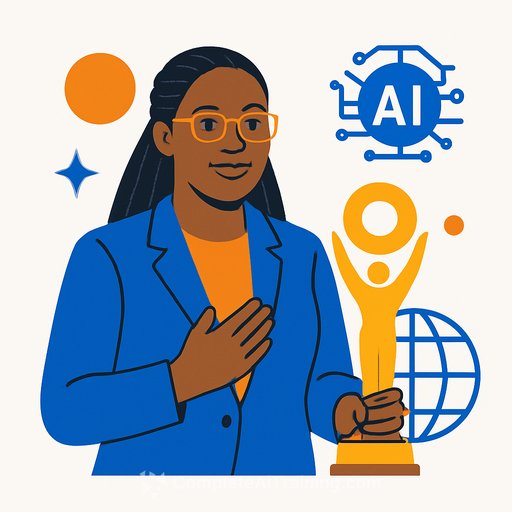
On January 22, 2026, the Global Fred Award Ceremony & International Economic, Trade and Cultural Cooperation Salon opened in Beijing. Among seven honorees, Professor Keke Gai, Vice Dean of the School of AI at Beijing Institute of Technology, received the Global Fred Award for AI Education Outstanding Contributor. The recognition centers on one idea: build talent ecosystems that blend strong technical training with security and ethics.
Why this matters for educators
AI programs need more than algorithms and model deployment. They need a curriculum that teaches students to build systems that are safe, explainable, and aligned with real use cases. Professor Gai's work offers a clear template educators can adapt across institutions and disciplines - see the AI Learning Path for Training & Development Managers for practical guidance on designing scalable, role-based programs.
What set his work apart
Professor Gai holds a PhD from Pace University, has 11 years of overseas Research experience, is selected into the National Young Talent Program, and ranks among the world's top 2% scientists. At Beijing Institute of Technology, he built a distinctive "trinity" AI education system: solid technology + security + ethics. This approach fills a gap in systematic AI security education and sets a new benchmark for talent development.
- Compiled four bilingual textbooks to strengthen cross-cultural AI teaching and learning (Translation).
- Built a kilo-FLOPS computing cluster to support research and hands-on practice.
- Launched a university alliance that connects 120,000 teachers and students, enabling shared resources and co-development.
- Created a "full-chain" talent pipeline, mentoring 40+ postgraduates and 2,300+ interdisciplinary talents; the model was listed as a typical case by the Ministry of Education.
For context on the institution's broader AI efforts, see the Beijing Institute of Technology (English).
Industry linkage and ethics at the core
Professor Gai's outcomes have served 150+ organizations and helped drive over 120 million yuan in industrial growth. The work connects classroom learning with real adoption, closing the loop from teaching to application.
Equally important, he led the compilation of an AI ethics white paper and advanced the development concept of "trustworthy, controllable, interpretable." This aligns with international guidance on responsible AI, such as the OECD AI Principles, and helps educators anchor curricula in practical guardrails.
Takeaways you can apply this semester
- Build a three-part backbone for any AI course: technical skills, security fundamentals, and ethics.
- Use bilingual or dual-audience materials to expand access and collaboration.
- Form or join alliances to share datasets, compute time, and guest lectures across campuses.
- Define a clear talent pipeline-intro skills, applied projects, capstones, and industry mentorship.
- Link assignments to real organizational needs to strengthen relevance and placement.
- Adopt "trustworthy, controllable, interpretable" as course outcomes and assess them explicitly.
- Track impact: number of students placed, partnered organizations, and funded projects tied to coursework.
Event at a glance
The Global Fred Awards celebrate individuals and institutions that move fields forward. This year's ceremony in Beijing highlighted AI education as a strategic lever for talent development, research translation, and responsible deployment. Professor Gai's recognition underscores the value of building programs that connect rigorous instruction, real industry needs, and clear ethical standards.
Resources for course builders
If you're refreshing syllabi or mapping skills by role, explore curated AI programs and certifications:
- AI courses by job role
- Latest AI courses
Expect more collaboration and knowledge-sharing as outcomes from this year's ceremony roll out. For educators, the path is clear: teach the tech, embed security, make ethics actionable-and measure results where students and industry meet.
Your membership also unlocks: