
AI news ·
Professors describe grief and distrust as students turn to AI to avoid thinking
College professors report a sharp rise in AI-driven cheating they can't prove or stop. Many have shifted to handwritten exams and oral finals, but say the trust between teacher and student is already broken.
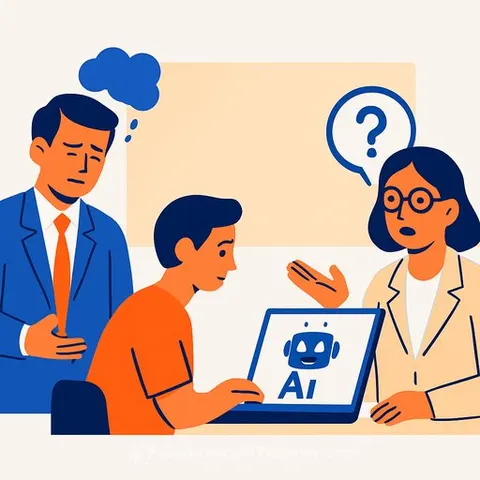
Professors Report Wave of Student Cheating as AI Tools Make Academic Dishonesty Easier to Hide
College instructors across the country say artificial intelligence has fundamentally broken the core transaction of higher education: the struggle between student and material that produces genuine learning.
In surveys and interviews, faculty describe a sharp rise in undetectable cheating, the erosion of trust in the classroom, and a creeping sense that the work that once gave their careers meaning has been rendered obsolete. One religious studies professor said she wept in front of her class when she realized her students no longer had to work through difficult ideas on their own.
"Was it always the case that half of our students would cheat if it were easy enough?" a history professor asked. "If they knew that it would be hard to prove? It's hard to consider that and not despair."
The Shift From Struggle to Simulation
A religious studies professor at a Catholic university designed a course called "Letters from Prison" that asked students to synthesize themes from texts about faith and endurance. For years, the assignment worked. Students grappled with the material, revised their thinking through feedback, and eventually produced work that felt personal and earned.
Last year, something changed. "Not one of my sixty students in 'Letters from Prison' struggled with this task," the professor wrote in a public post. "I received tidy summaries of the text-the kind of compelling reviews you'd find on a book jacket-as well as perfectly vapid course themes that somehow took account of everything while not saying much."
She suspected AI had done the work. When she added handwritten brainstorming to make assignments harder for machines, she found herself crying in front of the class. "Before AI, students used to work hard to come up with their own ideas," she told them. "I'd help, and they'd struggle, but they'd come to something that was their own. That doesn't happen anymore and I grieve that."
The professor is not alone in her grief. Faculty at community colleges, state universities, and private institutions report similar patterns: assignments that once required days of thinking now return polished and generic. The work looks competent on the surface. It just doesn't show any evidence of thought.
Detection Has Become Nearly Impossible
A history professor at a regional university estimated that half his students used AI on recent assignments. Early on, when he caught eight students, all but one admitted it. Last year, when he met with students about suspected AI use, only one confessed.
"Students now know how difficult it is for faculty to prove AI cheating," he said.
A theatre professor described the telltale signs: the inimitable ChatGPT style, the elevator-music quality of the prose, phrases like "This isn't a simple story about injustice-it's a clarion call for a positive understanding of justice." He switched to assigning obscure plays that the AI models never saw, which forces the machine to hallucinate plot points and characters.
But in courses built around canonical texts-Shakespeare, Faulkner, August Wilson-the AI has seen everything. A professor teaching a play that has been widely published and performed cannot easily distinguish between a student's genuine analysis and a machine's plausible summary.
An online instructor at a public university said she reads fifty short essays per term. "There is no definitive way to check," she said, "and with fifty students I don't want to spend my time playing 'CSI: Who Wrote This Paper?'"
The Problem Runs Deeper Than Cheating
Faculty worry that even when students aren't explicitly using AI to cheat, the availability of the tool changes how they approach learning. A philosophy lecturer at a regional state university said the introduction of AI, combined with declining enrollment, has made her pessimistic about her career. She estimates she has less than a decade left in the profession.
"I can no longer assign papers because seventy to one hundred per cent of the students will use AI," she said. She now conducts comprehensive oral finals in small seminars-a six-hour process for eleven students that doesn't scale to classes of 150.
A computer science professor eliminated difficult homework problems, which used to anchor his courses. He tried group quizzes and in-class presentations instead, but acknowledged the limits of what one instructor can do against systemic pressure. "I'm worried that these forces allow many students to coast through school without learning as much as they used to," he said.
A sociology professor at the University of Toronto took a different approach. He created multi-agent simulations where students coded representations of classical economic and social theories, then experimented with them. The best projects showed far more creativity than typical essays. But some students still used AI thoughtlessly, as a replacement for judgment. He met with dozens of students for thirty to forty-five minutes each, gave them zeros, and asked them to redo the work.
"I felt that the act of meeting them was the most important part," he said, "so they felt that somebody, especially a professor, was paying attention to them and what they produced, which, alas, is rare in larger universities."
Trust Between Faculty and Students Has Fractured
A religion professor at Belmont University said the hardest part has been the erosion of trust. She had honors students-the most motivated students on campus-submit AI-generated reflection journals. The assignment asked only for their own thoughts. There was no right answer. Just: tell me what you're thinking.
"I can't give honest feedback when it is not honest work," she said. "I can't help you work out how you want to think about something, how you want to be in the world, if you are not using your own brain to tell me where you are."
She now requires in-class writing with pen and paper, hand-written exams, hard copies of textbooks, and phones and laptops put away. Things have improved. But the experience has shifted from collaboration to policing.
A theatre professor expressed similar frustration. He wanted to be the kind of mentor his own professors had been-someone who helped students think like artists and collaborators. Instead, he has become a plagiarism cop. "I've stopped being a collaborator in these intro courses and started being a plagiarism cop, and I do resent that a bit," he said.
Some Institutions Are Experimenting With New Models
A few faculty members have found ways to adapt. A computer science professor at UNC allows students to use AI on exams, with the theory that if AI is a tool that will enhance their work, they should practice with it. He also assigns problems where students evaluate AI-generated code for correctness-shifting the emphasis from writing to critical judgment.
A statistics professor at UCLA made his MBA exam 100 percent AI-friendly. The class average was still only 75 percent. "The students who were truly lost apparently weren't saved by AI," he said. He found the experience freeing-it let him focus on lecture structure, pacing, and case studies rather than the mechanics of assignments.
But these are exceptions. Most faculty report that institutional responses have been slow and inconsistent. One professor said the tension feels less like an administration-versus-faculty divide and more like a mismatch between the speed of institutional policy-making and the slower, harder work of figuring out what should count as student learning.
The Underlying Question Remains Unresolved
Universities have not yet grappled with what they are actually trying to do. Are they credentialing students, or educating them? If it's the former, AI makes the process faster and cheaper. If it's the latter, AI makes it nearly impossible.
A community college professor noted that many students are simply trying to complete general-education requirements before transferring out. There is less investment in actual learning, more focus on checking boxes. At his college, financial-aid fraud has apparently occurred, with fake students enrolling and using AI to complete assignments.
The question that haunts many faculty is whether this represents a permanent change in student behavior or a temporary moment of adjustment. One professor said some students respond with indignance to instructors who simply let AI use happen. "There's this indignance, like, 'Why don't you want more from us than this?'" she said. "So, even if they're using it, they're still wanting us to hold them to a higher standard."
But for many professors, the damage to the core relationship-between teacher and student, between struggle and understanding-already feels done. The work that brought them meaning has been rendered optional. And they are not sure how to rebuild what has been lost.
For more on how education is changing, explore AI for Education and the AI Learning Path for Teachers.