Inside Google's Project EAT: A full-stack AI reset through 2026
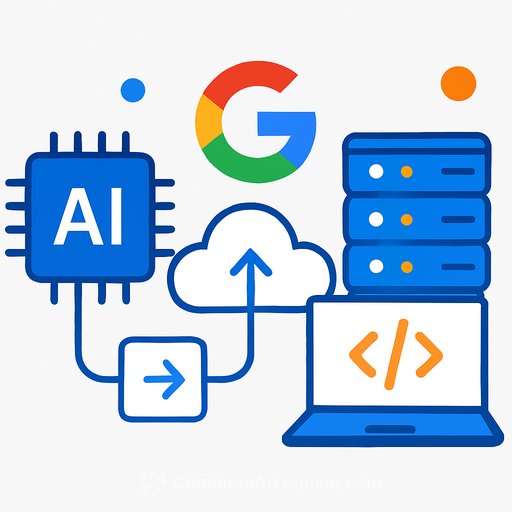
Google is rolling out Project EAT, a company-wide overhaul of its AI stack that unifies chip design, infrastructure, and developer tooling under one plan through 2026. Reporting indicates the goal is simple: cut cost, cut latency, and ship a coherent platform that works for internal teams and cloud customers.
The move comes as Nvidia dominates accelerators, Azure rides momentum with OpenAI, AWS pushes Trainium/Inferentia, and Meta builds gravity with open-source. Google's bet is that a tighter stack-silicon to software-can close the gap and win enterprise workloads.
What Project EAT covers
- Chip strategy: accelerate TPU roadmaps and make them a credible option alongside Nvidia GPUs.
- Infra optimization: rework data centers, cooling, and scheduling to drop total cost of AI at scale.
- Developer experience: modernize frameworks, docs, and managed services so teams ship faster with fewer moving parts.
TPUs vs GPUs: the silicon fight that decides margins
At the core is TPUs. Google has shipped custom AI chips since 2016, but adoption has been mostly internal. Project EAT aims to speed development cycles, improve performance per watt, and expose TPUs more cleanly through Google Cloud.
Why that matters: Nvidia owns the accelerator market and CUDA is the default developer workflow. If Google can't make TPUs more accessible and competitive, it stays dependent on Nvidia while losing cloud deals to customers who want the CUDA ecosystem. For context, see Google Cloud TPUs and Nvidia CUDA.
Infrastructure: cost, power, and throughput
Training and inference at Google scale stress power, cooling, and networks. Project EAT includes data center layout redesigns, higher-efficiency cooling, better memory/computation locality, and smarter workload orchestration.
The aim is to lower total cost of ownership while sustaining model size growth and spiky inference traffic. Expect more aggressive placement, scheduling tuned for model graphs, and policies that account for power budgets in real time.
Developer tooling: shorten the path from idea to shipped system
Google plans to tighten the experience across TensorFlow, JAX, and Google Cloud's managed AI services. PyTorch's rise set a new bar for ergonomics and community-Google knows the gap. Project EAT pushes for better docs, cleaner APIs, and opinionated defaults that reduce decision fatigue.
On Cloud, look for higher-level services that abstract cluster plumbing so teams focus on models, evaluation, release, and monitoring. The goal: less cluster babysitting, more productive iteration.
Org changes: fewer silos, faster handoffs
Teams across Research, Cloud, and hardware are being pulled into a single operating plan. The upside is fewer duplicated efforts and quicker productization. The downside is culture friction and the loss of some team autonomy.
Execution speed will hinge on shared roadmaps and incentives: tapeout dates tied to framework milestones, and Cloud services aligned to real TPU capabilities at release, not six months later.
Competitive outlook
If Google hits its targets, TPUs become a real alternative for training and inference, with Cloud offering a differentiated stack that isn't bound to CUDA. Better tooling could pull developers back into Google's ecosystem.
The bar is high. Nvidia's lead is backed by years of kernel tuning, libraries, and community trust. Microsoft has distribution and a strong AI story through OpenAI. AWS continues to iterate its silicon. Google needs clean execution across all three pillars to move the needle.
Timeline and risks
The 2026 horizon matches the reality of chip design, data center buildouts, and large-scale software rewrites. Slips in any layer ripple across the stack: a silicon re-spin delays Cloud features; infra constraints limit availability; tooling gaps slow adoption.
Supply chains, power availability, and regulatory approvals add more risk. Expect visible progress in phases, not all at once.
What this means for engineering and IT leaders
- Plan for heterogeneity. Assume mixed fleets (Nvidia + TPUs + CPU offload) and build portable training/inference flows.
- Track TCO, not just raw FLOPs. Power, cooling, interconnect, and memory bandwidth are becoming the real constraints.
- Push for higher-level services. Managed orchestration and deployment will save teams months of undifferentiated work.
- Measure developer time. Framework friction, flaky kernels, and tooling gaps cost more than extra hardware in many orgs.
- Design for observability. Collect per-layer latency, kernel-level traces, memory movement, and queue depth as first-class metrics.
Practical next steps
- Benchmark the same model across CUDA and TPU where feasible. Capture cost, throughput, and reliability-not just peak speed.
- Abstract your training loops and data pipelines behind lightweight interfaces. Keep swaps between backends realistic.
- Pilot managed services for inference autoscaling and model versioning. Bake in canarying, rollbacks, and cost alerts.
- Model your power budget early for 2025-2026 capacity planning. Tie model roadmap to facility constraints.
Bigger picture
Project EAT points to a broader trend: vertical integration. The winners will tune silicon, compilers, kernels, frameworks, and services together, then package it for enterprises with sane defaults and clear SLAs.
For most teams, the smart move is to stay flexible, keep an eye on TPU viability, and invest in platform work that reduces vendor lock-in while giving you the option to exploit new hardware as it lands.
Upskill your team
Want structured paths for engineers building AI systems on major platforms? Explore curated tracks by provider here: AI courses sorted by leading AI companies.
Your membership also unlocks: