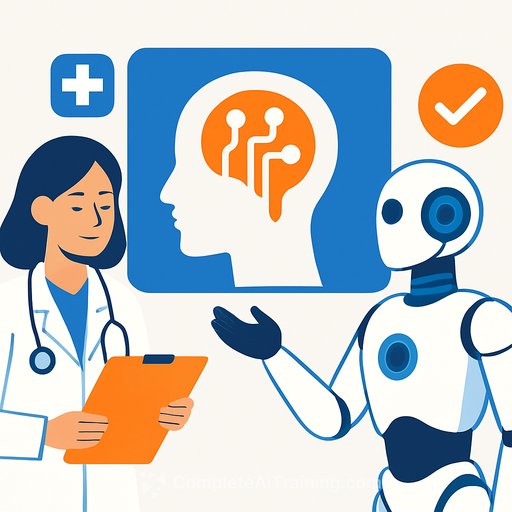
2026: The year AI in healthcare must prove it works
Healthcare leaders agree: next year is about accountable, integrated AI that delivers measurable outcomes. Pilots and sandbox demos won't cut it. Systems that reduce burden, improve access and quality, and stand up to governance will be the ones that scale.
Regulatory tailwinds are changing the pace
New federal initiatives are pushing AI beyond "nice to have." Leaders point to CMS' move toward outcomes-based models and the FDA's efforts to speed safer software deployment as catalysts for faster clinical impact. Expect AI to step up from administrative helper to a partner in personalized decision-making - with physicians in the loop.
Agentic AI is also moving from concept to practice. Instead of just flagging data, autonomous agents will propose tailored interventions and draft care adjustments for clinician review. Done right, this makes care proactive without adding clicks.
From engagement to activation - and accountability
The bar is rising. The question won't be "Did patients open the message?" but "Did more patients complete screenings, keep benefits, avoid avoidable ED visits?" If a tool can't tie to clear outcomes, it won't survive the next budget cycle.
After a year of testing autonomous agents, organizations are favoring scoped copilots embedded in well-defined workflows. Guardrails, audit trails, and human "escape hatches" are table stakes. 2026 is about proving impact on clinician workload, member behavior, and health outcomes.
Operations and revenue cycle will show early, repeatable wins
Coding, claims, and denials are primed for safe, scalable automation. Leaders expect higher accuracy, faster cash flow, and reclaimed human capacity where it matters most. AI as a "quiet team member" - drafting notes, prepping charts, managing inboxes, supporting prior auth and revenue cycle - already saved time in 2025 and will expand in scope.
The next step is orchestration. Instead of point solutions, organizations will adopt AI workflows and agents that complete multi-step tasks end-to-end. Clear ROI, safety evidence, and governance will be required before scaling.
Clinical care gets more proactive and context-aware
Expect smarter triage, tighter integration between virtual and in-person care, and more personalized treatment paths - with a notable push in preventative women's health. The systems that win will combine intelligence with empathy, and prioritize trust as much as efficiency.
Enterprise-wide AI orchestration is coming, with multi-modal models that fuse imaging, lab, and genomic data to give a fuller clinical picture. Generative tools will help draft reports, summarize findings, and automate repetitive steps - not just in academic centers but across community settings.
Diagnostics, video analytics, and access
Diagnostics will deepen. AI will surface early signals buried in data streams and help address shortages of trained personnel - critical for remote areas and emerging markets. The aim: earlier intervention and more consistent quality, regardless of location.
Video analytics is on the rise. With storage and compute now in reach, use cases like deterioration monitoring, safety event detection, and hand hygiene tracking are moving from pilot to practice. There's video in every environment - expect it to become clinically useful data.
Collaboration will scale too. Multi-institution learning systems - where models update continuously on shared insights and real-world populations - will push the field forward. That demands stronger validation, governance, and equity safeguards, but it's how broader access to advanced diagnostics and therapies happens.
Pharma, biotech, and investing get smarter
Large language models are already useful in regulatory submissions, medical coding, and prior authorization - always with expert oversight. Biotech investors will lean on predictive software to de-risk bets. While some big pharma will build in-house, many will partner with focused AI startups to stay ahead.
What to do now: a practical checklist
- Define outcomes that matter: reduced documentation time, completed screenings, fewer denials, improved access, lower no-shows, shorter LOS.
- Prioritize high-yield workflows: Coding, claims, denials, prior auth, chart prep, inbox triage, discharge planning, and care coordination.
- Choose copilots, not free-form bots: embed into EHR, RCM, and care pathways with clear guardrails and human oversight.
- Demand proof: pre/post metrics, bias checks, safety evidence, and governance before scaling. Make ROI reviews quarterly.
- Get data- and video-ready: standardize data pipelines, labeling, and retention; set policies for clinical video analytics.
- Plan for collaboration: design for multi-site learning with privacy, consent, and equity controls from day one.
- Level up the workforce: train clinicians, admins, and revenue teams on AI-supervision skills and exception handling.
- Interrogate integration: pick vendors with deep workflow and technical integration - not just a slick demo.
- Align incentives: outcome-based contracts; measure activation, not just engagement.
- Build patient trust: disclose AI use, explain benefits and limits, and offer human choices at key moments.
Risks to manage
- Model drift and hallucinations: monitor, retrain, and keep humans in the loop for high-stakes decisions.
- Privacy and security: tighten access controls, audit trails, and incident response.
- Bias and equity: test across subgroups, ensure representative data, and track disparities.
- Over-automation: set thresholds for human review; never automate rare, high-risk edge cases blindly.
- Hidden costs: budget for integration, change management, and continuous evaluation - not just licenses.
- Regulatory updates: align development with evolving CMS and FDA guidance.
Helpful references
For policy direction, see CMS Innovation Center models here and FDA Digital Health guidance here.
If you're upskilling teams on AI workflows, governance, and evaluation, explore curated learning paths by role here. For those leading training programs, consider the AI Learning Path for Training & Development Managers.
The bottom line
2025 wired AI into healthcare's plumbing. 2026 will test whether those systems change workload, behavior, and outcomes at scale. Teams that build with clear guardrails, deep integration, and relentless measurement will pull ahead.
Your membership also unlocks: