
AI news ·
Protesters march in San Francisco to demand pause on AI development
About 200 protesters marched in San Francisco demanding a global pause on training advanced AI models. Organizers cited job losses, soaring rents, and existential risks.
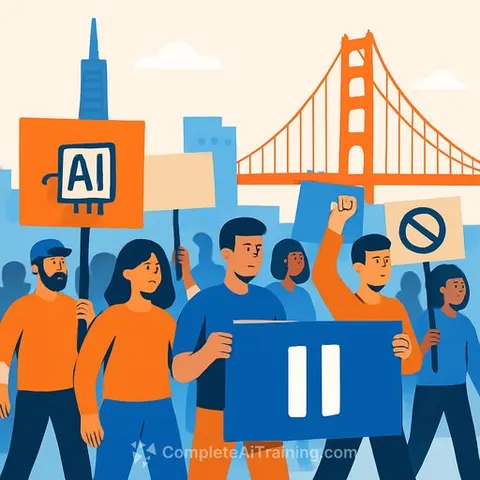
About 200 protesters marched through downtown San Francisco on Saturday, stopping outside the offices of OpenAI, Anthropic, and Google DeepMind to demand a halt on all new training of advanced AI models. The action, organized by the group Stop the AI Race, reflects growing public unease over housing costs, job displacement, environmental harms, and existential risks tied to the technology's rapid expansion.
Protesters carried signs reading "stop slop," "it's not too late to regulate," and "in a race off a cliff no one wins." The route deliberately passed three major AI labs in the city, which the organizers call the epicenter of the industry. Some onlookers paused to film the crowd from restaurant windows and apartment balconies.
Demands for a global pause
Stop the AI Race, led by former AI researcher Michaël Trazzi, wants an international agreement-including China-to freeze training runs for larger or more general frontier models. Current AI systems would remain available, but teams building more capable models would shift to narrow applications or alignment research, according to the Stop the AI Race website. Trazzi, who last year began a hunger strike outside Google DeepMind's London office, told the crowd, "We are in an emergency. The problem is they can't stop the race, unless other people stop."
None of the targeted companies has formally responded to the group's demand. Organizers point to a January interview in which DeepMind CEO Demis Hassabis said he would advocate for a collective pause and envisioned an AI version of CERN, "where all the best minds in the world would collaborate together." Hassabis added caveats about the need for global agreement, noting that even if one company or the West paused unilaterally, "it has no use unless the whole world agrees."
Voices from the march
Aleesa Carbo, a Johns Hopkins University student and AI researcher enrolled in the MATS fellowship, said she has pivoted her career toward AI safety. "I'm not against AI in principle, but I do think the way that companies are racing towards it is not in a very responsible manner," she said. "At the end of the day, these are dark boxes. Even us, the people who train these models, play with them, we don't fully understand them."
Duncan Haldane, CEO of a San Francisco startup that uses AI for circuit board design, brought his 1- and 5-year-old children to the protest. Haldane said the technology has benefited his company but still represents an "existential threat to humanity." Longtime resident Kathe Burick likened the race without regulatory guardrails to the "2001: A Space Odyssey" scene where HAL 9000 refuses to open the pod bay doors. A similar protest Burick attended in March drew only about 30 people; she said seeing larger turnout, especially young participants, gave her hope.
Local fallout and pushback
Former San Francisco supervisor Dean Preston criticized the "devastating" local effects of AI firms, listing soaring rents, job losses, environmental "havoc," and political influence. He pointed to recent pushback elsewhere in California: residents in Pittsburg protested a 300,000-square-foot data center proposed by Avaio Digital in June, while voters in Monterey Park became the first U.S. city to permanently ban data centers.
Some attendees want city-level action. Kathe Burick called on San Francisco's mayor and supervisors to regulate or even suspend AI operations. "Shut them down if they need to, or demand a pause or they can't operate in town," she said.
Why this matters for IT and development professionals
Public demonstrations that draw hundreds of participants-and cite specific risks from models that even their developers admit are poorly understood-signal that the regulatory landscape could shift quickly. For engineers and developers working with large models, the protest underscores that alignment and safety research are no longer niche academic topics. Teams building general-purpose AI systems may soon face calls to justify training runs with rigorous risk assessments, and local permitting for data centers is already hitting political resistance. Knowing what critics are saying and how alignment work is framed by groups outside the industry will become part of the job.