PTC and Lamborghini Unify Product Lifecycle with an AI-Driven Stack
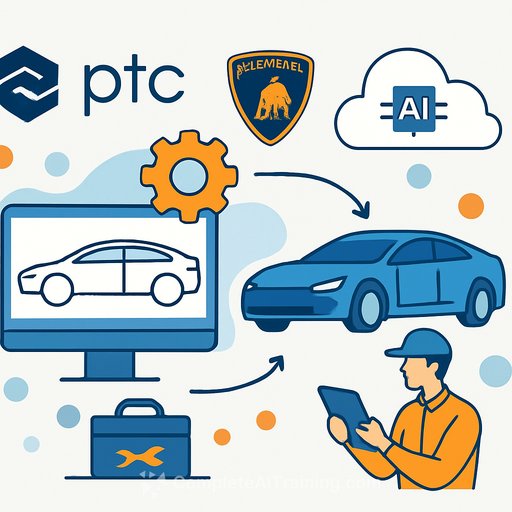
Automobili Lamborghini is moving product development onto a single, intelligent backbone using PTC's stack across CAD, PLM, ALM and service. The automaker is standardizing on Windchill for product data, Codebeamer for requirements and software, and Creo for complex CAD - boosting Design workflows and then connecting the dots with AI. The goal: traceability across the lifecycle, faster change decisions, and tighter collaboration without compromising craftsmanship or performance.
What Lamborghini Is Actually Doing
Windchill and Codebeamer give teams end-to-end traceability from requirements to release, with structured change management built in. Engineering and software stay in sync, while Creo anchors detailed design for high-complexity components like engines. The result is a connected system of record that reduces handoffs and keeps decisions visible across functions.
The AI Layer: Practical Applications
PTC is adding AI where it removes friction: Codebeamer AI assists requirements creation and consistency, Windchill AI supports parts rationalization and reuse, and ServiceMax AI surfaces insights from field work orders. That means fewer duplicate parts, cleaner specs, and faster feedback loops from service to engineering. For a company like Lamborghini, this shortens cycles while preserving quality.
Live Demo at CES 2026
PTC plans to demonstrate the full product lifecycle for a new front bumper at CES 2026-Creo for design, Codebeamer for requirements and software, Windchill for product data, and ServiceMax for service execution. The end-to-end scenario is built to show how AI threads through each step. Expect a clear view of how change flows, how data stays linked, and how service input reaches engineering sooner.
Arena PLM + QMS AI Engine
PTC also launched an AI Engine for Arena PLM and QMS, built on Amazon Bedrock, to automate document analysis and change workflows. The focus is on fewer documentation errors, quicker decisions, and easier compliance. You can learn more about Bedrock from AWS here: Amazon Bedrock.
Why This Matters for Product Leaders
This is a push toward a unified lifecycle with AI stitched into daily work. The promise isn't flashy dashboards-it's practical: fewer variants, tighter requirement discipline, faster change approvals, and service data that actually influences design. If your teams juggle siloed tools and rework, this model is worth copying.
What You Can Apply Now
- Map your lifecycle: define the system of record for requirements, product data, and CAD. Remove duplicate sources.
- Make traceability non-negotiable: link requirements to design, test, software, and service artifacts.
- Standardize change: one change process across hardware and software with clear roles and SLAs.
- Use AI where text and volume slow you down: requirements authoring, spec comparisons, parts deduplication, and field insight triage.
- Close the service loop: integrate service work orders into engineering backlogs to drive issue resolution and DfS (design for serviceability).
- Pilot on a contained scope (e.g., a bumper, harness, or ECU) and expand after cycle-time and quality gains are proven.
PTC's Strategic Shift and Signals
To double down on an AI-driven lifecycle (CAD, PLM, ALM, SLM, SaaS), PTC is divesting Kepware and ThingWorx. Go-to-market teams are aligned around this focus, with early field feedback pointing to operational gains. For product orgs, this suggests deeper roadmaps and integrations across the PTC stack rather than a scattered portfolio.
Financial Outlook (Context for Vendor Stability)
Management is targeting 7%-9% ARR growth in fiscal 2026 and $1B in free cash flow, with a potential stock buyback of $150M-$250M per quarter. PTC currently holds a Zacks Rank #3 (Hold). Shares are up 5.4% over six months versus the Zacks Computer-Software industry decline of 2.7%. Peers with Zacks Rank #2 (Buy) include Open Text (OTEX), Blackbaud (BLKB), and ACI Worldwide (ACIW).
Bottom Line for Product Development Teams
If your roadmap depends on faster cycles and fewer misses, unifying CAD, PLM, ALM, and service is the lever. Add AI to the friction points-requirements, parts reuse, and service feedback-and you'll pull weeks out of timelines while improving quality. Lamborghini's approach shows it's workable at high complexity.
If you're upskilling teams on AI to support these workflows, see the AI Learning Path for Training & Development Managers.
Your membership also unlocks: