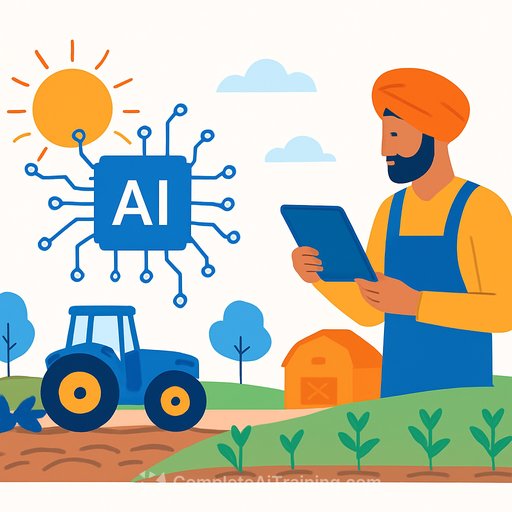
Punjab Government to Integrate AI in Agriculture with IIT Ropar
Punjab has moved to bring artificial intelligence into the farm sector with support from the Centre of Excellence at IIT Ropar. The goal is clear: higher productivity, better sustainability, and a measurable rise in farmer income across the state.
At a review meeting in Chandigarh, Agriculture and Farmers Welfare Minister Gurmeet Singh Khudian directed departments to focus on field deployment, not just pilots on paper. Successful interventions will be scaled with full government support.
What the Plan Covers
- Installation of automatic weather stations for hyperlocal advisories.
- Structured engagement with farmers for reliable field data collection.
- Support for horticulture clusters with targeted AI applications.
- Expansion of AI tools to improve livestock health and productivity.
Role of IIT Ropar and the Centre of Excellence
The Centre of Excellence, supported by a Rs 310 crore outlay from the Government of India, will anchor the technical backbone. IIT Ropar's faculty and partners will co-develop solutions and train officers for ground execution. Learn more about the institute here: IIT Ropar.
- AI-based crop advisory systems and multilingual farmer chatbots.
- Digital crop twins and yield estimation models.
- Soil health analytics and weather intelligence tools.
- Smart livestock management applications.
Why This Matters for Government Teams
This program aligns department workflows with real farm outcomes. Expect better resource use, climate resilience, and timely decisions at the block and village level. The focus is on practical tools that solve daily problems-not more dashboards without action.
Implementation Roadmap for Departments
- Governance: Set up a state-level program office with district implementation units. Define data ownership, access, and grievance protocols.
- Data Pipeline: Deploy and maintain weather stations and sensors. Standardize data formats and APIs for interoperability.
- Procurement: Use open standards, clear SLAs, and outcome-linked payments. Avoid vendor lock-in by insisting on data portability.
- Pilots: Start with 3-5 districts and 2-3 crops plus one livestock use case. Track clear success metrics before scaling.
- Farmer Interface: Follow UI and conversation best practices (see AI Design Courses) when deploying multilingual chatbots, IVRS, and WhatsApp broadcasts. Keep messages short, seasonal, and actionable.
- Training: Build officer capacity on AI basics, data quality, and field validation. Certify extension teams for consistency.
Budget, Data, and KPIs
Leverage the Centre of Excellence for shared assets and technical guidance. Align state funds with existing schemes to cover hardware, connectivity, and last-mile support.
- Core KPIs: yield improvement (%), input cost reduction (%), water saved per hectare, forecast accuracy (%), disease alert lead time (days), adoption rate (% of target farmers), and farmer satisfaction scores.
- Data Quality: audit trails, sampling protocols, and periodic ground-truthing for model updates.
Capacity Building and Courses
National-level courses on precision agriculture and AI in agriculture will support youth and government officers, with reserved seats for Punjab. For teams seeking structured options, explore curated AI Productivity Courses or AI courses by job to fast-track foundational skills.
Next Steps for Departments
- Select priority districts and crops (e.g., wheat, paddy, and key horticulture clusters).
- Sign data-sharing MoUs with IIT Ropar and partner agencies.
- Install the first tranche of weather stations with maintenance contracts.
- Launch a farmer communication plan with clear opt-in and consent.
- Stand up a rapid-response cell to resolve field issues within 72 hours.
Risks and Safeguards
- Data privacy: explicit consent, minimal data collection, and secure storage.
- Bias and accuracy: periodic model validation against field data; publish error rates.
- Uptime: backup connectivity and clear maintenance SLAs for devices.
- Usability: keep interfaces simple; prioritize voice and regional languages.
Suggested Timeline
- 0-90 days: governance setup, vendor onboarding, 50+ weather stations live, pilot design finalized.
- 3-6 months: pilots active in selected districts; weekly M&E reviews and model tuning.
- 6-12 months: scale to 10+ districts with proven use cases; expand livestock module.
- 12-24 months: statewide rollout with continuous training and independent evaluation.
Punjab's partnership with IIT Ropar is positioned to turn field data into decisions that farmers can use the same day. Keep it practical, measure what matters, and scale what works.
Your membership also unlocks: