Punjab Moves to Deploy AI in Agriculture with IIT Ropar: Practical Notes for Government Teams
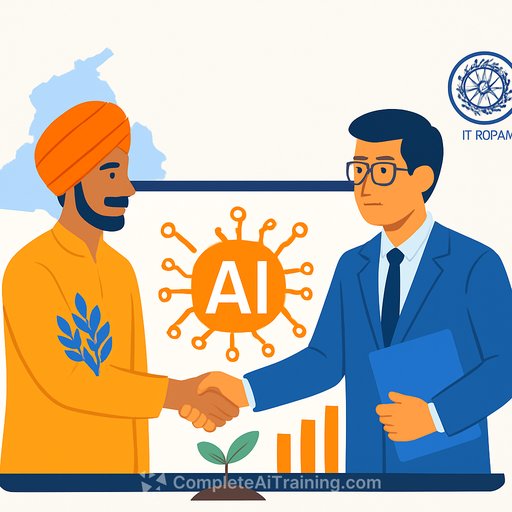
The Punjab government is building an AI-enabled agriculture program with support from the Centre of Excellence at IIT Ropar. Agriculture and Farmers Welfare Minister Gurmeet Singh Khudian chaired a review at Punjab Bhawan to map the rollout, from pilots to statewide scale.
Focus: Tangible Outcomes for Farmers
- Automatic weather stations to enable hyperlocal advisories and risk mitigation.
- Active farmer participation in data collection to improve accuracy and trust.
- Support for horticulture clusters to raise productivity and quality.
- AI for livestock to improve health, nutrition, and yield.
The minister underscored a simple filter: fund projects that show clear impact at the field level, then scale what works.
Capacity Building and Training
IIT Ropar proposed national-level courses on precision agriculture and AI in agriculture for youth and government officers. Seats reserved for Punjab students and officials will help grow in-house capability, reduce dependence on vendors, and speed field adoption.
For teams planning structured upskilling, explore a targeted learning path for production planners: AI Learning Path for Production Planners.
IIT Ropar's Role: What's in the Pipeline
Pushpendra P Singh from IIT Ropar shared that the Centre of Excellence, with a financial outlay of about Rs 310 crore supported by the Centre, is building a suite of AI solutions:
- Crop advisory systems and multilingual farmer chatbots
- Yield estimation and soil health analysis
- Weather forecasting tools
- Smart livestock management systems
More on IIT Ropar here: IIT Ropar.
Why This Matters for Public Administration
Done well, AI can help the state use inputs efficiently, reduce climate risk, and improve farmer income. The collaboration sets up a clear pathway: pilots with measurable outcomes, then scale through district-level playbooks and targeted funding.
What Government Departments Can Do Next
- Set pilot guardrails: 2-3 crops, 3-5 districts, clear timelines, and defined farmer cohorts.
- Data governance: consent-based data collection, anonymization, and secure sharing protocols across departments.
- Interoperability: adopt open standards so tools from different vendors work together.
- Local languages first: ensure chatbots and advisories work in Punjabi and Hindi with simple UX.
- Procurement model: consider performance-linked payments (e.g., accuracy of advisories, adoption rates).
- Farmer onboarding: partner with FPOs, KVKs, and dairy unions for training and feedback loops.
- Last-mile enablement: integrate with call centers, WhatsApp channels, and field staff visits.
- Training schedule for field staff and helpline agents: align modules to practical workflows and productivity goals - see AI Productivity Courses for course design ideas.
KPIs to Track in Pilots
- Advisory accuracy: yield prediction error, pest/disease alert precision, and weather forecast utility.
- Behavior change: percentage of farmers adopting recommended practices.
- Economic impact: net income change per acre; input cost reduction (fertilizer, water, feed).
- Service quality: response time for chatbot queries; uptime of weather stations.
- Livestock outcomes: improvements in milk yield, calving intervals, and disease incidence.
Field Deployment Checklist
- MoU and workplan with IIT Ropar; roles and SLAs defined.
- District nodal officers and a single program dashboard.
- Farmer consent forms, data standards, and privacy guidelines.
- Training schedule for field staff and helpline agents.
- Independent evaluation partner for baseline and endline studies.
Toward Sustainable, AI-Ready Agriculture
This initiative can place Punjab among the frontrunners in AI-enabled agriculture by focusing on field results, farmer trust, and institutional capacity. The combination of weather-linked advisories, precise input use, and livestock health monitoring can reduce risk and lift incomes at scale.
For broader context on AI in food systems, see the FAO's work here: FAO: Artificial Intelligence.
Your membership also unlocks: