Purdue researchers develop AI system to detect corn pathogens before symptoms appear
A Purdue University team received a $450,000 contract from the Defense Advanced Research Projects Agency to build an artificial intelligence system that identifies pathogenic threats to corn crops before visible damage occurs. The nine-month project, called SignAI, is one of seven funded from several hundred proposals submitted to DARPA's Biological Technologies Office.
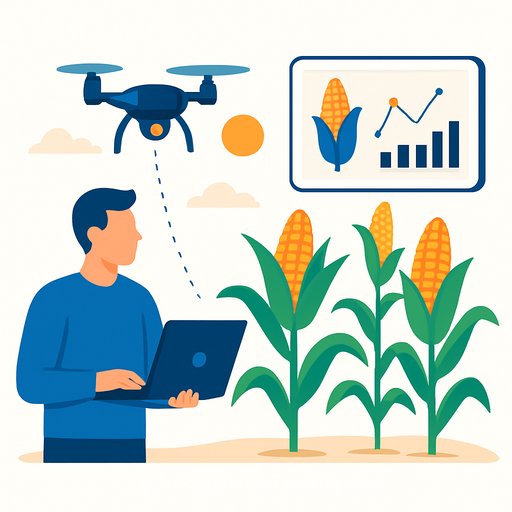
Christopher Brinton, Elmore Associate Professor of Electrical and Computer Engineering, leads the multidisciplinary team. The researchers aim to create an early warning system by analyzing data from field sensors, soil samples, and drone imagery to detect stress signatures in plants.
Detecting stress before symptoms emerge
Mohit Verma, associate professor of agricultural and biological engineering, said the core challenge is straightforward: "Can we find signatures of stress response or pathogen presence earlier than you see actual signs or symptoms on the plant and, therefore, have the potential to intervene early?"
The team will use a generative AI system to process data from novel biosensors developed in Verma's lab. These sensors can detect pathogenic DNA and RNA, as well as RNA markers indicating plant stress response.
Purdue has existing infrastructure to build on. About 25 research groups across campus collect soil samples, drone images, and data from field sensors and weather stations through the NSF Engineering Research Center for the Internet of Things for Precision Agriculture (IoT4Ag), launched in 2020.
Practical tools for farmers
The researchers are designing the system with farmer input. Yaguang Zhang, clinical assistant professor of agricultural and biological engineering, said the team is working with collaborators to determine what information farmers actually need to see from the data.
One collaborator is Aaron Ault, a full-time farmer and part-time research engineer in the Elmore Family School of Electrical and Computer Engineering.
The project will incorporate existing hardware like SPRING (Solar-Powered Remote IoT4Ag Network Gateway), a tripod-supported sensor platform farmers can place in fields. The system handles wireless connectivity and data collection without requiring farmers to manage underlying technology.
Scale and scope
The economic stakes are substantial. The U.S. Department of Agriculture projects 2026 corn exports alone could reach $17.6 billion. Food and agriculture support more than 34 million U.S. jobs.
Verma said the sensor network approach could eventually extend beyond Purdue to other agricultural research stations. "We're going to figure out the minimal dataset that gives you biosecurity," he said.
The project also supports Purdue's Computes initiative and One Health program, which focuses on research at the intersection of human, animal, and plant health. Additional co-leaders include James Krogmeier and David Love, both professors of electrical and computer engineering.
Learn more about AI for Science & Research and AI Research Courses.
Your membership also unlocks: